
Introduction
This article shows that the reported profit level indicator OMAD used in transfer pricing is always lower when intangible-producing expenses such as R&D are expensed rather than capitalized and the firm is growing over time while adopting a constant R&D intensity. This difference between restated OMAD and reported OMAD is made of two components, one permanent staying always fixed as time progresses and the other temporarily progressing over time to zero in the limit. Both components are positive and therefore reported OMAD is a downward biased indicator of profitability whether in the short or long term.
Background
First, we solve for the accumulated stock of R&D denoted by Kt where the value at time t is given by:
K_t = \frac{X_1}{\delta + g}[(1+g)^t-(1-\delta)^t]While 0 < δ ≤ 1 is the depreciation rate of the stock, g > 0 is the growth rate of R&D expenses over time, X1 is R&D outlay at time 1 and firm starts with zero R&D capital stock at time 0. The steps regarding the derivation of the above formula can be found in Appendix A of this article.
We shall also assume that from time 1 onwards the firm adopts a constant R&D intensity as time progresses. That is for all times t:
\frac{X_t}{S_t} = \frac{X_1}{S_1} = rwhere St is net sales of company for time t. It follows that:
S_t = (1+G)^{t-1} S_1where from the constant R&D intensity assumption, g = G. For ease of notation, we keep the two constants g and G separate, however.
Implication for OMAD
Given reported profit (not restated) Pt, assume that reported OMAD at time t is given by:
m_t = \frac{P_t}{S_t}Now define restated profit with R&D capitalization as:
P_t^{'} = P_t + X_t - \delta K_{t-1}In this case, the restated OMAD is given by:
m_t^{'} = \frac{P_t^{'}}{S_t}or:
m_t^{'} = m_t + r \frac{g}{\delta+g}+r\frac{\delta}{g+\delta}\frac{(1-\delta)^{t-1}}{(1+g)^{t-1}}For proof of the above see Appendix B of this blog. That is, we have:
m_t^{'} = m_t + f + e_tThe difference between restated OMAD and reported OMAD is positive for any time t and given by:
d_t = m_t^{'} -m_t = f + e_tf = r \frac{g}{\delta+g}e_t = r \frac{\delta}{\delta + g} \frac{(1-\delta)^{t-1}}{(1+g)^{t-1}}This difference is made of two components; one permanent defined by f and one temporary defined by et. The temporary component eventually goes to zero in the limit as time progresses, but f is always present regardless of the maturity of the firm.
Illustrative Example
Consider the following parameterization:
g = 5%
G = 5%
δ = 10%
mt = 15%
r = 7.5%
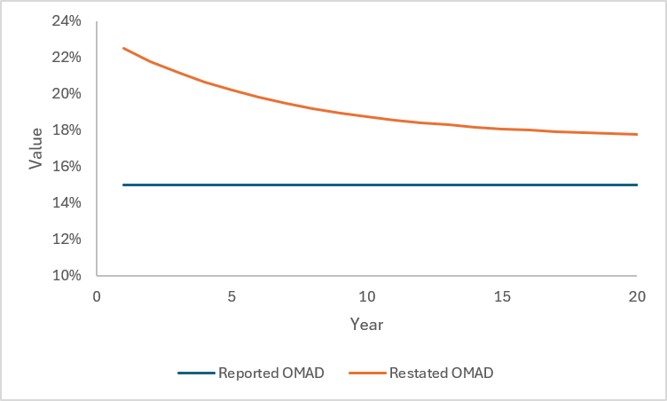
The exhibit below depicts the restated OMAD and the reported OMAD. Note that in the limit the permanent difference between the two is about 2.5%.
Appendix A
First, define the accumulation equation for the stock of R&D capital up to period t, with an initial stock at time 0 of K0 equal to zero and R&D outlays of Xt at any time t, where δ, with 0 < δ ≤ 1, denotes the constant rate at which the stock of R&D capital depreciates each period:
K_t = X_t + (1-\delta) K_{t-1}Expanding over k periods:
K_t = X_t + ..... + (1-\delta)^k X_{t-k} + (1-\delta)^{k+1} K_{t-k-1}Letting k = t-1:
K_t = X_t + ..... + (1-\delta)^{t-1} X_1Therefore:
K_t = W_t
where:
W_t = \sum_{j=0}^{t-1} X_{j+1} (1-\delta)^{t-j-1}Consider now the case of growing R&D outlays, where:
X_t = (1+g)^{t-1} X_1and g is greater than zero. In this case we define:
W_t^*= \sum_{j=0}^{t-1} X_1 (1+g)^j (1-\delta)^{t-j-1}and rearranging:
W_t^* = (1+g)^{t-1} X_1 \sum_{j=0}^{t-1} (\frac{1-\delta}{1+g})^jW_t^* = (1+g)^{t-1} X_1 Z_twhere:
Z_t = \sum_{j=0}^{t-1} (\frac{1-\delta}{1+g})^jand we let:
v = \frac{1-\delta}{1+g}Multiplying by v:
Z_t - v Z_t = 1-v^t
Z_t = \frac{1+g}{\delta+g} [1-(\frac{1-\delta}{1+g})^t]We then have:
W_t^* = (1+g)^{t-1} X_1 (\frac{1+g}{\delta+g}) [1-(\frac{1-\delta}{1+g})^t]Finalizing:
K_t = W_t^* = (\frac{X_1}{\delta+g})[(1+g)^t - (1-\delta)^t]Appendix B
The restated OMAD is given by:
m_t^{'} = \frac{P_t^{'}}{S_t}or:
m_t^{'} = \frac{m_tS_t + X_t - \delta K_{t-1}}{S_t}m_t^{'} = m_t + \frac{X_t - \delta K_{t-1}}{S_t}m_t^{'} = m_t + \frac{1}{S_t}\{(1+g)^{t-1} X_1 - \delta \frac{X_1}{\delta+g}[(1+g)^{t-1}-(1-\delta)^{t-1}] \}m_t^{'} = m_t + \frac{1}{S_t} \frac{X_1}{\delta+g} [ (1+g)^{t-1} g + (1-\delta)^{t-1} \delta]Since:
S_t = (1+g)^{t-1} S_1and we have a constant R&D intensity such that:
X_1 = r S_1
the restated OMAD can be decomposed as:
m_t^{'} = m_t + r \frac{g}{\delta+g} + r \frac{\delta}{\delta+g}\frac{(1-\delta)^{t-1}}{(1+g)^{t-1}}