
Adjusted taxable income (ATI) is an IRC §163(j) calculation on the federal corporate return that is filer-specific and not reported in public filings. The equation below, derived using Compustat data fields, is the closest approximation to ATI. The sections that follow derive each term, apply the equation to a filer whose fiscal years span a regime change, and test the sensitivity of the result to the principal specification.
THE PROVISION
§163(j) and the need for a public data proxy
IRC §163(j), as rewritten by the Tax Cuts and Jobs Act of 2017 (TCJA), limits the deduction for business interest expense to the sum of business interest income, thirty percent of ATI, and floor plan financing interest, with any disallowed interest carried forward indefinitely. The provision supersedes the earnings-stripping regime of former §163(j) and applies regardless of whether the lender is a related party, serving as a general constraint on leverage rather than a related-party rule.
The provision constrains income shifting through interest deductions, and its effect is largest where leverage is concentrated in high-tax jurisdictions. The consequence for a comparability analysis is indirect but material. A candidate comparable subject to disallowance pays more current tax than its reported pre-tax income suggests, and carries the leverage that produced the disallowance. Profit level indicators under the comparable profits method of Treas. Reg. §1.482-5 are computed before interest, so a disallowance does not enter them directly. It bears instead on the comparability factors of Treas. Reg. §1.482-1(d)(3), particularly the risks borne by the candidate, and on the threshold question of whether the candidate should be accepted at all.
ATI is reported on Form 8990, a federal corporate return schedule that is neither publicly available nor mirrored in the financial statements. Because comparables are assembled from public standardized data covering multiple filers, a practical alternative, given these constraints, is an ATI approximation constructed from income statement fields reported by most public companies.
| THE EQUATION | |
| ATI ≈ OIBDP + SPI | Tax years beginning before 2022, or after 2024. Depreciation, amortization and depletion are added back. |
| ATI ≈ OIADP + SPI | Tax years beginning 2022 through 2024, when the addback was suspended. |
| XINT > 0.30 × max(ATI, 0) | Screens the filer as potentially interest-limited. ATI is floored at zero by Treas. Reg. §1.163(j)-1(b)(1)(vii). The factor is fifty percent for tax years beginning in 2019 or 2020. |
The equation requires six Compustat fields, a single conditional branch, and no estimated parameters. The sections below derive each term and identify the conditions under which the approximation degrades.
Derivation of the terms
| FIELD | COMPUSTAT LABEL | DEFINITION |
| OIBDP | Operating Income Before Depreciation | Book operating income before depreciation, the nearest available analog to trade-or-business income, stated on a basis that already incorporates the depreciation, amortization and depletion addback required in an addback year. |
| OIADP | Operating Income After Depreciation | The corresponding measure after depreciation, applicable to tax years beginning in 2022 through 2024. The relation OIADP = OIBDP − DP held on every issuer-year tested. |
| SPI | Special Items | Unusual or nonrecurring pre-tax items that the filer reports above the tax line. Both operating income measures are defined as exclusive of special items, so an addback is required to reconcile the base to pre-tax income. The adjustment is a reconciliation requirement and makes no assertion regarding the tax treatment of any particular special item. |
| XINT | Interest and Related Expense, Total | Total interest and related expense, standing in for business interest expense as the term is defined for tax purposes. A null value in this sample reflects non-disclosure rather than an absence of interest expense, a distinction that governs more outcomes than any other data-handling decision in the method. |
| FYEAR | Data Year – Fiscal | Compustat’s fiscal year label indicates the calendar year in which the fiscal year ends for fiscal years ending June through December, and the prior calendar year for those ending January through May. When paired with FYR, it sets the tax year start date and selects the appropriate branch. |
| FYR | Fiscal Year-End Month | The month in which the fiscal year ends. Values of 1 through 5 and 12 set the tax-year-begin year to FYEAR; every other value sets it one year earlier. |
| DATADATE | Period end date | The exact date on which the fiscal year ends. The branch can be assigned without it, but consecutive DATADATE values confirm the FYR rule and expose short or changed fiscal periods. |
The nonoperating line is excluded from the base, with operating income being the nearest analog to trade-or-business income. The alternative specification, which retains the nonoperating line, is tested later in this article.
Application: four steps
- Extract the fields. GVKEY, DATADATE, FYEAR, FYR, OIBDP, OIADP, SPI and XINT under INDFMT=INDL and CONSOL=C. Six of the eight enter the equation; GVKEY identifies the row and DATADATE is used only to verify the period. Extend the year range one period beyond the analysis window, because the extract filters on DATADATE and would otherwise drop the final fiscal year of any non-December filer.
- Determine the year in which the tax year begins. Compustat assigns FYEAR by the month in which the fiscal year ends, using the ending calendar year for fiscal years ending June through December and the prior calendar year for those ending January through May, whereas §163(j) keys to the year in which the tax year begins. Apply FYEAR where FYR falls between 1 and 5 or equals 12, and FYEAR − 1 otherwise. Misapplication assigns filers whose fiscal years end June through November to the wrong branch.
- Select the branch and compute the base. OIBDP + SPI where the tax year begins before 2022 or after 2024, and OIADP + SPI in all other cases.
- Apply the screen. XINT > 0.30 × max(ATI, 0). Exclude issuer-years reporting a null XINT rather than substituting zero.
Case study: General Mills, fiscal 2024 and fiscal 2025 (FYEAR)
General Mills, a May year-end filer, spans the 2024 regime boundary. The applicable branch changes between the two fiscal years; special items are large in the second, and the screening outcome reverses. Every figure below is either a Compustat field or an intermediate result of the equation.
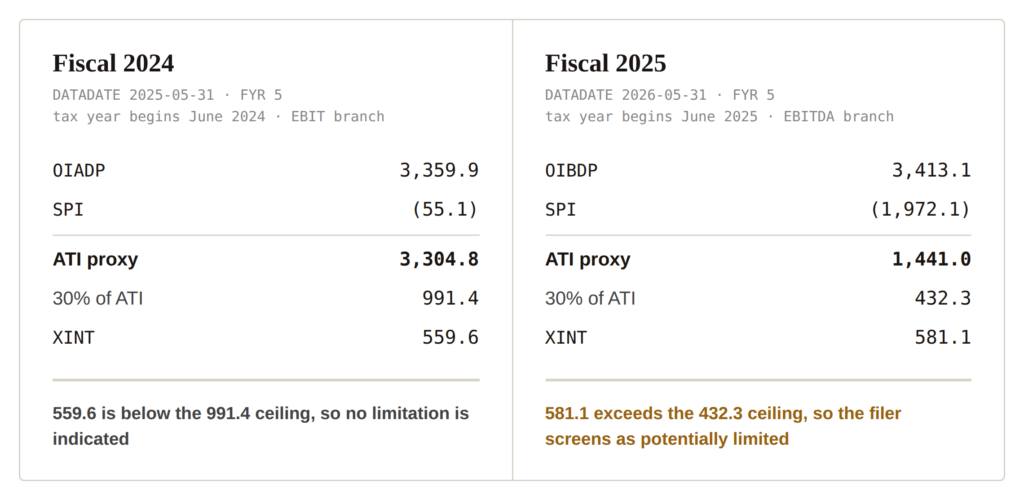
The branch changes because the tax year commencing in June 2025 begins after the 2024 boundary, which the FYEAR label of 2025 does not disclose on its face. The SPI addback is decisive: computed without it, the fiscal 2025 base is 3,413.1, and the ceiling is 1,023.9, against which interest expense of 581.1 indicates no limitation. The reversal between the two years arises from movement in the numerator and denominator together, which is how screening outcomes ordinarily change, rather than from movement in interest expense alone.
The equation applied to 119 public companies
We compiled the reported financial data for 119 S&P 500 companies, covering fiscal 2022 through 2025, yielding 476 issuer-years of Compustat data.
Four exclusions reduced the count to 408: Utilities and REITs (SIC 49 and 6798) are excluded from the sample because §163(j)(7) excepts rate-regulated utilities and permits a real property trade or business election. Financial companies (SIC 60 through 67) are excluded for a different reason: Compustat reports them in a financial-services format, and interest is an operating cost for a lender rather than a financing cost, so the screen is meaningless. Together, these remove 24 issuer-years. Foreign-incorporated filers are excluded because a foreign parent’s US return group is not the worldwide entity Compustat consolidates, removing 28. Filers that do not separately report interest expense are excluded because the screen has nothing to test, removing nine. Seven more were missing one or more additional required fields.
The equation screens 47 issuer-years as potentially interest-limited, or 11.5% of the sample.
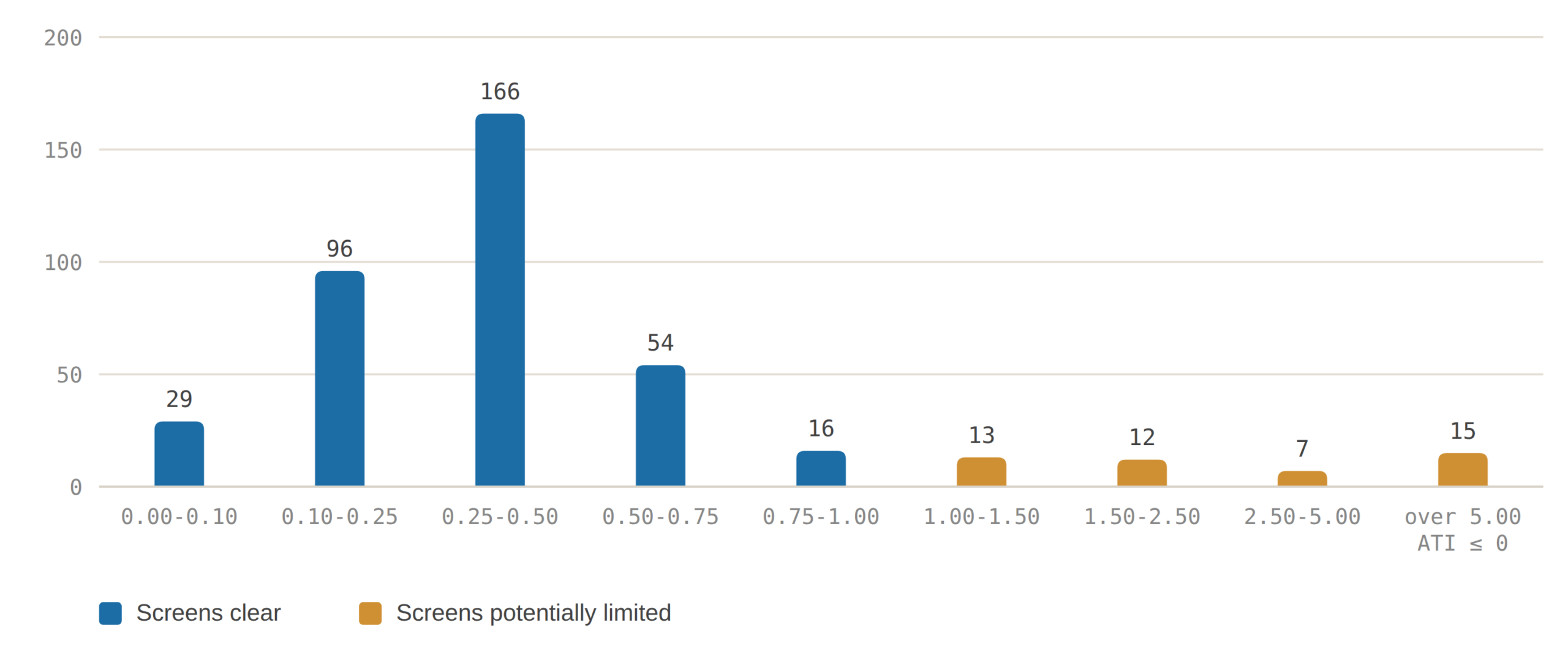
The exhibit plots the coverage ratio, XINT ÷ (0.30 × ATI), for each issuer-year. A ratio above 1.00 indicates that a filer’s interest expense exceeds the ceiling. Most of the sample sits well below 1.00.
The 10 issuer-year standouts
The equation excludes nonoperating income from the base, but including it is also defensible. The two specifications give the same result for 398 of 408 issuer-years. They only differ for filers near the interest expense ceiling, as those far below it are unaffected.
| TICKER | FYEAR | ATI PROXY ($M) | ALT. BASE ($M) | XINT ($M) | 30% OF PROXY | EQUATION | ALT. BASE |
| ADM | 2024 | 1,718 | 2,993 | 738 | 515 | limited | clear |
| ALB | 2023 | 258 | 2,290 | 189 | 77 | limited | clear |
| CMI | 2023 | 1,205 | 2,009 | 383 | 362 | limited | clear |
| DD | 2024 | 1,508 | 1,696 | 504 | 452 | limited | clear |
| GE | 2023 | 2,419 | 11,309 | 1,118 | 726 | limited | clear |
| IFF | 2025 | 1,075 | 791 | 241 | 323 | clear | limited |
| LHX | 2024 | 1,918 | 2,272 | 675 | 575 | limited | clear |
| MOS | 2024 | 1,152 | 661 | 272 | 346 | clear | limited |
| PSX | 2024 | 2,011 | 3,603 | 928 | 603 | limited | clear |
| UBER | 2023 | 1,036 | 3,002 | 633 | 311 | limited | clear |
Limitations
- The 2022 through 2024 branch is the weaker specification. These tax years are determined by tax depreciation, whereas OIADP accounts for book depreciation. Under bonus depreciation, the equation tends to overstate the ATI and deductible capacity, subsequently underestimating the disallowance risk for capital-intensive filers. The addback branches eliminate this divergence because depreciation is excluded from the base under either measurement.
- The global reporting group is not the federal consolidated return group. Compustat consolidates financial results globally, whereas the United States consolidated return group comprises the includible corporations described in IRC §1504. This divergence is probably the largest single source of error in the equation, irreconcilable with publicly available data.
- The output is a screen rather than a determination. The statutory comparison incorporates business interest income and floor plan financing interest, and XINT reports book interest expense rather than the tax-law measure of business interest expense.
- The equation applies only within the stated window. Tax years beginning after 2025 change the base; using the equation for years before 2022 requires the CARES Act 50% limitation for 2019 and 2020. Excepted trades or businesses, the IRC §448(c) gross receipts exemption, and partnership-level calculations are not modeled.
- The sample exhibits survivorship bias. The sample covers S&P 500 companies from the present back to their fiscal 2022-2025 figures. Any company that was removed from the index during this period (e.g., due to market value decline, a merger, acquisition, or bankruptcy) is excluded from the sample. Companies usually leave the index after their market value falls, and heavily indebted companies are the ones most often limited by §163(j), so the sample is likely weighted toward filers least subject to those limitations. The rates reported in this article describe these surviving 119 companies rather than public filers generally.
Sample and verification
- The nine issuer-years that were dropped for missing XINT belong to three filers that ceased reporting interest expense as a separate line item and did not resume reporting it, so this exclusion is not random with respect to the screening outcome.
- The relation PI + XINT + DP = OIBDP + NOPI + SPI held for 466 of 466 testable issuer-years, and OIADP = OIBDP − DP for 486 of 486. Both are accounting identities and serve as extraction controls rather than as evidence bearing on ATI.
- The derivation of the tax-year-begin year from consecutive DATADATE values agreed with the FYR rule for every comparable issuer-year, and no reporting period fell outside the range of 330 to 400 days. The rule stated in step two is verified for this sample rather than assumed.
- The extract returned 486 rows, comprising the 476 issuer-years in the window plus the 10 adjacent periods required by step 1, all with DATAFMT=STD. Restatements post-date the return, so as-originally-reported data would constitute the preferable vintage. A comparison of the two vintages could not be run on this extract and remains open.
References
Statute and regulations
Internal Revenue Code §163(j), Limitation on business interest. 26 U.S.C. §163(j).
Treas. Reg. §1.163(j)-1(b)(1)(vii), adjusted taxable income cannot be less than zero.
Internal Revenue Code §448(c), gross receipts test applied by §163(j)(3).
Internal Revenue Code §1504, definitions of affiliated group and includible corporation. Foreign corporations are excluded by §1504(b)(3).
Treas. Reg. §1.482-1(d)(3), comparability factors.
Treas. Reg. §1.482-5, Comparable profits method.
Tax Cuts and Jobs Act, Pub. L. No. 115-97 (2017).
Coronavirus Aid, Relief, and Economic Security Act, Pub. L. No. 116-136, §2306 (2020), adding the fifty percent limitation for taxable years beginning in 2019 and 2020, formerly §163(j)(10) and redesignated §163(j)(12) by Pub. L. No. 119-21.
Pub. L. No. 119-21 (2025), §70303, restoring the depreciation, amortization and depletion addback for taxable years beginning after December 31, 2024, and §70342(a), excluding amounts included under §§951(a), 951A(a) and 78 from adjusted taxable income for taxable years beginning after December 31, 2025.
Administrative guidance
Internal Revenue Service, Form 8990, Limitation on Business Interest Expense Under Section 163(j).
Data
S&P Global Market Intelligence, Compustat Fundamentals.