
Background
The rate of return on capital employed, defined in 26 CFR 1.482-5(b)(4)(i) as the ratio of operating profit to operating assets, is reliable only if the tested party and the comparables use assets of similar composition and measure them using the same method. The same conditions apply to any profit-level indicator with a balance-sheet denominator.
Lease accounting affects both conditions. Before adopting Accounting Standards Codification (ASC) Topic 842, a lessee excluded property held under an operating lease from its balance sheet. After adoption, it records that property as a right-of-use asset equal to the present value of its remaining lease payments, while an owner records the same property at depreciated cost. Two companies with identical operations can therefore report operating assets that differ by the owner’s entire carrying amount if the lessee reports under ASC 840, or by the difference between depreciated cost and present value if it reports under ASC 842. The size of the difference depends on the lease terms and the age of the owner’s property.
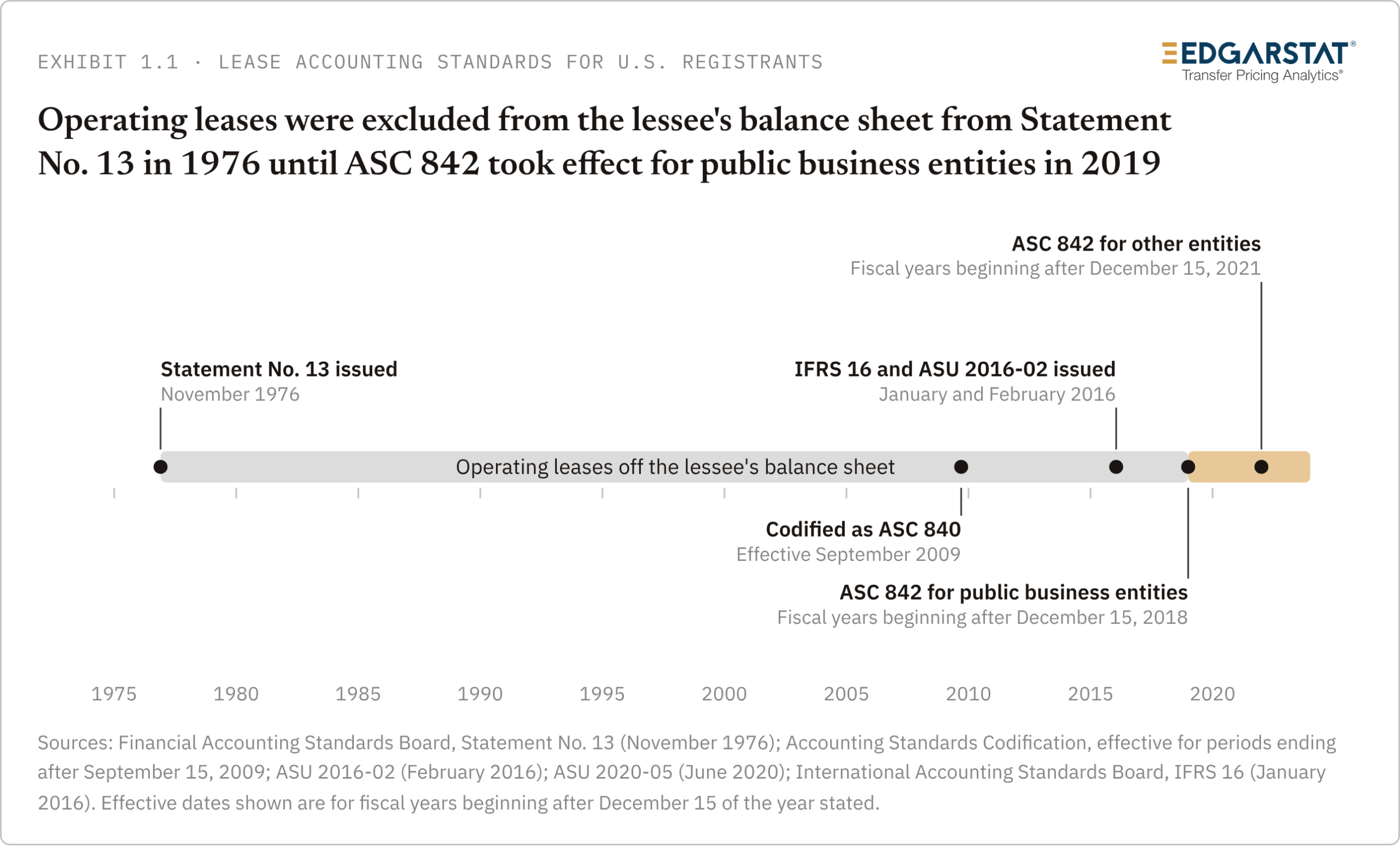
Statement No. 13 in 1976 and ASC 840 in 2009 excluded operating leases from the lessee’s balance sheet
Under Statement No. 13, Accounting for Leases, a lessee recorded a lease as an asset and an obligation if it transferred ownership, contained a bargain purchase option, had a term of at least 75 percent of the property’s economic life, or required payments with a present value of at least 90 percent of the property’s fair value. Any other lease was an operating lease: the lessee charged rent to expense and disclosed future minimum lease payments in a note. Because the tests were numerical thresholds, a lease with payments equal to 89 percent of fair value was excluded from the balance sheet, whereas an otherwise identical lease at 90 percent was included.
The Securities and Exchange Commission staff estimated that issuers had approximately $1.25 trillion in “non-cancelable future cash obligations committed under operating leases,” which were disclosed only in the notes. The Codification renumbered Statement No. 13 as Topic 840 and did not change the lessee model.
ASC 842 requires a right-of-use asset for every lease longer than 12 months
Accounting Standards Update (ASU) 2016-02, issued in February 2016, replaced Topic 840 with Topic 842. ASC 842-20-25-1 requires a lessee to recognize a right-of-use asset and a lease liability for the remaining lease payments. The standard still distinguishes operating leases from finance leases, and ASC 842-20-25-6 requires a single straight-line lease cost for an operating lease. Adoption changed the lessee’s balance sheet but did not change its operating income.
Public business entities adopted ASC 842 for fiscal years beginning after December 15, 2018: fiscal year 2019 for a December year-end and fiscal year 2020 for a June year-end. ASU 2018-11, issued in July 2018, permitted adoption at the adoption date without restating prior years, so a company that elected that method reports those years on the ASC 840 basis in its later filings.
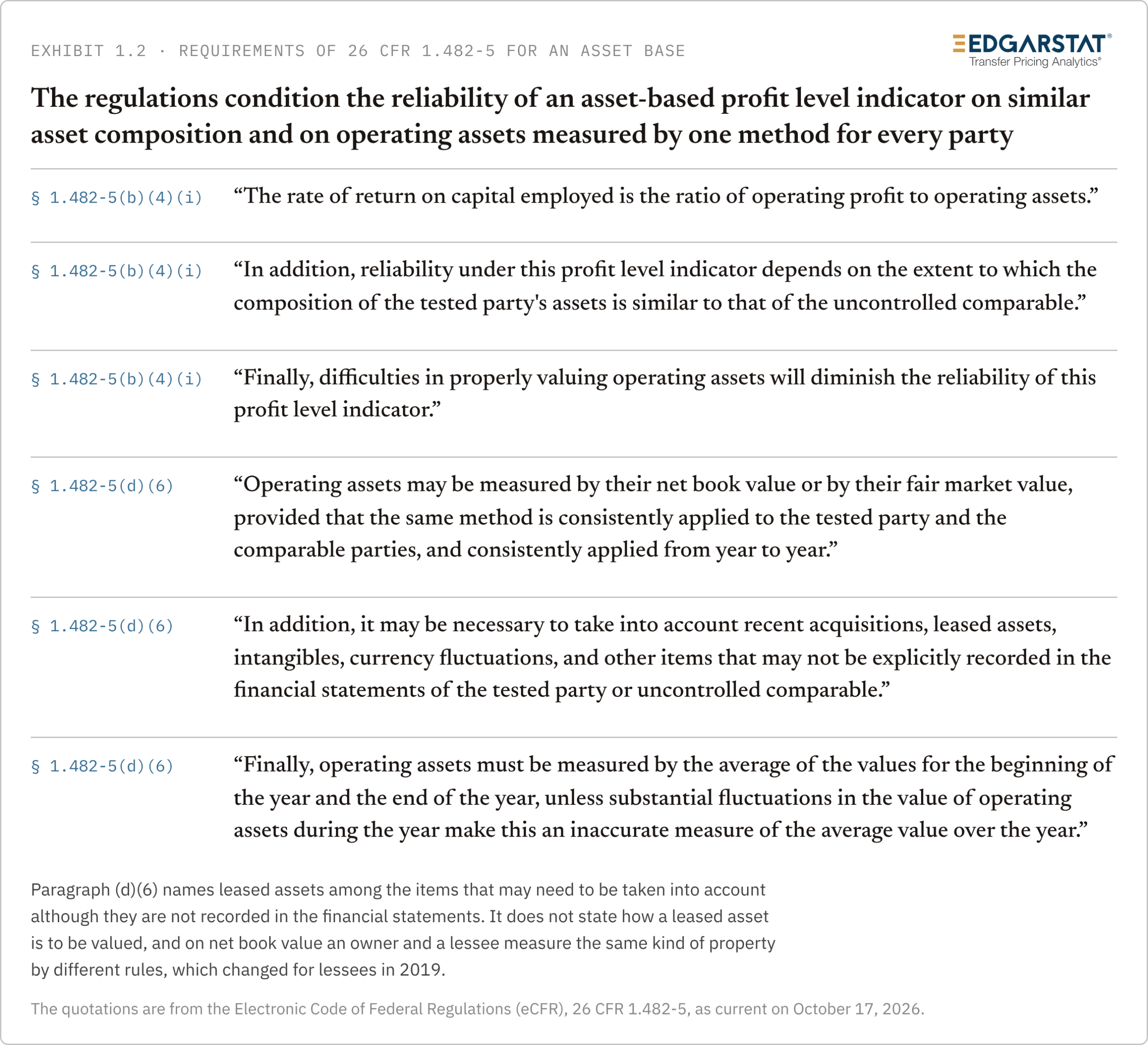
The regulations require similar assets measured by one method
Under 26 CFR 1.482-5(b)(4)(i), reliability “depends on the extent to which the composition of the tested party’s assets is similar to that of the uncontrolled comparable,” and “difficulties in properly valuing operating assets will diminish the reliability of this profit level indicator.” Paragraph (d)(6) defines operating assets as “the value of all assets used in the relevant business activity of the tested party” and permits the use of net book value or fair market value, “provided that the same method is consistently applied to the tested party and the comparable parties, and consistently applied from year to year.” The same paragraph provides that “it may be necessary to take into account recent acquisitions, leased assets, intangibles, currency fluctuations, and other items that may not be explicitly recorded in the financial statements of the tested party or uncontrolled comparable,” and that operating assets “must be measured by the average of the values for the beginning of the year and the end of the year,” or by a more accurate average when the value fluctuates substantially during the year.
The regulation therefore anticipates that a comparable’s leased property may be absent from its balance sheet and may require the analyst to take it into account, but it does not specify how that property is to be valued. The year-to-year consistency it requires is absent for any lessee whose fiscal years span its adoption date.
The three methods compared: a practical example
For the same hypothetical store, the ASC 842 lessee records 56 percent of the owner’s asset base, and the ASC 840 lessee records none of it
A store earns $200,000 a year before rent and depreciation. The owner buys the building for $1,000,000, excluding land, and depreciates it straight-line over 40 years. At the end of year 1, its net book value is $975,000, and its operating income is $175,000. A lessee of the same store pays $80,000 at the end of each year for 10 years. Under ASC 840, it records $80,000 of rent expense and no asset. Under ASC 842, it records an asset and a liability of $588,807, the present value of the payments at 6 percent. The first payment includes $35,328 of interest and reduces the liability by $44,672. Under ASC 842-20-35-3(b), the asset is reduced by the same amount, so both balances are $544,135 at year-end, and the lease cost is still $80,000. The lessee’s operating income is $120,000 under either standard.

Operating income differs by $55,000 because the owner records $25,000 of depreciation instead of $80,000 of rent. ASC 842 changed the denominator of an asset-based ratio, but did not change this numerator difference.
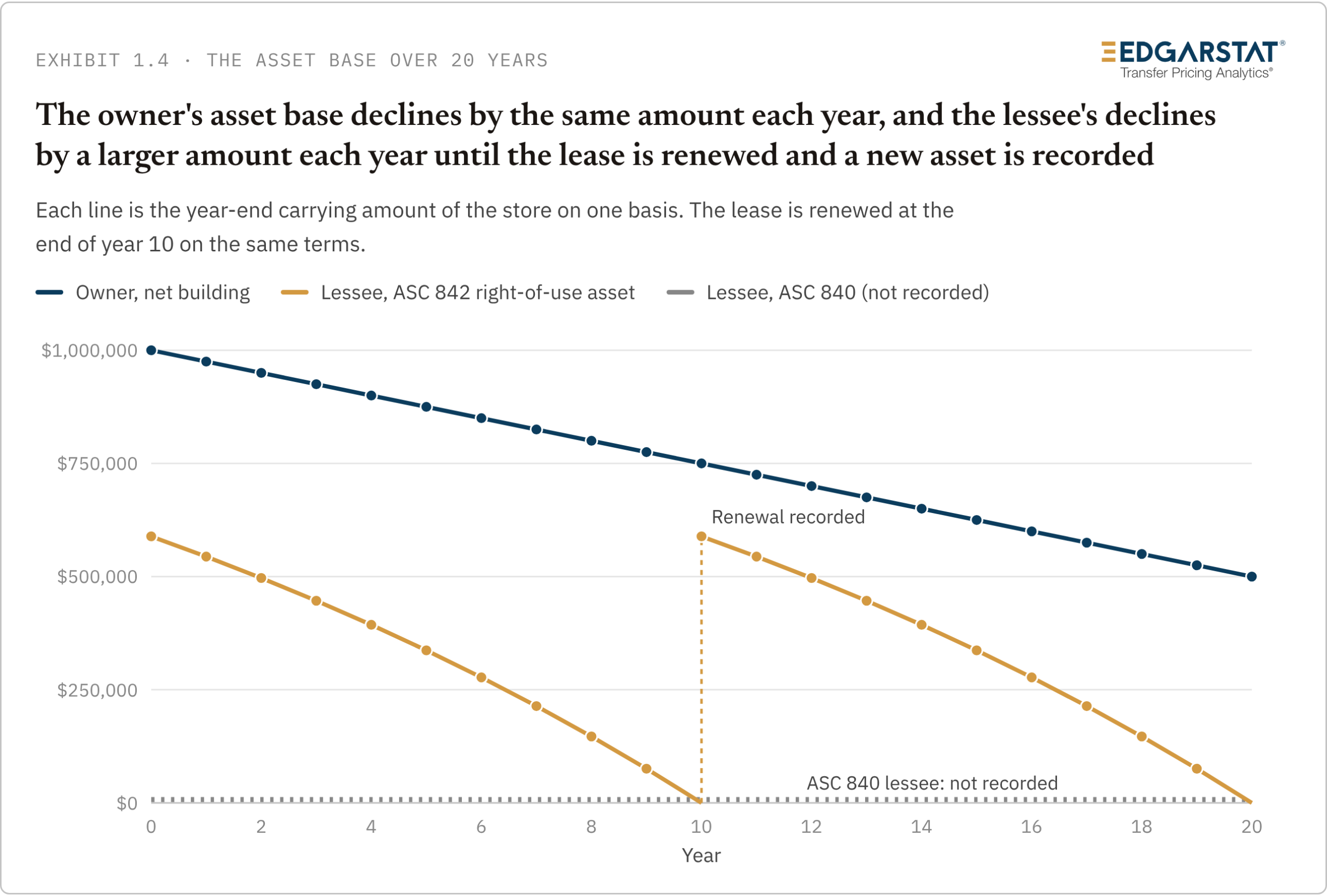
The difference between the two asset bases depends on the age of the property and the remaining lease term
The owner’s net book value declines by $25,000 per year, reaching $500,000 at the end of year 20. The lessee’s asset declines by a larger amount each year because each payment includes less interest, and it is zero at the end of year 10. A renewal on the same terms is recorded as a new asset of $588,807.
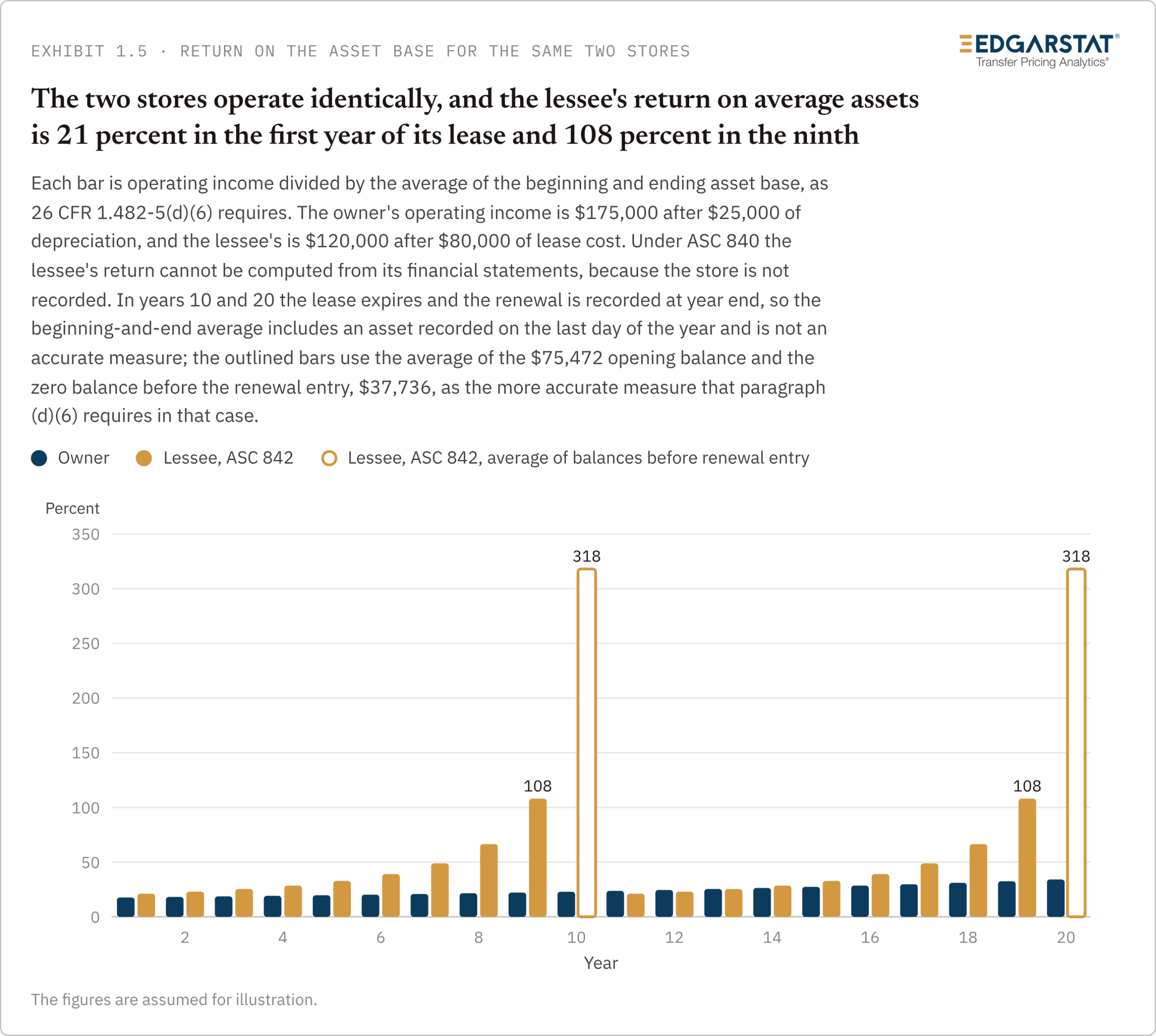
Using the average of beginning and ending balances that paragraph (d)(6) requires, the owner’s return increases from 17.7 percent in year 1 to 34.1 percent in year 20, and the lessee’s from 21.2 percent in the first year of its lease to 108 percent in the ninth. In the tenth year, the renewal is recorded at year-end, so the beginning-and-end average, $332,139, includes an asset held for one day; on the average of the opening balance and the zero balance before the renewal, $37,736, the return is 318 percent. Under ASC 840, the lessee’s return cannot be computed from its financial statements. The two stores operate identically, so these differences are attributable to the method and date of measurement, and comparables that include both owners and lessees vary for reasons unrelated to operating performance.
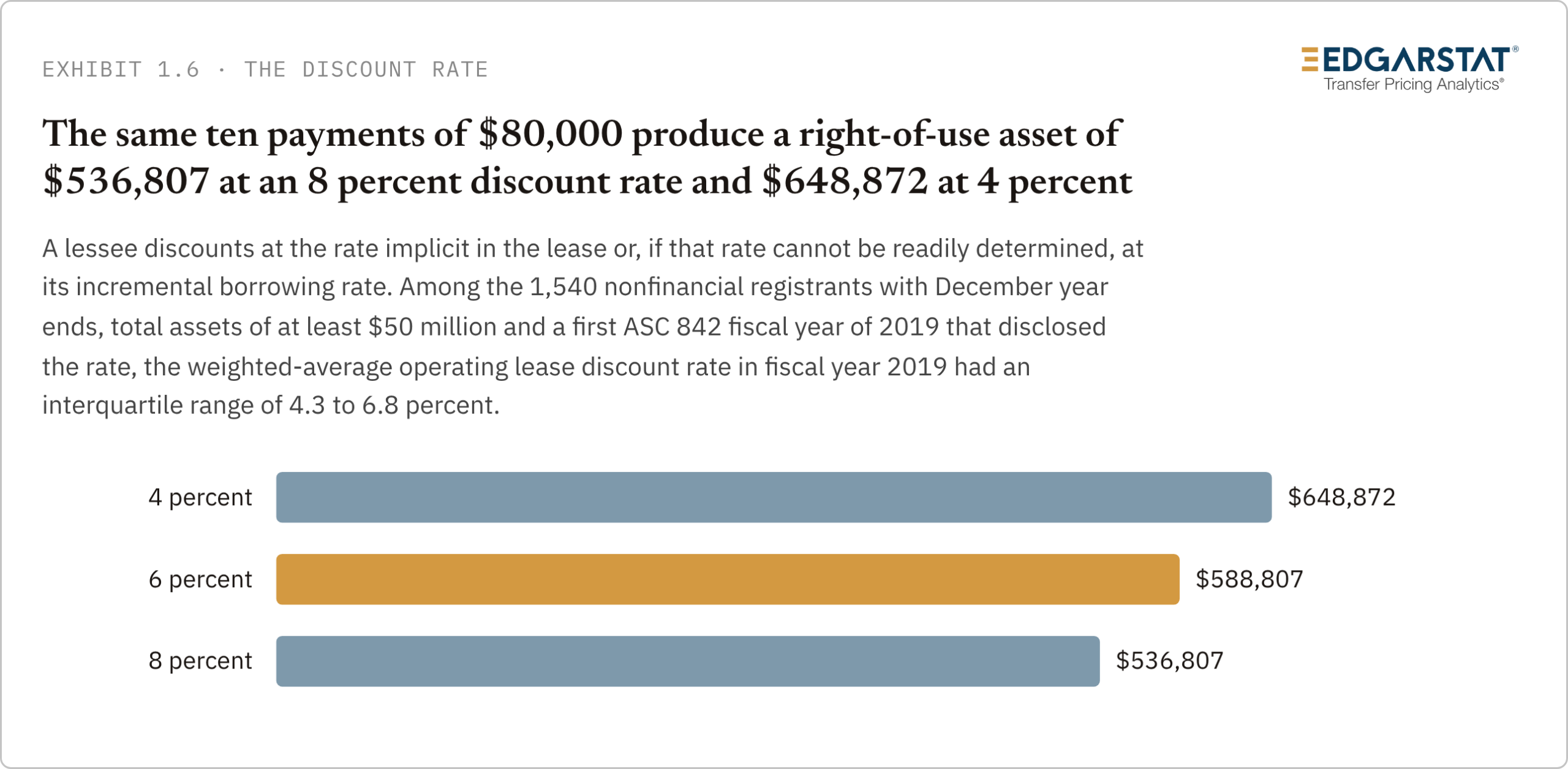
The lessee’s asset also depends on the discount rate, either the rate implicit in the lease or, if that cannot be readily determined, the lessee’s incremental borrowing rate. The same ten payments have a present value of $648,872 at 4 percent and $536,807 at 8 percent, a 20.9 percent difference. The weighted-average operating lease discount rates disclosed by 1,540 nonfinancial registrants with December year-ends for fiscal year 2019 had an interquartile range of 4.3 to 6.8 percent.
Most of the variation in each component of the asset base is within industries
Selecting comparables by Standard Industrial Classification (SIC) code controls for differences between industries but not for differences among companies within the same industry. In the fiscal year 2019 balance sheets of nonfinancial registrants with December year-ends, as reported to EDGAR, within the 14 two-digit SIC groups with at least 25 such registrants, within-industry differences account for 71 percent of the variance in lease share across 1,324 registrants. Lease share is the operating right-of-use asset divided by the sum of that asset and net property, plant and equipment (PP&E). Within-industry differences also account for 81 percent of the variance in net PP&E as a share of gross PP&E, which measures how far the property in PP&E has been depreciated (1,091 registrants), and 85 percent of the variance in lease discount rates (1,185 registrants).
Lease share answers one question for each company: of the property it uses, measured on the ASC 842 basis, what fraction is held under operating leases? A company with $100 of net PP&E and $100 of operating lease asset has a lease share of 50 percent; a company with no operating leases has a share of zero. Net PP&E as reported includes finance lease assets where a registrant presents them in that line, as ASC 842-20-45-1 permits; 397 of the 1,324 registrants disclose one, at a median of 2.2 percent of net PP&E, and with all of them removed the within-industry share is still 71 percent.
In business services and software (SIC 73), the median registrant has a lease share of 48.2 percent and records about 93 cents of operating lease asset per dollar of net PP&E. The interquartile range, the middle half of the 260 registrants in the group, is between 29.3 and 62.5 percent, or from 42 cents to $1.67 of operating lease asset per dollar of net PP&E; Ebix and Sprout Social are at the lower end, DoorDash and Alteryx at the upper end, and OneSpan at the median. In chemicals and drugs (SIC 28), the middle half is between 10.8 and 63.6 percent, or from 12 cents to $1.75. A return on assets computed for either group therefore includes companies whose asset bases consist mostly of PP&E and companies whose asset bases consist mostly of discounted lease payments, with no change in SIC code to indicate the difference. Only electric, gas, and sanitary services (SIC 49) and oil and gas extraction (SIC 13) have median lease shares below 2 percent, at 0.9 and 1.6 percent.
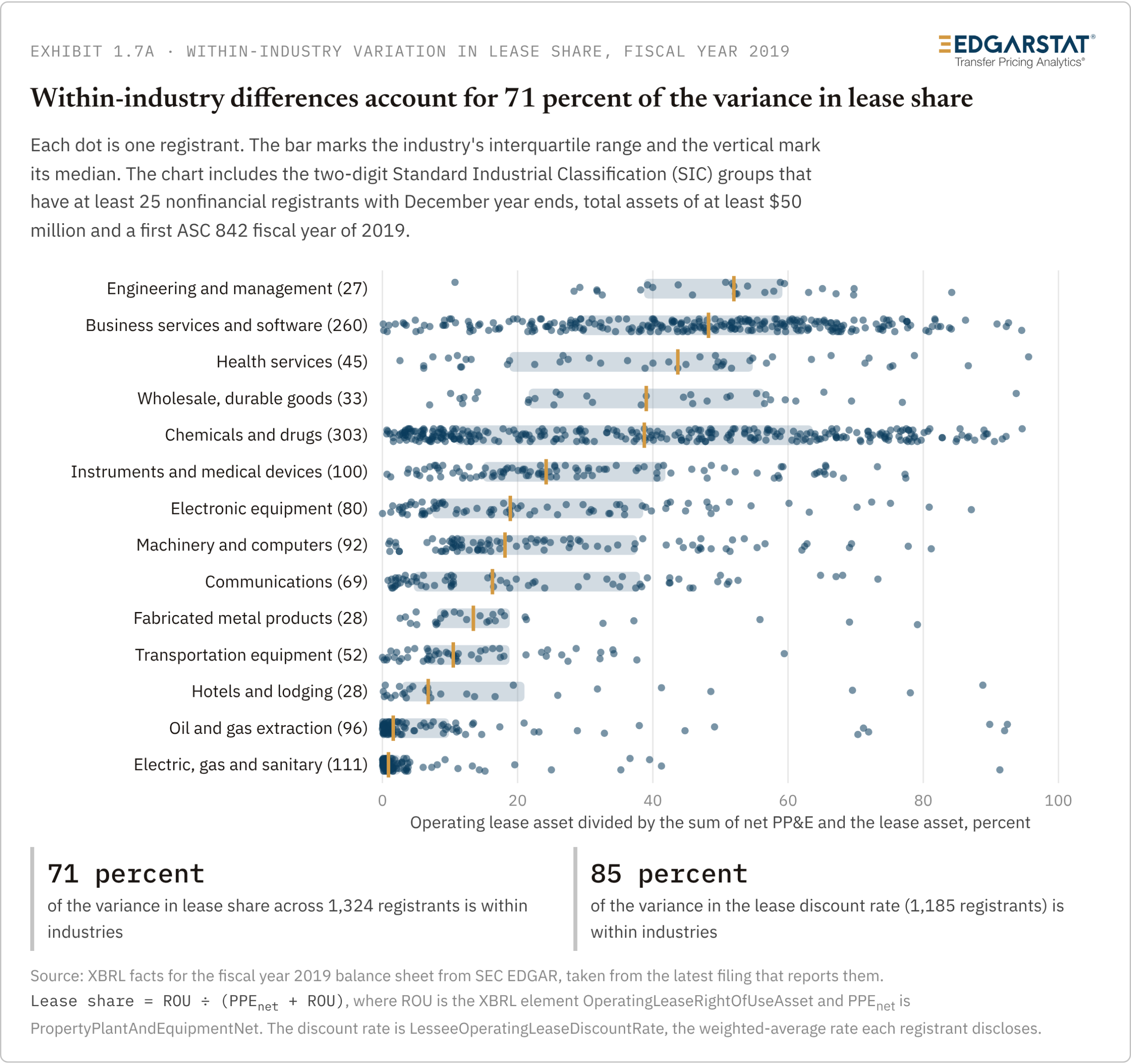
A narrower industry definition reduces the within-industry share of the variance but does not eliminate it. At the four-digit SIC level, within-code differences account for 55 percent of the variance in lease share across the same 1,324 registrants in 166 codes, and 60 percent in the 30 codes with at least ten registrants. In pharmaceutical preparations (SIC 2834), the interquartile range among 170 registrants runs from 23.2 to 70.3 percent; in prepackaged software (SIC 7372), it runs from 33.3 to 62.3 percent among 69 registrants. Industry classification identifies what a registrant sells and does not indicate whether the property it uses is in PP&E or held under operating leases.

Exhibit 1.7B concerns the property reported in PP&E, including finance lease assets when a registrant presents them, and shows that one consistently applied method does not produce comparable amounts. Net book value is the portion of the property’s undepreciated cost, which depends on the property’s age and useful life, and is indiscernible from the industry code. In business services and software, the registrant at the lower quartile reports 31 cents of net PP&E per dollar of gross cost and the registrant at the upper quartile reports 56 cents. For property of the same cost, the second’s asset base is 1.8 times the first’s, and the return on operating assets differs by the same factor before any difference in operating profit. At the four-digit SIC level, within-code differences still account for 67 percent of the variance in the ratio across the same 1,091 registrants in 163 codes, and 77 percent in the 24 codes with at least ten registrants.
Takeaways
The data establish that an asset-based profit level indicator has a comparability problem that the § 482 regulation’s own conditions describe and that the usual search method does not resolve. In the fiscal year 2019 balance sheets of 1,324 registrants, the operating lease asset ranges from below 1 percent to above 90 percent of the asset base within a single two-digit SIC code, and the fraction of PP&E cost not yet depreciated ranges from below 10 percent to above 90 percent within that same SIC code; 71 percent of the variation in the first measure and 81 percent in the second are among registrants in the same industry, and four-digit SIC codes leave 55 and 67 percent of it in place. Two registrants in the same code can therefore report operating assets that differ by the whole of one registrant’s operating lease assets, or by a factor of 1.8 on property of the same cost, with otherwise no differences in their operations. Whether a particular set of comparables is affected, and by how much, depends on the lease shares and the registrants’ depreciation in them.
Future blog entries will analyze the effects of operating-lease accounting on intra-industry asset bases.
Endnotes
- 26 CFR 1.482-5, paragraphs (b)(4)(i) and (d)(6), Electronic Code of Federal Regulations, current as of October 17, 2026.
- Financial Accounting Standards Board, Statement of Financial Accounting Standards No. 13, Accounting for Leases (November 1976), paragraph 7. The 90 percent criterion in paragraph 7(d) is measured against fair value less any investment tax credit retained by the lessor, and criteria 7(c) and 7(d) do not apply when the lease term begins within the last 25 percent of the property’s economic life; the text above omits those qualifications.
- Financial Accounting Standards Board, Accounting Standards Codification, effective for interim and annual periods ending after September 15, 2009.
- Staff of the Securities and Exchange Commission, Report and Recommendations Pursuant to Section 401(c) of the Sarbanes-Oxley Act of 2002 on Arrangements with Off-Balance Sheet Implications, Special Purpose Entities, and Transparency of Filings by Issuers (June 2005).
- Financial Accounting Standards Board, ASU 2016-02, Leases (Topic 842) (February 25, 2016); ASC 842-20-25-1, 842-20-25-6, 842-20-30-3 and 842-20-35-3(b); 842-20-45-1; ASC 842-10-65-1 (effective dates).
- Financial Accounting Standards Board, ASU 2018-11, Leases (Topic 842): Targeted Improvements (July 30, 2018).
- Financial Accounting Standards Board, ASU 2020-05, Revenue from Contracts with Customers (Topic 606) and Leases (Topic 842): Effective Dates for Certain Entities (June 2020).
- International Accounting Standards Board, IFRS 16, Leases (January 2016).
- Data: XBRL (eXtensible Business Reporting Language) facts for the fiscal year 2019 balance sheet, retrieved from the EDGAR frames and submissions services of the Securities and Exchange Commission on October 17, 2026, taken from the latest filing that reports each fact. The sample comprises nonfinancial registrants (SIC codes outside 6000 to 6799) with December year ends, total assets of at least $50 million, net PP&E of at least $1 million and a first ASC 842 fiscal year of 2019, excluding registrants whose filed net PP&E appears to include the lease asset; 1,736 registrants meet those conditions, of which 1,324 are in the 14 two-digit SIC groups with at least 25 members. Exhibits 1.3 to 1.6 are illustrations with assumed figures.