
Summary
Before Accounting Standards Update (ASU) 2014-15, U.S. generally accepted accounting principles established by the Financial Accounting Standards Board (FASB GAAP) did not contain any guidance on management’s responsibility to evaluate whether there is substantial doubt about an entity’s ability to continue as a going concern or to provide related footnote disclosures. The evaluation was required of auditors; AU Section 341, derived from Statement on Auditing Standards (SAS) No. 59, required it in audits under generally accepted auditing standards for periods beginning on or after January 1, 1989, except for audits of financial statements based on the assumption of liquidation.
ASU 2014-15, issued in August 2014 and codified in Subtopic 205-40 of the Accounting Standards Codification (ASC), requires management to evaluate, for each annual and interim reporting period, whether there is substantial doubt about the entity’s ability to continue as a going concern within one year after the date the financial statements are issued (or available to be issued, when applicable), and to provide related disclosures. The Subtopic became mandatory for annual periods ending after December 15, 2016, and for interim periods within annual periods beginning after that date, with early application permitted for reporting periods for which the financial statements had not previously been issued. According to the Public Company Accounting Oversight Board (PCAOB) staff, the auditor’s requirements in AU Section 341 did not change, and as of this writing, paragraph .02 of AS 2415 (formerly AU 341) still states that the auditor’s evaluation period is a reasonable period of time not to exceed one year beyond the date of the financial statements being audited.

1. Before ASC 205-40: the auditor’s evaluation
When it issued ASU 2014-15, the FASB stated that “there is no guidance in GAAP about management’s responsibility to evaluate whether there is substantial doubt about an entity’s ability to continue as a going concern or to provide related footnote disclosures.”[1] On the other hand, the requirement to evaluate going concern ability was set forth in auditing standards and, for audits of issuers required under the Securities Exchange Act of 1934, in federal securities law.
AU Section 341, derived from SAS No. 59 and later-amending statements, was effective for audits of financial statements for periods beginning on or after January 1, 1989 (AU 341.18) and applied to audits conducted under generally accepted auditing standards, except for audits of financial statements based on the assumption of liquidation (AU 341.01 and footnote 1). In the archived PCAOB text effective for audits of fiscal years ending on or after November 15, 2007, AU 341.02 required the auditor to evaluate whether there was substantial doubt about the entity’s ability to continue as a going concern “for a reasonable period of time, not to exceed one year beyond the date of the financial statements being audited.”[3] AU 341 did not define substantial doubt (ASU 2014-15, Basis for Conclusions, paragraph BC16). When substantial doubt remained after the auditor considered management’s plans, AU 341.12 required an explanatory paragraph in the audit report.[1][3]
The Private Securities Litigation Reform Act of 1995 (Pub. L. 104-67) added Section 10A to the Securities Exchange Act of 1934. Section 10A(a)(3) requires that each audit of an issuer’s financial statements required under that Act include, “in accordance with generally accepted auditing standards, as may be modified or supplemented from time to time by the Commission,” “an evaluation of whether there is substantial doubt about the ability of the issuer to continue as a going concern during the ensuing fiscal year.” Section 301(b) of the 1995 Act applied the requirement to annual reports for periods beginning on or after January 1, 1996, for registrants required to file selected quarterly financial data, and on or after January 1, 1997, for other registrants.[5]
2. The FASB project, 2008 to 2014
The FASB’s Exposure Draft, Going Concern, dated October 9, 2008, would have required management, when assessing whether the going concern assumption is appropriate, to consider “all available information about the future, which is at least, but is not limited to, 12 months from the end of the reporting period.”[2] Respondents raised concerns about “potential complexities arising from the indefinite nature of the proposed time horizon” (Basis for Conclusions, paragraph BC3), and most respondents to another Exposure Draft, issued in June 2013, “disagreed with the proposed assessment period of 24 months” (BC5 and BC28). ASU 2014-15[7] limited the assessment period to one year after the date the financial statements are issued (or available to be issued), citing “the practical limitations in reliably assessing an entity’s potential inability to meet its obligations beyond one year” (BC28), and defined substantial doubt using the term “probable,” citing, among other reasons, that “that term is defined within GAAP (Topic 450 on contingencies)” (BC19).[1]
3. Requirements of ASC 205-40
ASC 205-40-05-1 presumes an entity’s continuation as a going concern “as the basis for financial reporting unless and until the entity’s liquidation becomes imminent” and provides that financial statements are prepared under the liquidation basis of accounting in Subtopic 205-30 if and when liquidation becomes imminent. When liquidation is not imminent, but conditions and events raise substantial doubt, “financial statements continue to be prepared under the going concern basis of accounting,” and the guidance in Subtopic 205-40 is followed to determine whether to disclose information about the relevant conditions or events (ASC 205-40-05-2).[1]
ASC 205-40-50-1 requires management, “in connection with preparing financial statements for each annual and interim reporting period,” to evaluate whether conditions and events, considered in the aggregate, raise substantial doubt about the entity’s ability to continue as a going concern within one year after the date the financial statements are issued, or within one year after the date they are available to be issued, when applicable. The Subtopic applies to all entities (ASC 205-40-15-1). Substantial doubt exists when those conditions and events “indicate that it is probable that the entity will be unable to meet its obligations as they become due within one year after the date that the financial statements are issued (or within one year after the date that the financial statements are available to be issued when applicable).” “Probable,” as defined in the ASC Master Glossary, means that “the future event or events are likely to occur.”[1]
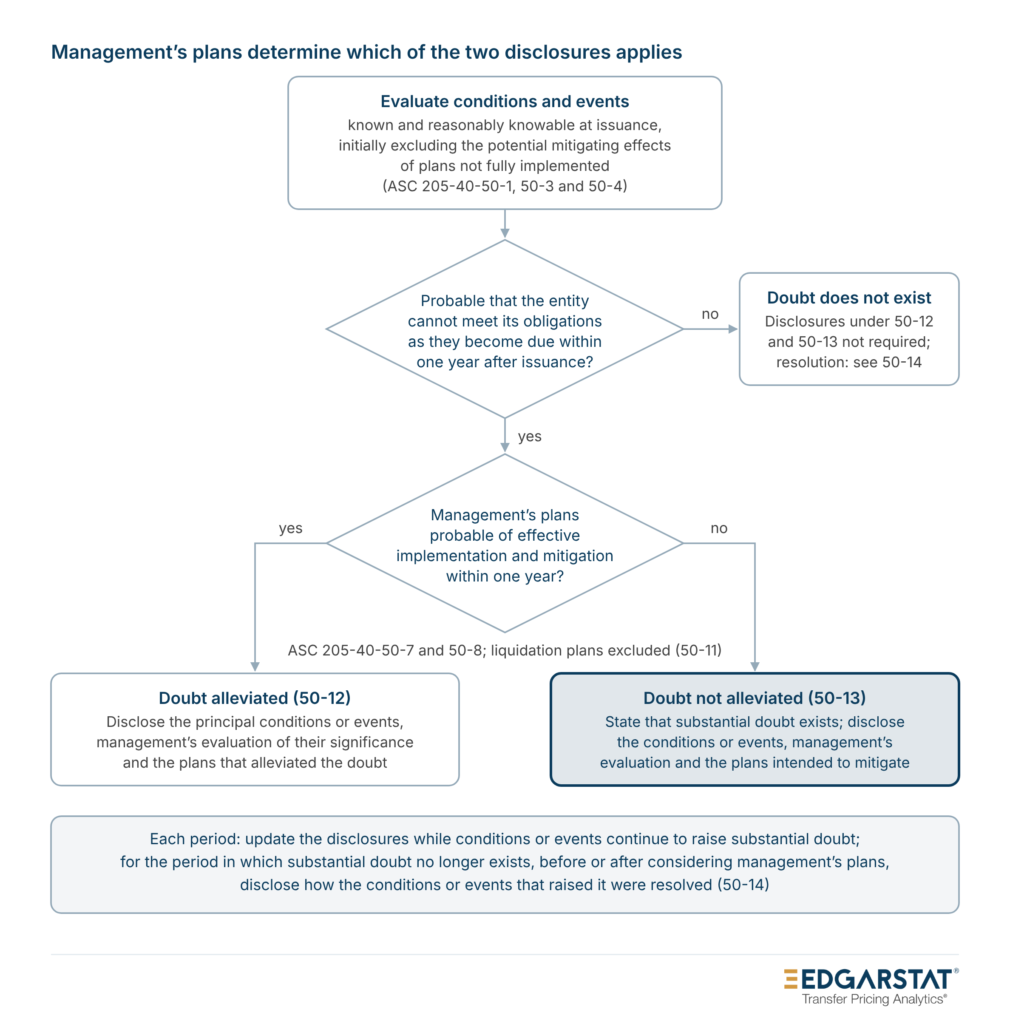
Management first evaluates conditions and events known and reasonably knowable at the issuance date, without considering “the potential mitigating effect of management’s plans that have not been fully implemented” (ASC 205-40-50-3 and 50-4). If substantial doubt is raised, management’s plans alleviate it only to the extent that information available at the issuance date indicates that it is probable both that the plans will be effectively implemented within one year after the issuance date and that, when implemented, they will mitigate the relevant conditions or events within that year (ASC 205-40-50-7). Generally, a plan must have been approved by management or others with the appropriate authority before the issuance date to be considered probable of effective implementation (ASC 205-40-50-8), and a plan to meet obligations through liquidation is not considered, even if liquidation is probable (ASC 205-40-50-11).
When management’s plans alleviate substantial doubt, ASC 205-40-50-12 requires disclosure, or a reference to similar information disclosed elsewhere in the footnotes, of the principal conditions or events that raised substantial doubt before consideration of management’s plans, management’s evaluation of their significance in relation to the entity’s ability to meet its obligations, and the plans that alleviated the doubt. When they do not, ASC 205-40-50-13 requires a statement that there is substantial doubt about the entity’s ability to continue as a going concern within one year after the issuance date, together with the principal conditions or events, management’s evaluation of their significance, and management’s plans intended to mitigate them. While conditions or events continue to raise substantial doubt, the disclosures continue in later annual and interim periods, “should become more extensive as additional information becomes available,” and explain how the conditions or events have changed between periods; in the period in which substantial doubt no longer exists, before or after consideration of management’s plans, the entity discloses how the conditions or events were resolved (ASC 205-40-50-14).[1] ASU 2025-11, issued in December 2025, amends ASC 205-40-50-12 through 50-14 to state that these disclosures are required in interim and annual reporting periods, effective for public business entities for interim reporting periods within annual reporting periods beginning after December 15, 2027, and for other entities for those beginning after December 15, 2028; early adoption is permitted in any interim period whose financial statements have not been issued or made available for issuance.[9]
4. Auditing standards after ASU 2014-15
In Staff Audit Practice Alert No. 13 (September 22, 2014), PCAOB staff stated that the AU 341 requirements for the auditor’s evaluation, and for the auditor’s reporting when substantial doubt exists, “have not changed and continue to be in effect.” The alert stated that a determination that no disclosure is required under the ASC amendments “is not conclusive as to whether an explanatory paragraph is required under AU sec. 341” and that auditors “should make a separate evaluation of the need for disclosure in the auditor’s report in accordance with the requirements of AU sec. 341.” The alert also stated that, in evaluating whether the financial statements are presented fairly, auditors “should assess management’s going concern evaluation.”[7] Practice alerts are staff guidance and do not establish Board rules.
AU 341 became an interim auditing standard of the PCAOB under rules the Board adopted on April 16, 2003, and the Securities and Exchange Commission (SEC) approved on April 25.[6][7] PCAOB Release No. 2015-002 redesignated AU 341 as AS 2415, with the reorganization to “be effective, subject to SEC approval, as of December 31, 2016.”[8] AS 2415 has since been amended, but as of this writing, paragraph .02 retains the evaluation period “not to exceed one year beyond the date of the financial statements being audited.”[4]
5. Requirements before and after ASC 205-40 compared
The management requirements in ASC 205-40 differ from the auditor’s requirements in AS 2415 regarding the party performing the evaluation, the evaluation’s frequency, the threshold for substantial doubt, and the date from which the evaluation period is measured. Both consider conditions and events first and management’s plans second.
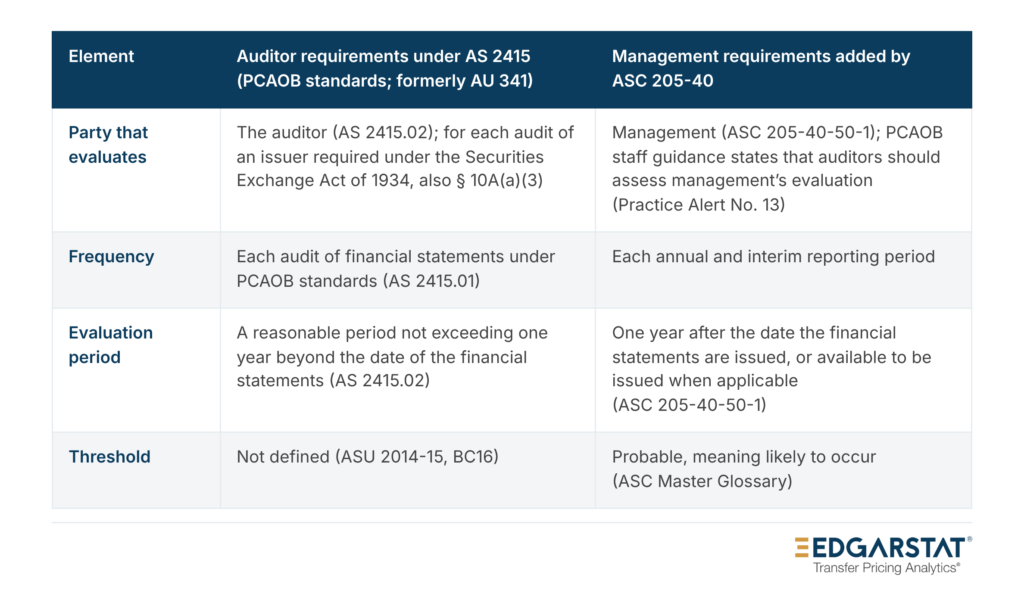
The two evaluation periods are measured from different dates.[1][4] For a company with a December 31 year-end that issues its financial statements on March 1, management’s evaluation period ends on the following March 1, and the evaluation period stated in AS 2415.02 ends no later than the following December 31.

Future blog entries will examine real-world going concern disclosures across companies and industries, applying data analysis to better understand this critical financial reporting element.
Endnotes
- FASB, ASU 2014-15, Presentation of Financial Statements—Going Concern (Subtopic 205-40), August 2014: Summary; ASC 205-40-05-1, 05-2, 15-1, 50-1, 50-3, 50-4, 50-7, 50-8, 50-11 to 50-14 and 65-1; Master Glossary; Basis for Conclusions, BC3, BC5, BC16, BC19 and BC28.
- FASB, Exposure Draft, Going Concern, File Reference No. 1650-100, October 9, 2008, paragraph 4.
- PCAOB, AU Section 341, archived text, paragraphs .01 (including footnote 1), .02, .12 and .18, and the archived 2007 text of paragraph .02.
- PCAOB, AS 2415, paragraphs .01 to .03, and amendment history.
- Pub. L. 104-67, § 301(a)–(b), 109 Stat. 737, 762–764 (December 22, 1995); 15 U.S.C. § 78j-1(a).
- SEC, Release No. 34-49444, March 18, 2004, notice of filing of proposed technical amendments to the PCAOB’s interim standards rules, Item II.A(a) (the Board’s statement of purpose).
- PCAOB, Staff Audit Practice Alert No. 13, September 22, 2014.
- PCAOB, Release No. 2015-002, March 31, 2015, Section VII (effective date) and Appendices 2 and 4 (AU 341 redesignated as AS 2415).
- FASB, ASU 2025-11, Interim Reporting (Topic 270): Narrow-Scope Improvements, December 2025: ASC 205-40-50-12 through 50-14 as amended, and ASC 270-10-65-1 (effective date and early adoption).