
Summary
Anthropic recorded a $94.3 billion loss on its convertible notes in the first nine months of 2026, 2.8 times its revenue, because its shares became more valuable.[1][2] Ednaldo Silva, writing on LinkedIn, also pointed out that the loss on the notes was nearly three times Anthropic’s revenue. We reviewed Anthropic’s registration statement on Form S-1 (the S-1) and Amendment No. 1 (the S-1/A) to explain how a higher valuation produces a loss for Anthropic.[1]
1. Google and Amazon bought Anthropic’s convertible notes between 2023 and 2025
A convertible note is a loan that can convert into the borrower’s shares instead of being repaid in cash. Anthropic issued notes to Google and Amazon from September 2023 to November 2025.[3] As of September 30, 2026, Amazon held the outstanding notes, with $6.2 billion in principal.[4]
Before an initial public offering (IPO), Amazon’s notes are convertible into non-voting preferred stock at the lower of a fixed per-share price or the price in Anthropic’s most recent equity financing. Portions of the notes were converted on these terms when Anthropic sold preferred stock to investors in 2025 and in January and February 2026.[3]
Immediately before the IPO closes, the notes that remain outstanding convert automatically into non-voting common stock at the lower of a fixed per-share price or the IPO price. All preferred stock, including shares from earlier note conversions, also converts into common stock.[4] Each conversion of the notes, before and at the IPO, is subject to a 12 percent ownership cap: a note converts only to the extent that Amazon would not then hold more than 12 percent of Anthropic’s capitalization.[3][4]
2. Anthropic elected to carry the notes at fair value, which it remeasures every quarter
Anthropic elected the fair value option under Accounting Standards Codification (ASC) Topic 825 so that it would not have to account separately for the liability and equity components of the notes. It records each note as a single liability at fair value and recognizes changes in fair value in its statement of operations.[5] Fair value is “the price that would be received to sell an asset or paid to transfer a liability in an orderly transaction between market participants at the measurement date” (ASC 820-10-20).[6] Because “there is no current market” for the notes, Anthropic estimates fair value using unobservable inputs, which ASC 820-10-35-52 classifies as Level 3 of the fair value hierarchy.[7] The valuation’s inputs include “the estimated fair value of our equity securities into which the notes may convert,” and in valuing its common stock, Anthropic states that its enterprise value “was primarily estimated by reference to the closest round of equity financing to the date of the valuation.”[7]
3. Above the capped conversion price, a higher share value produces a loss
The most recent S-1/A, Anthropic’s amended registration statement filed November 2, 2026, states: “Because these instruments are marked to market, increases in our enterprise valuation drive increases in this expense.”[2] The conversion terms are consistent with that statement: because the conversion price cannot exceed the fixed price, an increase in Anthropic’s share value above that price increases the value of the shares the notes will deliver, and with it the notes’ fair value.[7] Anthropic records the increase in the liability as an expense, which does not require a payment.[8]
Consider a hypothetical company that issues a note for $100 that converts into 10 shares of common stock, after which the value of its shares increases from $10 to $50 (Exhibit 1).
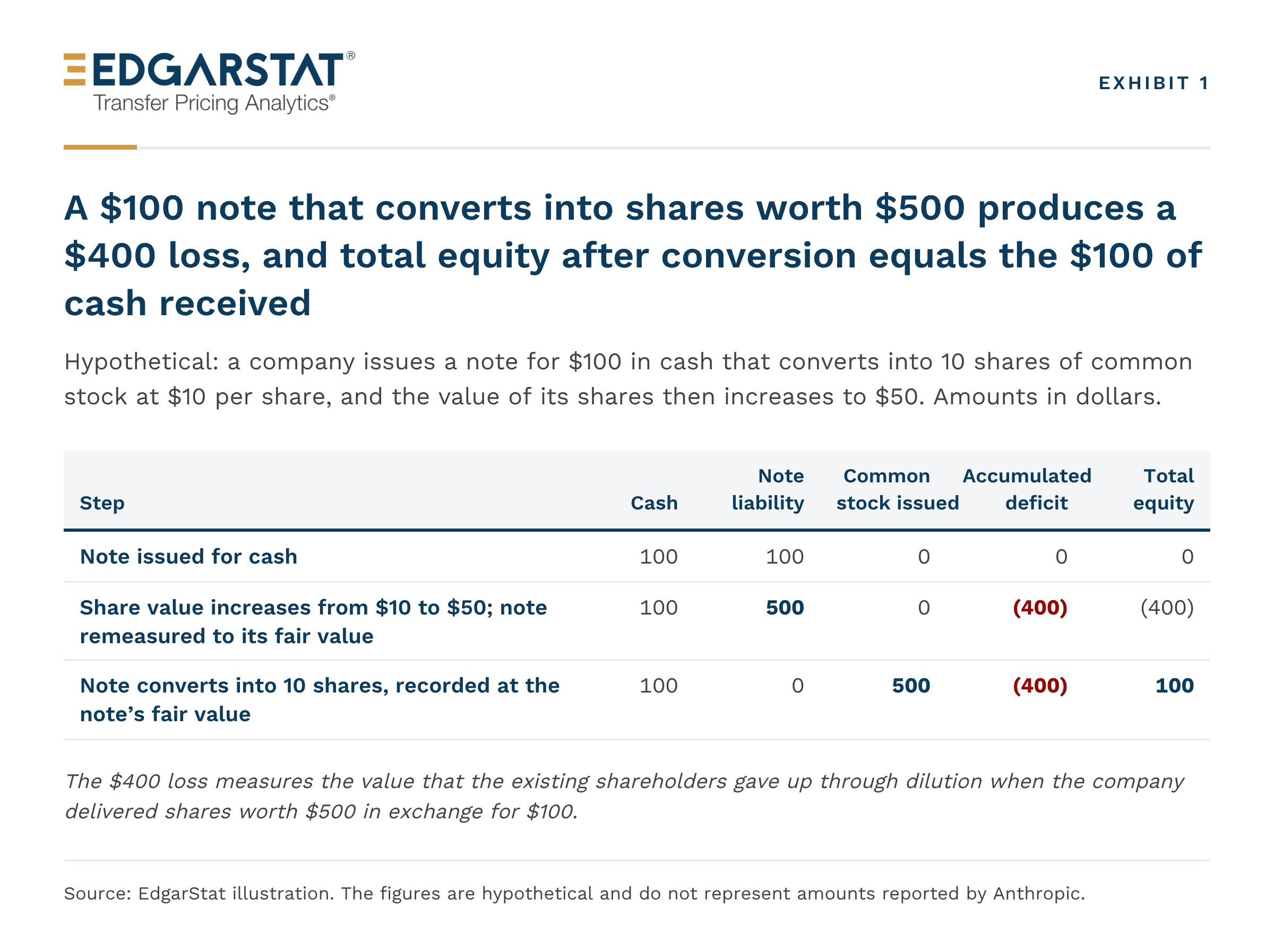
After conversion, total equity has increased by the $100 of cash received, as it would have if the company had sold 10 shares for $100. The $400 loss measures the value that the existing shareholders gave up through dilution when the company delivered shares worth $500 for $100.
4. The losses were $72.4 billion through June and $94.3 billion through September 2026
Anthropic reports the losses on the notes on a line titled “Change in fair value of convertible notes, derivative liabilities, and SAFEs,” which it presents with other income (expense), below its operating loss.[9] The losses were $12.8 billion in the first quarter of 2026 and $59.6 billion in the second, for a total of $72.4 billion through June. With $21.9 billion in the third quarter, losses through September totaled $94.3 billion (Exhibit 2).[10] The S-1/A attributes the second-quarter loss to “the increase in our enterprise valuation in connection with our Series H financing,” which was Anthropic’s sale of Series H preferred stock to investors in that quarter.[11]
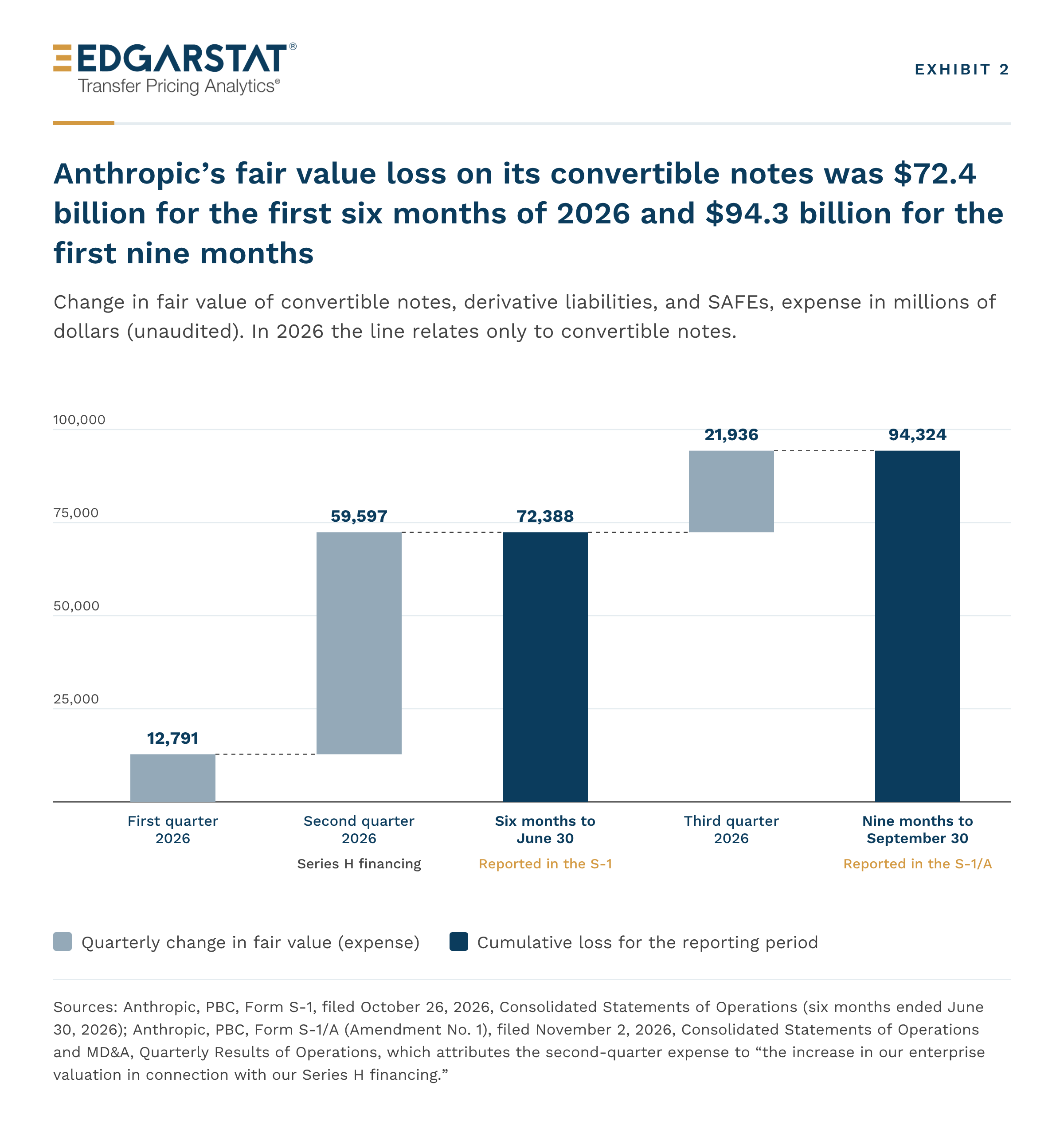
The loss on the notes accounted for $72.4 billion of Anthropic’s $80.7 billion net loss for the first six months of 2026, or 89.6 percent, and $94.3 billion of its $104.0 billion net loss for the first nine months, or 90.7 percent.[1] On September 30, 2026, the notes had a fair value of $130.5 billion, which was 21 times their principal amount of $6.2 billion.[12]
For the nine months ended September 30, 2026, Anthropic reported revenue of $33.2 billion and an operating loss of $1.3 billion, so the $94.3 billion loss on the notes was about 75 times the operating loss and 2.8 times revenue.[1] In the second quarter of 2026, the only quarter presented in the S-1/A in which Anthropic reported operating income, it earned $1.0 billion from operations and recorded a loss of $59.6 billion on the notes.[10] Anthropic’s own non-GAAP measure, meaning one not prepared under generally accepted accounting principles (GAAP), excludes the change in fair value and other items and shows adjusted net income of $5.6 billion for the nine months, against a net loss of $104.0 billion.[13] Fortune’s coverage of the S-1 described a “staggering loss of $80.7 billion” for the first half of 2026 and attributed most of it to changes in the fair value of convertible notes and other non-cash charges.[13] Silva’s LinkedIn post also notes that the charge is the largest line item on the income statement, and it states that the S-1/A does not give a value for any of the significant unobservable inputs used to measure the notes, although ASC 820-10-50-2(bbb)(2) requires quantitative information about the significant unobservable inputs that a reporting entity develops in measuring a Level 3 fair value.[13] Net loss alone is therefore a poor measure of Anthropic’s operating results in 2026.
5. Each loss increases the liability and remains in the accumulated deficit after conversion
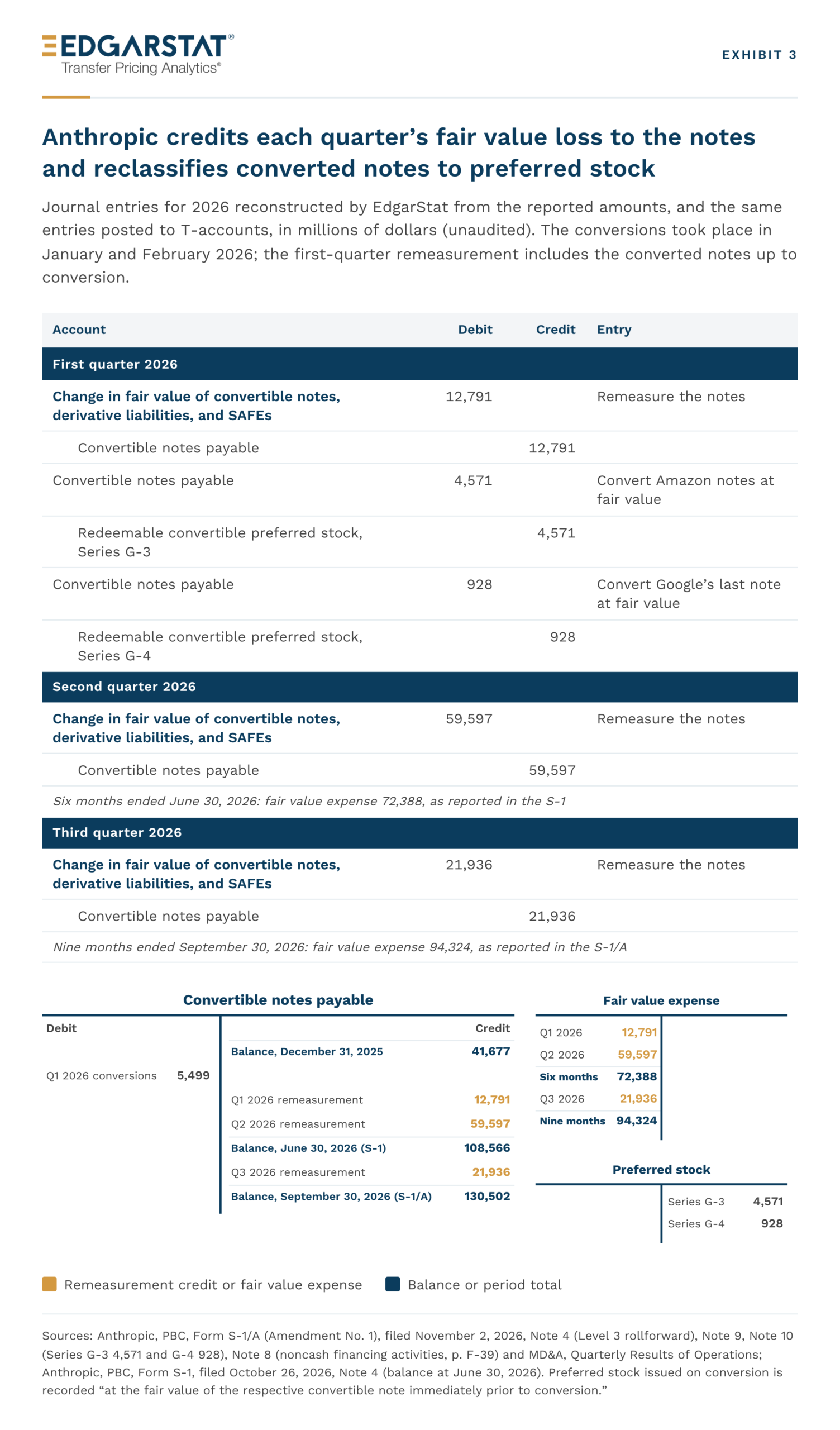
Exhibit 3 reconstructs the 2026 entries: each quarter’s loss is debited to the change in fair value line and credited to convertible notes payable.[10] In January and February 2026, Anthropic converted notes with a fair value of $5.5 billion into preferred stock and recorded the conversion at fair value, with no gain or loss. The losses remain in Anthropic’s accumulated deficit, which includes $135.1 billion of fair value changes on the notes and derivative liabilities since 2023.[14]
6. Gains and losses continue until the remaining notes convert or are settled
The S-1/A states: “We will continue to recognize changes in the fair value of our convertible notes until they are converted into equity, repaid, or otherwise settled.”[2] A portion that cannot convert because of the ownership cap is reissued as a non-interest-bearing rollover note, which “remains subject to fair value measurement.”[7] A decrease in the notes’ fair value would be recorded as a gain.[2]
7. So what: the notes’ terms provide for conversion into shares, and the losses reflect the dilution
In substance, the notes are debt whose terms provide for settlement by issuing shares, preferred stock before the IPO and common stock at and after it; cash repayment applies only in limited circumstances.[3] Each increase in Anthropic’s valuation increases the fair value of that debt, and Anthropic records the increase as a loss.[2] When Anthropic converted notes in 2026, it recorded the stock at the notes’ fair value immediately before conversion, without a gain or loss.[14] At September 30, 2026, the remaining notes had a fair value of $130.5 billion against principal of $6.2 billion.[12] As Exhibit 1 shows, the excess of the shares’ value over the cash Anthropic received measures what its other shareholders gave up through dilution. Notes that the ownership cap prevents from converting remain outstanding as rollover notes at fair value and convert at later quarter ends as the cap allows; a balance that never converts is repaid in cash at maturity.[3][7]
Endnotes
- Anthropic, PBC, Form S-1, filed October 26, 2026, accession 0001628280-26-067168 (the S-1), and Form S-1/A (Amendment No. 1), filed November 2, 2026, accession 0001628280-26-068676 (the S-1/A). The S-1/A cover page carries the legend “Subject to Completion,” and p. i states that Anthropic is incorporated as a public benefit corporation. The notes and the fair value election are described in S-1/A Note 9, pp. F-40 to F-44 (notes 3 and 5). Consolidated Statements of Operations, p. F-8 of each filing, whose column headings present fiscal years ended December 31: the nine months ended September 30, 2026, unaudited, in the S-1/A, and the six months ended June 30, 2026, unaudited, in the S-1. The percentages are EdgarStat’s calculations: the fair value loss was 89.6 percent of the net loss of $80.7 billion for the six months and 90.7 percent of the net loss of $104.0 billion for the nine months. The ratios of the fair value loss to revenue and to the operating loss are EdgarStat’s calculations from the nine-month figures: $94.3 billion against revenue of $33.2 billion and an operating loss of $1.3 billion. Page numbers in these notes are those printed in each filing.
- S-1/A, Management’s Discussion and Analysis (MD&A), Components of Results of Operations, Change in Fair Value of Convertible Notes, Derivative Liabilities, and SAFEs, p. 149, which contains both quoted sentences and describes the line as consisting of “gains and losses.”
- S-1/A, Note 9, Convertible Notes, Revolving Credit Agreement and SAFEs, pp. F-40 to F-43. In September 2023 Anthropic entered into note purchase agreements with Google LLC, for up to $2.0 billion in three tranches, or separate issues of notes, and with Amazon, for up to $4.0 billion in two tranches; in August 2024 it entered into a second agreement with Google for approximately $1.3 billion, and in November 2024 a second agreement with Amazon for up to $4.0 billion in three tranches (pp. F-40 and F-41). The Google notes converted at contractual discounts to the price of each financing. Before an IPO, the Amazon notes convert at the lesser of a fixed price per share and the price in the most recent preferred stock financing, for the 2023 agreement, or qualified equity financing, for the 2024 agreement (pp. F-41 and F-42). Any conversion of the Amazon notes is subject to Amazon’s ownership cap, and a portion that cannot convert at an IPO converts into Class N (non-voting) common stock at the close of each later fiscal quarter (p. F-42). Conversions took place in the Series E-1 and F-1 financings in 2025 and the Series G-1 financing in January and February 2026; none of the notes under the 2024 Amazon agreement converted, and by September 30, 2026 every Google note had converted (pp. F-40 to F-43). The notes may be settled in cash at maturity or, at Amazon’s election, by set-off against amounts Amazon owes Anthropic under certain commercial agreements. Amazon may elect cash in place of conversion in certain liquidation transactions, in which Anthropic may also be required to make additional cash payments under the 2024 agreement, and Anthropic may be required to repay the notes on certain events of default (p. F-42). If a balance does not convert before maturity because of the ownership cap, “such balance will be repaid in cash at such maturity date” (S-1/A, Risk Factors, p. 60). Anthropic had not issued any notes at September 30, 2026 under the note purchase agreements it entered into with Google in March 2026 and with Amazon in April 2026, and no amounts were outstanding at that date under its agreements of August 2025 and March 2026 to finance rent obligations (pp. F-41 and F-43). The S-1/A does not state how notes issued under these agreements would be measured.
- S-1/A, MD&A, Liquidity and Capital Resources, Convertible Notes, Outstanding Notes, pp. 168 and 169: the ownership cap, which applies “unless Amazon elects in its sole discretion to waive the limitation,” and under which capitalization is “calculated for this purpose to include all of our outstanding capital stock on an as-converted basis together with shares underlying our outstanding equity awards and other outstanding convertible securities”; the reissue of the portion of a note that cannot convert as a non-interest-bearing rollover note; the table of principal outstanding ($2.2 billion under the 2023 agreement at $2.0928 per share and $4.0 billion under the 2024 agreement at $5.0478 per share); footnote (1), under which notes that cannot convert in connection with the offering “will convert at the end of each fiscal quarter at the lowest of such fixed price, the IPO Price, and the 10-day trailing volume-weighted average price of our Class A common stock, subject to such continued ownership cap”; and footnote (2), under which the shares issued at the offering and the principal remaining as rollover notes “will be determined based on the final offering size and Amazon’s election with respect to the ownership cap.” The fixed prices of $2.0928 and $5.0478 per Class N share reflect the 10-for-1 stock split of September 17, 2026; Note 9 states the conversion prices in the agreements as $20.9280 and $50.4779 per share of preferred stock (pp. F-41 and F-42). Class A common stock is the class offered to the public (prospectus cover, p. i). The Offering, p. 20 (the conversion of the notes into Class N common stock, and the automatic conversion of all outstanding preferred stock, including Series G-3 and G-4, into common stock, each immediately prior to the completion of the offering); Note 9, p. F-42 (automatic conversion into Class N common stock in connection with an initial public offering); Note 1, pp. F-15 and F-16 (the 10-for-1 stock split of September 17, 2026, and the retroactive adjustment of share and per share information); Note 10, p. F-48, which describes Class N common stock as “non-voting common stock.” Risk Factors, p. 60: “The delivery of shares of our Class N common stock upon conversion of our outstanding convertible promissory notes could result in dilution to our existing stockholders.”
- S-1/A, Note 9, Fair Value Option, p. F-44, which states that Anthropic elected the fair value option “to eliminate the accounting complexity that would otherwise result from separately accounting for the liability and equity components of the convertible notes under the traditional bifurcation model.” The same page states: “There were no changes in fair value attributable to credit risk recognized as of December 31, 2023, 2024, and 2025, as well as September 30, 2026 (unaudited).” The text of ASC 825 was not consulted; the description of the fair value option rests on this note.
- FASB Accounting Standards Codification, Topic 820, Fair Value Measurement, as read on November 3, 2026. Paragraph references are given in the text.
- S-1/A, Note 4, Fair Value Measurements: fair value hierarchy table, p. F-31 (convertible notes of $130.5 billion in Level 3 at September 30, 2026), and Level 3 Liabilities, p. F-32 (“There is no current market for these liabilities”). Level 3 inputs are “unobservable inputs for the asset or liability” (ASC 820-10-35-52). MD&A, Critical Accounting Estimates, Fair Value of Convertible Notes, Derivative Liabilities, and SAFEs, p. 180, which states that the valuation considers outcomes “including conversion into redeemable convertible preferred stock or Class N common stock, cash repayment at maturity, and cash settlement at a premium upon a change of control,” and that an unconverted balance is reissued as a rollover note “that remains subject to fair value measurement.” The fair value of the notes therefore reflects cash settlement outcomes as well as conversion. Valuation method: the valuation inputs include “the estimated fair value of our equity securities into which the notes may convert” (MD&A, p. 180), and in its description of how the board values the common stock, the S-1/A states that “the enterprise value of our business was primarily estimated by reference to the closest round of equity financing to the date of the valuation” (MD&A, Critical Accounting Estimates, p. 179). The notes are valued with “a hybrid approach comprising a CCA and a CSE method” (Note 4, p. F-32; MD&A, p. 180). The contingent claims analysis (CCA) “is based on the Black-Scholes-Merton option pricing model, which models each class of stock as a call option with a unique claim on our assets,” and the common stock equivalent (CSE) method “presumes that all shares of redeemable convertible preferred stock convert into common stock based upon their conversion terms and other differences in the rights and preferences of the shares of redeemable convertible preferred stock are ignored” (pp. 179 and 180). The stated assumptions include the “weight applied to the CCA and CSE methods, assumed volatility, time to a liquidity event, need for and terms of financings or expected financings, and the risk free interest rate” (p. F-32). The S-1/A does not disclose the values of these assumptions for the notes. EdgarStat cross-check: the notes outstanding at June 30, 2026 were convertible into 1,840,444,962 Class N shares at their fixed prices, before the ownership cap (S-1, MD&A, p. 165). Because the conversion rate of the preferred stock was adjusted for the 10-for-1 stock split (Note 1, p. F-15), the Series H price of $589.0095 per preferred share (Note 10, p. F-47) equals $58.90 per Class N share. At that price the shares are worth $108.4 billion, within 0.2 percent of the notes’ fair value of $108.6 billion at June 30, 2026 (S-1, Consolidated Balance Sheets, p. F-6). The fair value of $130.5 billion at September 30, 2026 implies $70.91 per Class N share; the S-1/A does not identify a priced financing in the third quarter of 2026 or explain the third-quarter increase separately.
- S-1/A, Consolidated Statements of Cash Flows, p. F-13, where the change in fair value is an adjustment to reconcile net loss to net cash provided by (used in) operating activities.
- The line is captioned “Change in fair value of convertible notes, derivative liabilities, and SAFEs” (S-1/A, Consolidated Statements of Operations, p. F-8). S-1/A, Note 9: before 2026 the line also included the change in fair value of Anthropic’s obligations to issue later tranches of notes, which it accounted for as derivative liabilities “until the related note is issued” (p. F-40), and of simple agreements for future equity (SAFEs) issued in 2023 and converted into preferred stock in 2023 and 2024, which it carried at fair value under the same election (pp. F-43 and F-44). Interest accrued on the notes that bore interest, at rates of 8.0 to 10.0 percent a year, is recorded in the change in fair value (pp. F-40, F-41 and F-44); the last such note converted in January 2026. The Level 3 rollforward in Note 4, p. F-33, does not show any SAFE or derivative liability outstanding in 2026.
- S-1/A, MD&A, Quarterly Results of Operations, Quarterly Consolidated Statements of Operations, p. 161 (each quarter of 2026, unaudited). The first two quarters sum to the six-month figure in the S-1, and the three quarters sum to the nine-month figure in the S-1/A. The entries in Exhibit 3 are EdgarStat’s reconstruction from these amounts and the conversion amounts in note 14.
- S-1/A, MD&A, Quarterly Results of Operations, Quarterly Trends, Change in Fair Value of Convertible Notes, Derivative Liabilities, and SAFEs, p. 164. Note 10, Series G and Series H Financings, p. F-47, describes the sale of Series H-1 and Series H-2 redeemable convertible preferred stock at $589.0095 per share in the second quarter of 2026.
- S-1/A, Consolidated Balance Sheets, p. F-6 (convertible notes payable of $130.5 billion at September 30, 2026). The multiple of principal is EdgarStat’s calculation ($130.5 billion divided by principal of $6.2 billion). Principal differs from the cash Anthropic received: the second tranche under the Amazon 2023 agreement had principal of $3.4 billion, “reflecting an issuance premium to the $2.8 billion in proceeds received” (Note 9, p. F-41).
- S-1/A, MD&A, Non-GAAP Financial Measures, Adjusted Net Income (Loss), pp. 159 and 160. Anthropic defines Adjusted Net Income (Loss) as net loss excluding stock-based compensation expense, non-cash charitable contributions, the Bartz settlement, the change in fair value of convertible notes, derivative liabilities, and SAFEs, the change in fair value of certain mark-to-market financial instruments, and the related income tax effects; for the nine months ended September 30, 2026, it was $5.6 billion against a net loss of $104.0 billion. Jim Edwards, Fortune, October 27, 2026, https://fortune.com/2026/10/27/anthropic-ipo-s-1-investors-81-billion-loss/, which states that “the company’s income statement shows a staggering loss of $80.7 billion” and that “the vast bulk of that deficit arose from changes in the ‘fair value’ of convertible notes and other non-cash charges.” Ednaldo Silva, LinkedIn post, https://lnkd.in/p/ebKp4EHf, which states that the charge is “the largest line item on the income statement” and “nearly three times revenue for the period,” and that its author “couldn’t find a single number” for the inputs “in either the notes or Critical Accounting Estimates.” ASC 820-10-50-2(bbb)(2) provides: “For recurring and nonrecurring fair value measurements categorized within Level 3 of the fair value hierarchy, a reporting entity shall provide quantitative information about the significant unobservable inputs used in the fair value measurement. A reporting entity is not required to create quantitative information to comply with this disclosure requirement if quantitative unobservable inputs are not developed by the reporting entity when measuring fair value (for example, when a reporting entity uses prices from prior transactions or third-party pricing information without adjustment). However, when providing this disclosure, a reporting entity cannot ignore quantitative unobservable inputs that are significant to the fair value measurement and are reasonably available to the reporting entity.” The paragraph also exempts certain employee benefit plans, an exemption that does not apply to Anthropic. Under (bbb)(2)(i), the information includes the range and weighted average of those inputs, or for certain inputs another measure such as the median, and ASC 820-10-50-2(g) requires, for recurring Level 3 measurements, a narrative description of the uncertainty of the measurement if the significant unobservable inputs reasonably could have been different at the reporting date. The exemptions for a nonpublic entity in ASC 820-10-50-2(bbb)(2)(ii) and 820-10-50-2F do not apply to Anthropic, because an entity that files with a regulatory agency in preparation for the sale of securities in a public market is excluded from the definition of a nonpublic entity (ASC 820-10-20). The paragraph as it now reads does not refer to reporting periods; a pending amendment by Accounting Standards Update 2025-11, with transition dates of December 16, 2027 and December 16, 2028, would apply it expressly to interim and annual reporting periods, and ASC 270, which governs interim reporting, was not consulted. The S-1/A presents one set of notes for the years ended December 31, 2023 to 2025 and the nine months ended September 30, 2026; Note 4 lists the assumptions used to value the notes (p. F-32, quoted in note 7) without giving a value for any of them, and states only that Level 3 measurements “are sensitive to changes in the assumptions or methodology used to determine fair value” (p. F-33).
- S-1/A, Note 10, Redeemable Convertible Preferred Stock, Common Stock and Stockholders’ Deficit: table of preferred stock by series, p. F-47 (net carrying value of $4.6 billion for Series G-3, issued on conversion of Amazon notes, and $0.9 billion for Series G-4, issued on conversion of Google’s last note), and p. F-49 (preferred stock issued on conversion recorded “at the fair value of the respective convertible note immediately prior to conversion,” and all redeemable convertible preferred stock presented outside of permanent equity); Consolidated Balance Sheets, p. F-6, which presents the preferred stock between liabilities and stockholders’ deficit; Note 8, Supplemental Financial Information, p. F-39, which reports the conversion of convertible notes into Series G-3 and Series G-4 preferred stock of $5.5 billion for the nine months ended September 30, 2026; Note 9, p. F-43 (conversion of a portion of the Amazon 2023 rollover note into Series G-3 in January and February 2026) and p. F-41 (conversion of the third tranche of notes issued under the Google 2023 note purchase agreement into Series G-4). Because the preferred stock is presented outside permanent equity, the stock recorded on the 2026 conversions is excluded from stockholders’ deficit at September 30, 2026; immediately before the IPO is completed, it converts into common stock (note 4). MD&A, Liquidity and Capital Resources, p. 165, states that the accumulated deficit of $156.2 billion at September 30, 2026 “includes $135.1 billion related to changes in the fair value of our convertible notes driven by increases in our enterprise valuation and derivative liabilities since 2023.”