
Summary
Disclosures regarding unrecognized tax benefits (UTBs) are pertinent to transfer pricing analysis, as the definition of a tax position encompasses the allocation or shift of income between jurisdictions, so any UTBs resulting from transfer pricing positions are included in the disclosed totals. Public business entities (PBEs) must provide, at the end of each annual reporting period, a tabular reconciliation of total UTBs and the portion of those UTBs that, if recognized, would affect the effective tax rate. At a minimum, this reconciliation must detail gross increases and decreases for tax positions taken in prior periods, gross increases and decreases for tax positions taken in the current period, decreases attributable to settlements with taxing authorities, and reductions resulting from the expiration of the applicable statute of limitations; it does not require identification of the portion attributable to transfer pricing, so the disclosed totals do not by themselves quantify the UTBs arising from transfer pricing positions. In the basis for conclusions of Accounting Standards Update (ASU) 2023-09, the Financial Accounting Standards Board (FASB) notes that investors primarily use the disclosure of changes in UTBs, which it had proposed to require by jurisdiction in the rate reconciliation, to evaluate how an entity assesses its tax positions, and that they consider an aggregate amount generally sufficient for their analyses.¹
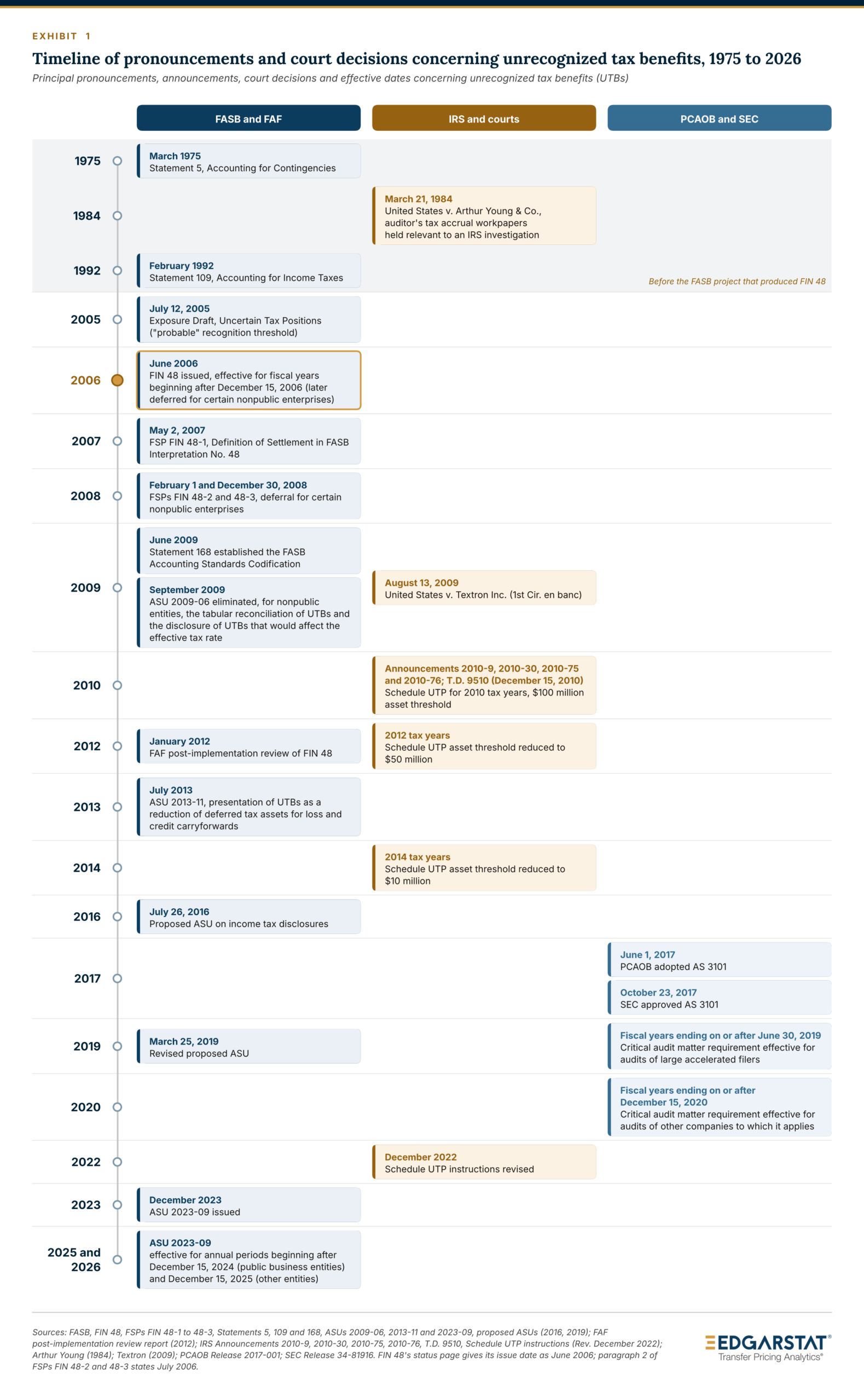
Before the FASB issued Interpretation No. 48, Accounting for Uncertainty in Income Taxes (FIN 48), in 2006, Statement No. 109, Accounting for Income Taxes (Statement 109), did not establish a recognition threshold or measurement attribute for a tax position taken in a tax return, and the FASB characterized the resulting practice as diverse.² Effective for public enterprises in fiscal years beginning after December 15, 2006, FIN 48 requires an enterprise to recognize the benefit of a tax position when, based on the technical merits, the position is more likely than not to be sustained upon examination. The benefit is measured at the largest amount with a greater than 50% likelihood of realization upon settlement. A position that does not meet this threshold is recognized in the first interim period in which the threshold is met, the position is effectively settled, or the statute of limitations expires; the difference between the benefit taken or expected to be taken in a tax return and the recognized benefit is a UTB.³ The pertinent provisions of FIN 48 are incorporated, as amended, within Subtopic 740-10 of the FASB Accounting Standards Codification (ASC). Beginning with the 2010 tax year, the Internal Revenue Service (IRS) has required certain corporations to list on Schedule UTP, Uncertain Tax Position Statement, the federal income tax positions for which they or a related party record a reserve in audited financial statements, which the current instructions describe as a liability for UTBs, or for which they recognize the benefit because they expect to litigate (Exhibit 1).⁴
1. Tax Reserves before FIN 48
The basis for conclusions of FIN 48 documents the practices enterprises employed under Statement 109. Enterprises sometimes recognized positions on an as-filed or to-be-filed basis, in some cases with a valuation allowance. Some recognized positions they considered uncertain but not aggressive on a best-estimate basis or when the benefit satisfied the definition of an asset, and some treated positions they considered aggressive as gain contingencies under FASB Statement No. 5, Accounting for Contingencies (Statement 5).⁵ In its January 2012 post-implementation review, the Financial Accounting Foundation (FAF), which oversees the FASB, noted that the Securities and Exchange Commission (SEC) and other stakeholders had expressed concerns about earnings management, particularly what were referred to as “cookie jar reserves,” in the years before the FASB added the project that produced FIN 48 to its agenda.⁶
2. FIN 48, 2005 to 2006
In July 2005, the FASB issued the Exposure Draft, Uncertain Tax Positions, which proposed recognizing a tax position when it was probable (as defined by Statement 5) to be sustained, and derecognizing it when it was more likely than not that it would not be sustained. Many respondents indicated that a probable threshold “would result in a systematic overstatement of tax liabilities.” After receiving 118 comment letters and holding a public roundtable, the Board concluded that the confidence level expressed by the term “probable” was “not consistently understood and applied by constituents.” In its redeliberations, the Board adopted a single more-likely-than-not threshold for both recognition and derecognition.⁷
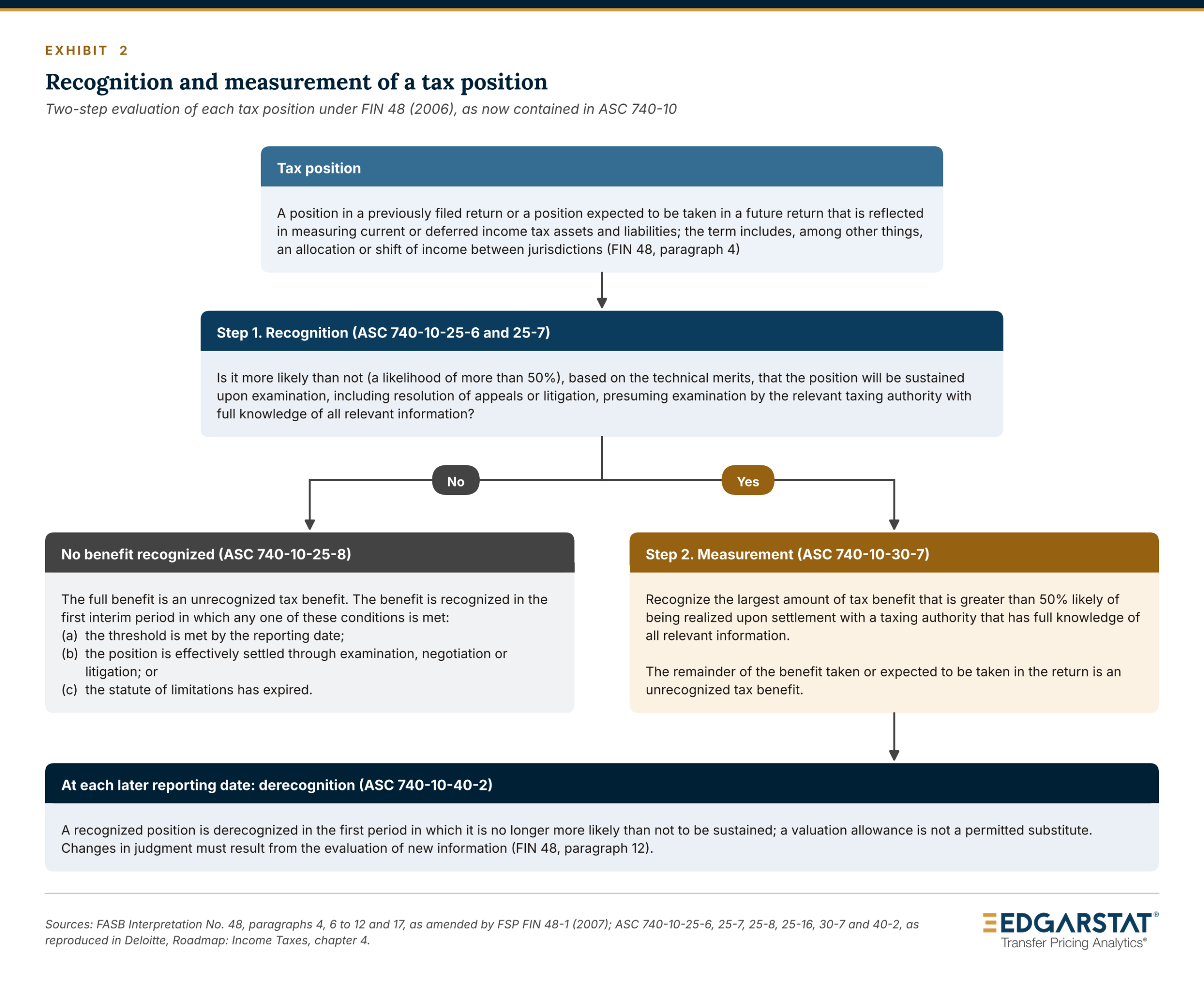
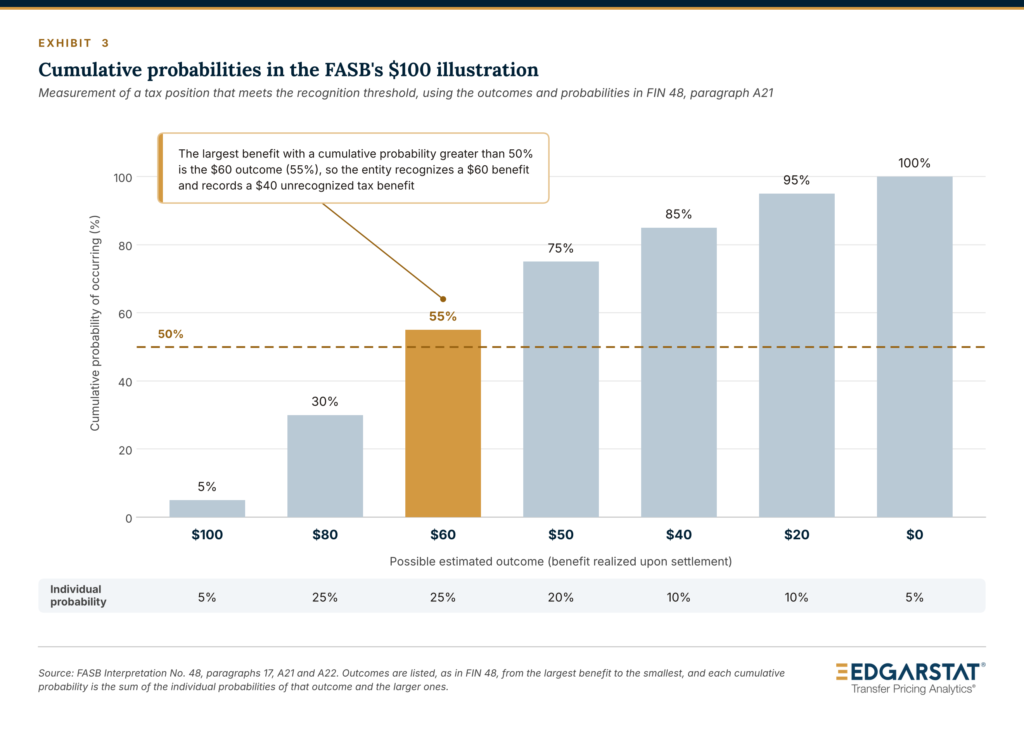
FIN 48 applies to all tax positions accounted for under Statement 109. It defines a tax position as a position taken in a previously filed tax return or expected to be taken in a future tax return that is reflected in the measurement of current or deferred income tax assets and liabilities for interim or annual periods; this definition encompasses, among other items, the decision not to file a return and the allocation or shift of income between jurisdictions. A position is recognized when it is “more likely than not” (a likelihood of more than 50%), based on the technical merits, that it will be sustained upon examination. Recognized positions are measured at the largest amount of benefit that is more than 50% likely to be realized upon settlement; both steps assume a taxing authority with full knowledge of all relevant information (Exhibit 2). In the FASB illustration, a tax position with a $100 benefit is measured at $60, the largest amount with a cumulative probability exceeding 50%, and the remaining $40 is a UTB (Exhibit 3).⁸
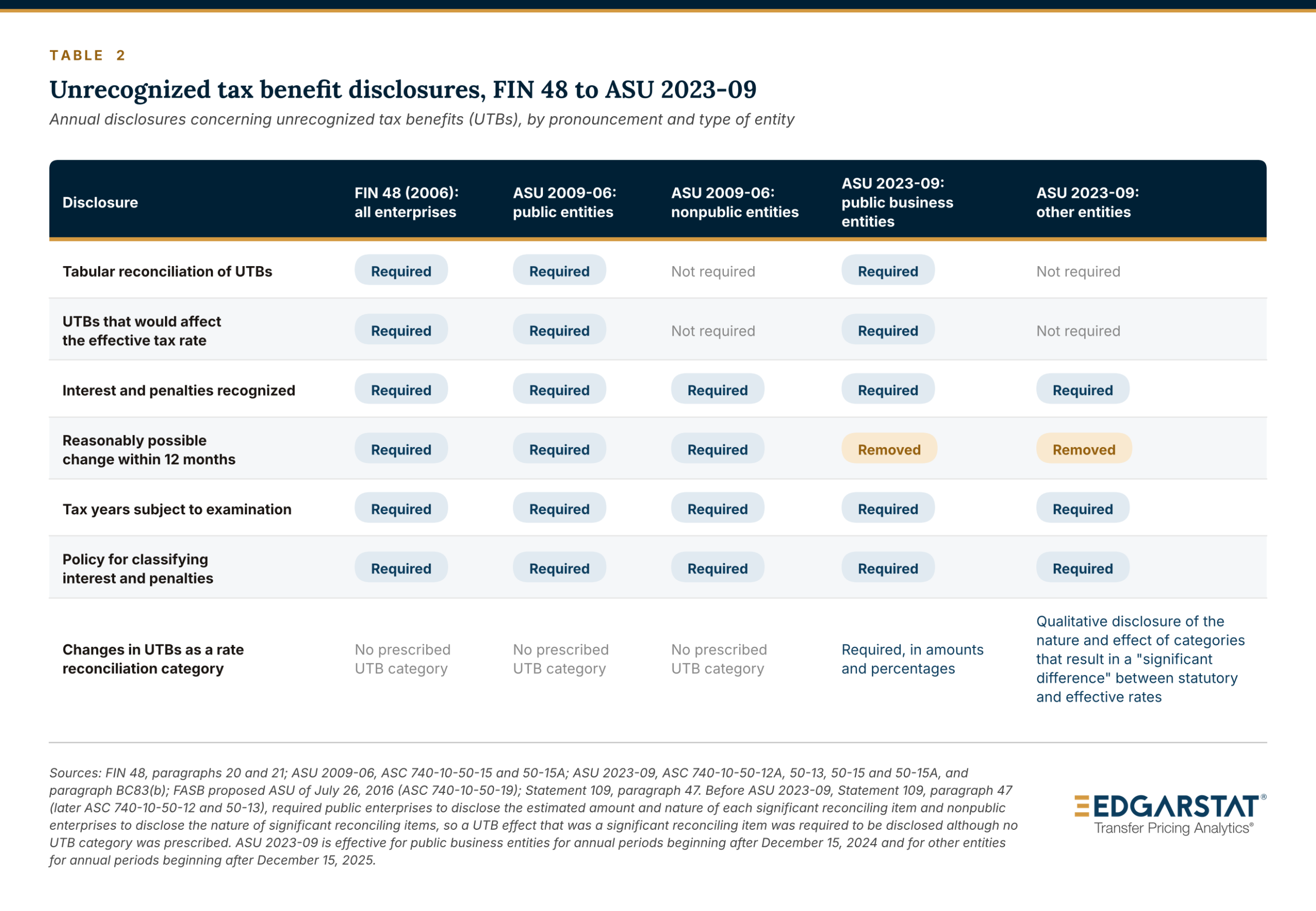
During deliberations on the Exposure Draft, the Board initially determined that disclosures beyond those required by Statement 5 were not necessary, reasoning that a probable threshold “would capture the effects of uncertainty.” After the threshold was lowered, Board members disagreed about whether a more-likely-than-not standard was “sufficiently high to capture the effects of uncertainty,” and the Board added a tabular reconciliation of the UTB balance, characterizing it as information about “a significant and sensitive estimate.”⁹ FIN 48 required five disclosures at the end of each annual reporting period presented, in addition to a disclosure of the enterprise’s policy for classifying interest and penalties; Tables 1 and 2 list all six requirements. One of these, the twelve-month estimate, applies to positions for which it is “reasonably possible that the total amounts of unrecognized tax benefits will significantly increase or decrease within 12 months of the reporting date.”¹⁰
3. Implementation and Codification, 2007 to 2013
In 2007, FASB Staff Position (FSP) FIN 48-1 replaced the term “ultimately settled” with “effectively settled” in the subsequent recognition provision and established three conditions for an enterprise to evaluate when determining effective settlement. These conditions are that (1) the taxing authority has completed its examination procedures, including all appeals and administrative reviews it is required and expected to perform; (2) the enterprise does not intend to appeal or litigate any aspect of the position included in the completed examination; and (3) the likelihood that the authority will examine or reexamine any aspect of the position is remote.¹¹
In 2009, FASB Statement No. 168 established the Codification as the source of authoritative U.S. generally accepted accounting principles recognized by the FASB for application by nongovernmental entities.¹² Issued in September 2009, ASU 2009-06 eliminated, for nonpublic entities, the tabular reconciliation and the disclosure of the total amount of UTBs that, if recognized, would affect the effective tax rate, after users of private company financial statements indicated that those disclosures “do not provide decision-useful information.” The update also added a paragraph that requires both disclosures of public entities only.¹³
The FAF’s 2012 report, its first post-implementation review, found that uncertain positions were “recognized and measured more consistently” under FIN 48, although consistent application “may not increase the comparability” of information across entities, primarily because of management judgment and the complexity of tax codes.¹⁴ ASU 2013-11 requires that a UTB, or a portion of a UTB, be presented as a reduction of a deferred tax asset for a net operating loss carryforward, a similar tax loss or a tax credit carryforward. The UTB is instead presented as a liability, and is not combined with deferred tax assets, to the extent the carryforward is not available at the reporting date under the tax law of the applicable jurisdiction to settle the additional income taxes that would result from disallowance of the position, or the tax law does not require its use for that purpose and the entity does not intend to use it.¹⁵
4. IRS Access to Tax Accrual Workpapers and Schedule UTP
In 1984, the Supreme Court ruled in United States v. Arthur Young & Co. that an independent auditor’s tax accrual workpapers (the documents and memoranda relating to the auditor’s evaluation of a corporation’s reserves for contingent tax liabilities) are relevant to IRS investigations, and declined to create an accountant work-product immunity that would protect them from an IRS summons.¹⁶ In 2009, the Court of Appeals for the First Circuit, sitting en banc, held in United States v. Textron Inc. by three votes to two that the work product doctrine did not protect Textron’s tax accrual workpapers, which were prepared to support its financial statements, because they were not prepared for use in possible litigation.¹⁷
After proposing the schedule and releasing a draft earlier in 2010, the IRS issued the final Schedule UTP and its instructions in September 2010. Schedule UTP applies to corporations filing Form 1120, 1120-F, 1120-L or 1120-PC that issue or are included in audited financial statements, have at least one position to report, and have total assets that equal or exceed a threshold. The threshold was $100 million starting with 2010 tax years and was reduced in two stages to $10 million starting with 2014 tax years. The final schedule replaced the proposed reporting of a maximum tax adjustment with a ranking of positions by the federal income tax reserve, including interest and penalties, recorded for each position other than those reported because of an expectation to litigate.¹⁸ Treasury regulations issued in December 2010 require corporations to attach Schedule UTP to their returns in accordance with IRS forms, instructions or other appropriate guidance, for returns filed for tax years beginning on or after January 1, 2010.¹⁹
When it released the final schedule, the IRS expanded its policy of restraint in seeking documents from taxpayers and third parties. Under this policy, the IRS will not assert during an examination that privilege was waived because a privileged document was provided to the independent auditor as part of a financial statement audit, unless the taxpayer has otherwise waived the privilege or the IRS requests the tax accrual workpapers because unusual circumstances exist or the taxpayer claimed the benefits of a listed transaction.²⁰ Since the 2010 instructions, Schedule UTP has required positions to be ranked by size, except that positions reported because of an expectation to litigate are not sized and may be assigned any rank, and has required transfer pricing positions to be coded “T” and all other positions “G”; the current instructions (Rev. December 2022) retain both requirements.²¹
5. Current Requirements in ASC 740-10
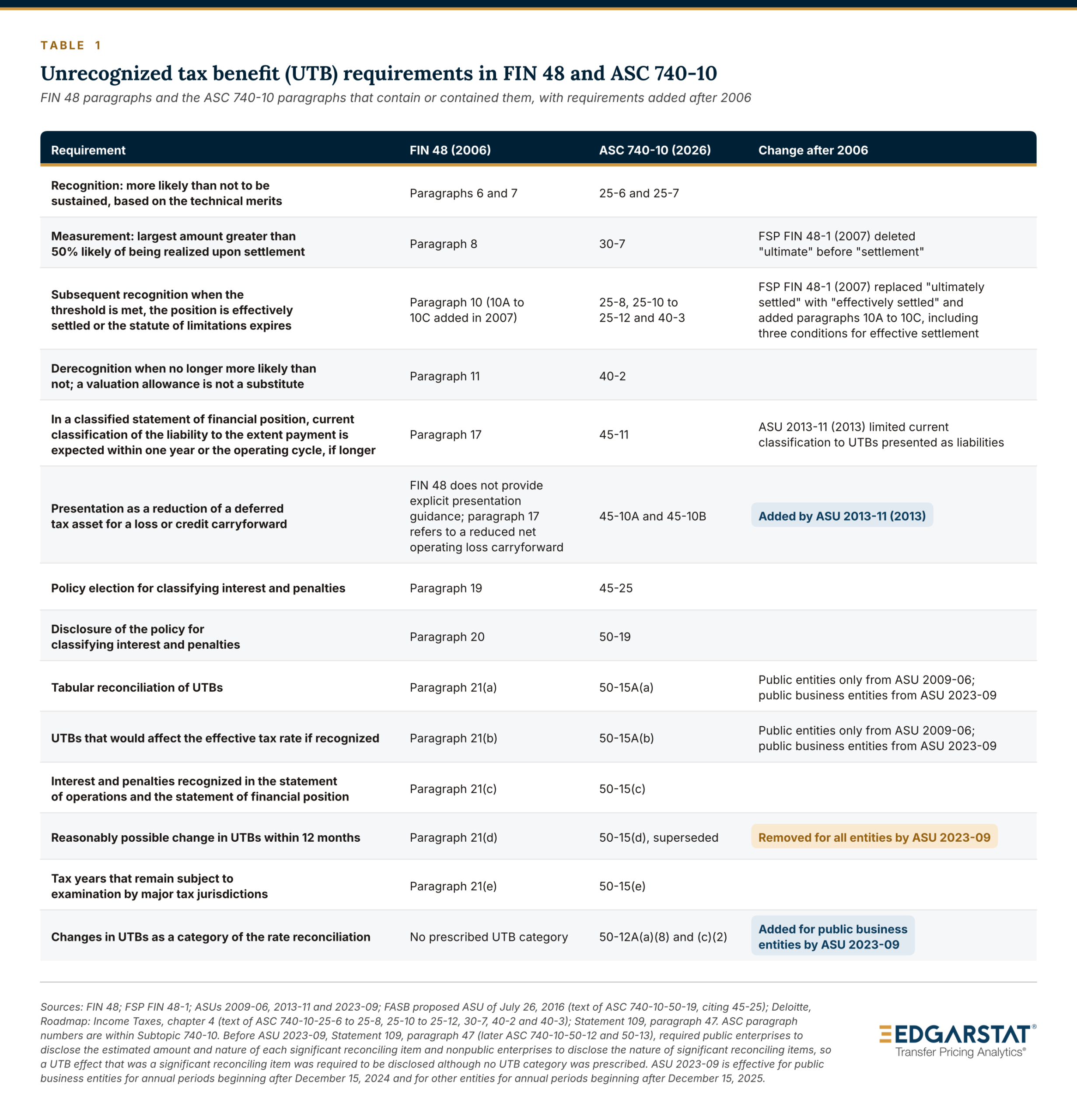
Table 1 identifies the ASC 740-10 paragraphs that contain, or until ASU 2023-09 contained, each listed FIN 48 requirement. It shows that ASC 740-10, as amended by ASU 2023-09, contains all of those requirements except the twelve-month estimate, several of them as amended after 2006, and that ASUs 2013-11 and 2023-09 each added one of the listed requirements that FIN 48 did not contain. Table 2 compares the annual disclosure requirements of FIN 48 with those of ASU 2009-06 and ASU 2023-09, and shows that since ASU 2009-06 (September 2009) the tabular reconciliation and the amount of UTBs that, if recognized, would affect the effective tax rate have been required only of public entities, a term that ASU 2023-09 replaced with PBEs. Both tables describe the ASU 2023-09 requirements as they apply once an entity has adopted that update.²²
6. Disclosure Proposals and ASU 2023-09, 2016 to 2026
The proposed ASUs issued in 2016 and 2019 would have required PBEs to disclose the line items in the statement of financial position in which UTBs are presented, with the related amounts, and the amount of UTBs that offsets deferred tax assets for carryforwards.²³ ASU 2023-09 records “a lack of general support” for the amendments in the two proposals and does not require either disclosure.²⁴
ASU 2023-09 is effective for PBEs for annual periods beginning after December 15, 2024, and for all other entities for annual periods beginning after December 15, 2025. In eliminating the twelve-month estimate, the Board noted that the disclosure “generally provides only estimated changes expected in the next 3 months” and acknowledged that stakeholders should continue to consider whether disclosures should be provided under Topic 275, Risks and Uncertainties.²⁵ ASU 2023-09 also added “changes in unrecognized tax benefits” as one of eight categories in a PBE’s rate reconciliation, which reconciles reported income tax expense from continuing operations with the amount calculated by applying the statutory federal (national) income tax rate of the jurisdiction of domicile to income from continuing operations before income taxes. Changes in judgment about positions taken in prior annual periods are reported in this category, which may be disclosed on an aggregated basis across all jurisdictions, and a UTB recorded in the current annual period for a position taken or expected to be taken in that period may be presented net with the related tax position in the category where that position is reported.²⁶
7. Critical Audit Matters
In 2017, the Public Company Accounting Oversight Board (PCAOB) adopted, and the SEC approved, auditing standard AS 3101, which requires the auditor’s report to communicate critical audit matters (CAMs) or to state that the auditor “determined that there are no critical audit matters.” A CAM is any matter arising from the audit of the financial statements that was communicated, or required to be communicated, to the audit committee and that relates to accounts or disclosures that are material to the financial statements and “involved especially challenging, subjective, or complex auditor judgment.” The requirement became effective for audits of large accelerated filers for fiscal years ending on or after June 30, 2019, and for audits of other companies to which it applies for fiscal years ending on or after December 15, 2020.²⁷ Auditors for 11 of the 20 registrants examined in later entries of this series reported at least one CAM concerning UTBs or uncertain tax positions in their reports for fiscal years 2019 to 2025. Of the 134 CAMs in the 70 reports for the ten pharmaceutical registrants, 25 concerned UTBs; of the 94 CAMs in the 70 reports for the ten technology registrants, 41 concerned uncertain tax positions.²⁸ These entries analyze UTB disclosures across registrants in different industries.
Takeaways
- The FAF’s 2012 review of FIN 48 found that uncertain tax positions were recognized and measured more consistently under the two-step requirement, now contained in ASC 740-10, although consistent application may not increase the comparability of information across entities, primarily because of management judgment and the complexity of tax codes.
- ASU 2009-06 limited the tabular reconciliation and the total amount of UTBs that, if recognized, would affect the effective tax rate to public entities. ASU 2023-09, effective for PBEs for annual periods beginning after December 15, 2024, and for other entities for annual periods beginning after December 15, 2025, eliminated the twelve-month estimate and added “changes in unrecognized tax benefits” as one of eight categories in the PBE rate reconciliation. This category reflects changes in judgment about positions taken in prior annual periods and may be disclosed on an aggregated basis across all jurisdictions.
- Beginning with the 2010 tax year, the IRS has required corporations that meet the Schedule UTP filing requirements to list the federal income tax positions for which they or a related party record a reserve in audited financial statements (in the current instructions, a liability for UTBs), or for which they recognize the benefit because they expect to litigate, and the instructions have required transfer pricing positions to be coded “T” since 2010. For fiscal years 2019 to 2025, auditors for 11 of the 20 registrants analyzed in later entries of this series reported at least one CAM concerning UTBs or uncertain tax positions.
Endnotes
- ASC 740-10-50-15A, as amended by ASU 2023-09; ASU 2023-09, paragraphs BC12 and BC26, and ASC 740-10-50-12A(c)(2)(iii); FIN 48, paragraph 4. The investors’ statement in paragraph BC12 concerns the “changes in unrecognized tax benefits” category of the rate reconciliation, which ASC 740-10-50-12A(c)(2)(iii) permits to be disclosed on an aggregated basis for all jurisdictions, and does not concern the tabular reconciliation.
- FASB, Interpretation No. 48, Accounting for Uncertainty in Income Taxes (FIN 48), as amended by FSPs FIN 48-1 to FIN 48-3, Summary and paragraphs 1 and 2. The FASB’s status page for FIN 48 gives its issue date as June 2006, and paragraph 2 of FSPs FIN 48-2 and FIN 48-3 states July 2006.
- FIN 48, paragraphs 6, 7, 8, 10, 17 and 22. Paragraph 22, as amended by FSP FIN 48-2, applies the same effective date to nonpublic consolidated entities of public enterprises that apply U.S. generally accepted accounting principles. For other nonpublic enterprises, except those that had already issued a full set of annual financial statements applying FIN 48, FSP FIN 48-2 (February 1, 2008) deferred the effective date to annual financial statements for fiscal years beginning after December 15, 2007, and FSP FIN 48-3 (December 30, 2008) deferred it to annual financial statements for fiscal years beginning after December 15, 2008, requiring an enterprise that elected the deferral to disclose that fact and its accounting policy for evaluating uncertain tax positions.
- IRS Announcement 2010-75, 2010-41 I.R.B. 428; IRS Announcement 2010-76, 2010-41 I.R.B. 432, Background and footnote 1; IRS, Instructions for Schedule UTP (Form 1120) (Rev. December 2022), Reporting Uncertain Tax Positions on Schedule UTP (Tax positions to be reported) and Who Must File. Under the heading Record a liability for unrecognized tax benefits, the instructions list some of the types of entries that, entered alone or together, indicate the recording of such a liability: an increase in a current or non-current liability for income taxes, interest or penalties payable, or a reduction of a current or non-current receivable for income taxes, interest or both, with respect to the tax position; or a reduction in a deferred tax asset or an increase in a deferred tax liability with respect to the tax position.
- FIN 48, paragraphs B4 to B6, which refer to paragraph 17 of Statement 5 for the treatment of gain contingencies; FASB, Statement No. 109, Accounting for Income Taxes (February 1992), status page. FIN 48’s basis for conclusions also records that positions were sometimes recognized when they met a predetermined threshold and reduced by a contingent liability when the threshold was no longer met or a payment became probable.
- Financial Accounting Foundation, Post-Implementation Review Report on FASB Interpretation No. 48 (January 2012), Summary and Background.
- FIN 48, paragraphs B3 and B30 to B33. The Exposure Draft was issued on July 12, 2005, the public roundtable was held on October 10, 2005, and the Board redeliberated the proposal from December 2005 to May 2006.
- FIN 48, paragraphs 3, 4, 6, 7, 8, A21 and A22; FSP FIN 48-1, paragraphs 2, 8 and A1(a). FSP FIN 48-1 replaced “ultimate settlement” with “settlement” in paragraph 8 in 2007.
- FIN 48, paragraphs B60 to B64. The Board rejected the objection that the tabular reconciliation would provide “a ‘roadmap’ for taxing authorities,” stating that it “does not equate a taxing authority with a counterparty in a lawsuit” and that aggregate disclosure “does not reveal information about individual tax positions.”
- FIN 48, paragraphs 20 and 21. Paragraph 21(d) contains the twelve-month estimate and requires the nature of the uncertainty, the nature of the event that could occur in the next 12 months that would cause the change, and an estimate of the range of the reasonably possible change or a statement that an estimate of the range cannot be made.
- FASB Staff Position FIN 48-1, Definition of Settlement in FASB Interpretation No. 48 (May 2, 2007), paragraphs 2, 4, 8 and A1(b). The replacement applies to paragraph 10(b) of FIN 48. In assessing whether reexamination is remote, management must consider the taxing authority’s policy on reopening closed examinations and the specific facts and circumstances of the position, and must presume that the taxing authority has full knowledge of all relevant information.
- FASB, Statement No. 168, The FASB Accounting Standards Codification and the Hierarchy of Generally Accepted Accounting Principles (June 2009), Summary and effective date paragraph. Statement 168 is effective for interim and annual periods ending after September 15, 2009, with an exception for certain nonpublic nongovernmental entities that concerns revenue recognition guidance.
- ASU 2009-06, Implementation Guidance on Accounting for Uncertainty in Income Taxes and Disclosure Amendments for Nonpublic Entities (September 2009), Summary and paragraphs 4 and 5. ASU 2009-06 added ASC 740-10-50-15A.
- Financial Accounting Foundation, Post-Implementation Review Report on FASB Interpretation No. 48 (January 2012), Summary.
- ASU 2013-11, Presentation of an Unrecognized Tax Benefit When a Net Operating Loss Carryforward, a Similar Tax Loss, or a Tax Credit Carryforward Exists (July 2013), Summary and ASC 740-10-45-10A, 45-10B, 45-12 and 65-3. ASC 740-10-45-10A applies except as indicated in 45-10B and 45-12, and 45-12 provides that a UTB presented as a liability is not classified as a deferred tax liability unless it arises from a taxable temporary difference. The assessment under 45-10B is based on the UTB and deferred tax asset that exist at the reporting date and presumes disallowance of the position at the reporting date. The amendments are effective for public entities for fiscal years, and interim periods within those years, beginning after December 15, 2013, and for nonpublic entities, beginning after December 15, 2014; early adoption is permitted, and the amendments are applied prospectively to all UTBs that exist at the effective date, with retrospective application permitted.
- United States v. Arthur Young & Co., 465 U.S. 805 (1984), decided March 21, 1984. The Court held the workpapers relevant within the meaning of § 7602 of the Internal Revenue Code.
- United States v. Textron Inc., 577 F.3d 21 (1st Cir. 2009) (en banc), No. 07-2631, decided August 13, 2009.
- IRS Announcement 2010-9, 2010-7 I.R.B. 408 (proposal); Announcement 2010-30, 2010-19 I.R.B. 668 (draft schedule); Announcement 2010-75, 2010-41 I.R.B. 428 (final schedule and instructions); T.D. 9510, preamble (release of Schedule UTP on September 24, 2010). Under Announcement 2010-75, the threshold was reduced to $50 million starting with 2012 tax years and to $10 million starting with 2014 tax years.
- Treasury Decision 9510, 75 Fed. Reg. 78160 (December 15, 2010), effective December 15, 2010, adding Treas. Reg. § 1.6012-2(a)(4) and (5).
- IRS Announcement 2010-76, 2010-41 I.R.B. 432, Summary and Policy of Restraint, paragraphs (1), (2) and (5). The announcement states that the IRS “will forgo seeking particular documents that relate to uncertain tax positions and the workpapers that document the completion of Schedule UTP,” and the waiver statement applies during an examination. The privileges are the attorney-client privilege, the tax advice privilege in § 7525 of the Code and the work product doctrine, and the exception applies to a request for tax accrual workpapers made under IRM 4.10.20.3. Paragraph (5) states that the announcement does not create or imply the application of any of those privileges to any document of any taxpayer or third party. Announcement 2010-75 states that Announcement 2010-76 was released contemporaneously with it.
- IRS, Instructions for Schedule UTP (2010), Part I, column (f); IRS, Instructions for Schedule UTP (Form 1120) (Rev. December 2022), retrieved from irs.gov on October 30, 2026, Who Must File, Ranking Tax Positions by Size, and instructions for Part I, columns (g) and (h). The instructions designate as a major tax position any position whose size is 10% or more of the sum of the sizes of all positions listed in Parts I and II (current-year positions and prior-year positions not reported on an earlier Schedule UTP), disregarding expectation-to-litigate positions.
- ASU 2023-09 replaced the term public entity with the term public business entity; ASU 2023-09, paragraph BC83(a), and ASC 740-10-50-15A as amended by ASU 2023-09. An EdgarStat search of the text of the 19 ASUs numbered 2024-01 through 2026-03 did not find any reference to unrecognized tax benefits. Those ASUs are the Updates listed by the FASB as issued after ASU 2023-09 when the listing was read on October 30, 2026.
- FASB, proposed ASU, Income Taxes (Topic 740): Disclosure Framework, Changes to the Disclosure Requirements for Income Taxes (July 26, 2016) and revised proposal (March 25, 2019), Summary.
- ASU 2023-09, Improvements to Income Tax Disclosures (December 2023), paragraphs BC3 and BC83; ASC 740-10-50-15 and 50-15A as amended by ASU 2023-09, which do not contain either proposed disclosure.
- ASU 2023-09, Summary, paragraphs BC88 and BC91, and ASC 740-10-65-9. Early adoption is permitted for annual financial statements that have not yet been issued or made available for issuance, and the amendments are applied prospectively, with retrospective application permitted (ASC 740-10-65-9(c) and (d)). ASC 740-10-50-15(d) contained the twelve-month estimate.
- ASU 2023-09, ASC 740-10-50-12, 50-12A(a) and (c)(2); paragraph BC26.
- AS 3101, The Auditor’s Report on an Audit of Financial Statements When the Auditor Expresses an Unqualified Opinion; PCAOB Release No. 2017-001 (June 1, 2017), including AS 3101.05(b) and its note, .11 and .13, and section IX, Effective Date; SEC Release No. 34-81916 (October 23, 2017). The critical audit matter requirement does not apply to audits of emerging growth companies, brokers and dealers reporting under Exchange Act Rule 17a-5, investment companies registered under the Investment Company Act of 1940 other than business development companies, and employee stock purchase, savings and similar plans.
- EdgarStat’s studies of the UTB disclosures of ten pharmaceutical registrants and ten technology registrants, which are later entries in this series. In the pharmaceutical study, the auditors of Pfizer, Bristol-Myers Squibb and Amgen each reported seven CAMs concerning UTBs, and the auditors of Regeneron and AbbVie reported three CAMs and one CAM, respectively. In the technology study, the auditors of Microsoft, Apple, Meta, IBM and Amazon reported a CAM concerning uncertain tax positions in each of the seven years, and the auditors of Oracle reported one in each year from fiscal year 2020 to fiscal year 2025. Microsoft’s fiscal year 2019 ended on June 30, 2019, the first fiscal year-end to which the critical audit matter requirement applied for audits of large accelerated filers. The technology study labels fiscal years by the Compustat convention, under which Oracle’s fiscal year 2025 ended on May 31, 2026 and NVIDIA’s fiscal year 2025 ended on January 25, 2026.