
For charges between corporations under common ownership, transfer pricing and market-based sourcing govern different parts of a separate entity state’s calculation of apportioned income. The state multiplies each corporation’s income subject to apportionment by its apportionment factor.¹ Intercompany prices determine how much taxable income each affiliate reports and are frequently tested under § 482 or a comparable state standard. Market-based sourcing assigns receipts among jurisdictions to determine the sales factor, without testing whether those prices are at arm’s length. A state that adopts market-based sourcing without examining intercompany prices addresses only one potential source of distortion in its tax base.
The Two Rules
Section 482 authorizes the Secretary to allocate gross income, deductions, credits, or allowances among commonly controlled organizations if he determines that the allocation is necessary “to prevent evasion of taxes or clearly to reflect the income” of any of them. The regulations state that § 482 places a controlled taxpayer on a tax parity with an uncontrolled taxpayer “by determining the true taxable income of the controlled taxpayer.”² A state applying the arm’s length standard examines the intercompany charge and its effect on the taxable income reported by the payor and the recipient.
The Multistate Tax Commission’s model assigns receipts other than those from sales of tangible personal property to a state “if the taxpayer’s market for the sales is in this state.” Services are sourced to the extent they are delivered to a location in the state, and licensed intangibles to the extent they are used there.³ Under a single sales factor, receipts assigned to the state divided by total receipts determine the share of income apportioned to that state. These sourcing rules do not test whether an intercompany charge is at arm’s length.
A Hypothetical $50 Million Overcharge
OpCo earns $100 million before an $80 million charge from its affiliate, HoldCo, for services and licensed intangibles. Assume an arm’s length charge is $30 million and HoldCo does not have any deductions. Both corporations are taxable in a hypothetical State that uses separate entity reporting and a single sales factor, and in every other state to which their receipts are assigned.
On the returns as filed, receipts are sourced using cost of performance. OpCo reports $20 million of taxable income and assigns 2% of its receipts to the State. HoldCo reports $80 million and assigns none. Together, they apportion $0.4 million of income to the State.
Exhibit 1 shows the effect of applying the two adjustments in sequence. Reducing the intercompany charge to $30 million increases OpCo’s taxable income to $70 million and reduces HoldCo’s to $30 million. At the filed sales factors, apportioned income increases to $1.4 million. Applying market-based sourcing then increases OpCo’s factor to 3% and HoldCo’s to 0.5%, and apportioned income to $2.25 million, or $1.85 million more than filed.⁴
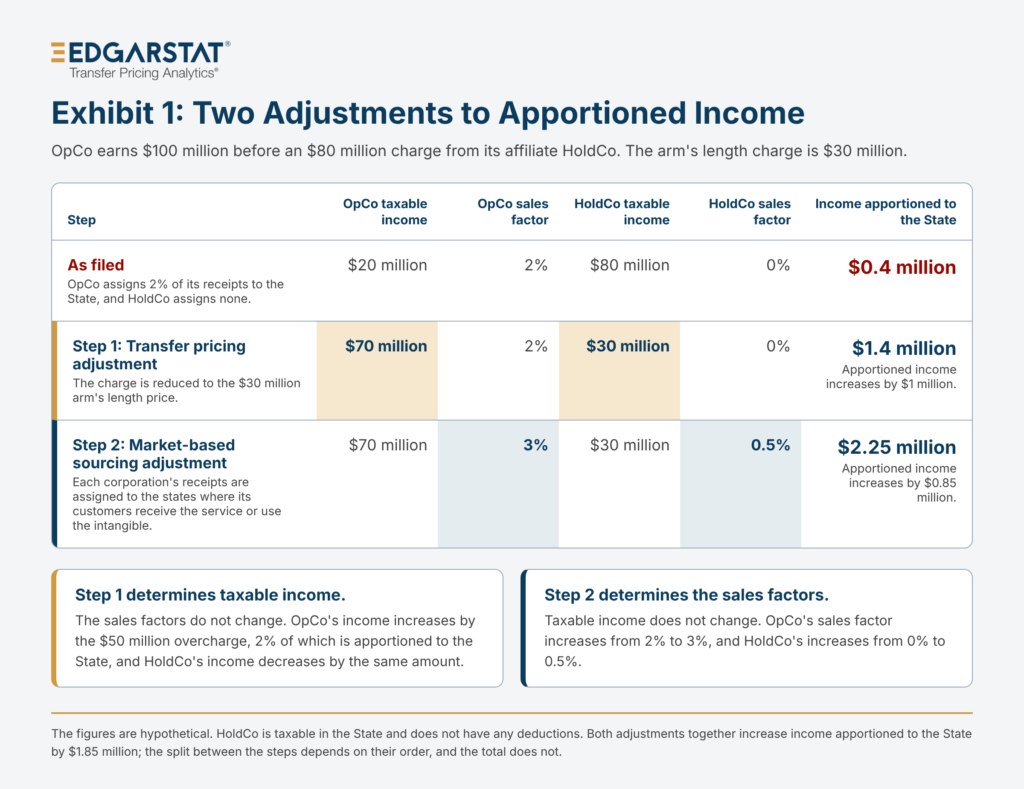
Applied alone, market-based sourcing increases apportioned income to $1 million. The $50 million overcharge remains in HoldCo’s income, where the 0.5% factor apportions $0.25 million of it to the State. In OpCo’s income, at a 3% factor, that same $50 million would produce $1.5 million of apportioned income.
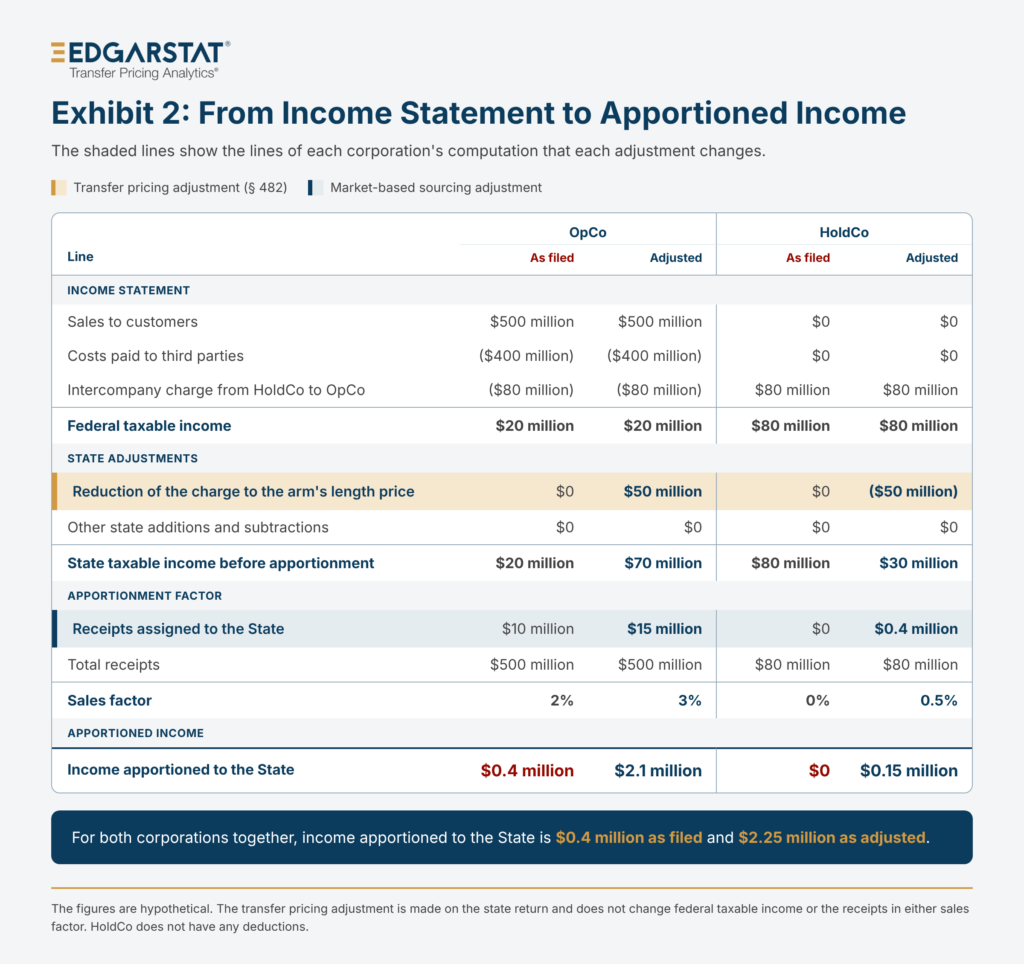
Exhibit 2 traces the adjustments from federal taxable income to apportioned income. A $50 million addition for OpCo and a corresponding subtraction for HoldCo change state taxable income without changing federal taxable income. The hypothetical assumes that these adjustments leave the receipts used in the sales factors unchanged, including HoldCo’s $80 million.⁵ Market-based sourcing increases receipts assigned to the State from $10 million to $15 million for OpCo and from zero to $0.4 million for HoldCo, without changing either corporation’s taxable income.
Takeaways
- In a separate entity state, transfer pricing determines how much taxable income each affiliate reports, and market-based sourcing determines where its receipts are assigned for apportionment.
- Market-based sourcing does not correct income distortions caused by intercompany prices that depart from arm’s length.
- In the hypothetical, the transfer pricing adjustment alone produces $1.4 million of apportioned income and market-based sourcing alone produces $1 million; applying both produces $2.25 million, an increase of $1.85 million over the returns as filed.
- Neither adjustment, administered in isolation, produces apportioned income that reflects the business each corporation carries on in the state.
Endnotes
- The terms for income before and after apportionment vary by state, and some states prescribe different apportionment formulas for particular industries.
- IRC § 482; Treas. Reg. § 1.482-1(a)(1). Section 482 applies to two or more organizations, trades, or businesses “owned or controlled directly or indirectly by the same interests.” For a transfer or license of intangible property, the statute requires that the income “shall be commensurate with the income attributable to the intangible.”
- Model Multistate Tax Compact, art. IV, § 17(a)(3) and (a)(4)(i), as amended by the Multistate Tax Commission on July 30, 2014. Section 17(a) covers receipts other than those from sales of tangible personal property, which § 16 governs. Each state’s own law governs its sourcing rules. Section 17(c) excludes from the denominator any receipt assigned to a state in which the taxpayer is not taxable, or whose state of assignment cannot be determined or reasonably approximated. The hypothetical assumes that all receipts are assigned to states in which the corporations are taxable, so this exclusion does not apply.
- The increase attributable to each adjustment depends on the order in which they are applied. Applied in reverse order, market-based sourcing increases apportioned income by $0.6 million and the transfer pricing adjustment by $1.25 million. The total increase is $1.85 million in either order.
- Whether a state transfer pricing adjustment also changes sales-factor receipts depends on state law; the hypothetical assumes that it does not. HoldCo’s 0.5% factor is also an assumption. Under market-based sourcing, that factor depends on the nature of HoldCo’s charge and on where OpCo receives the service or uses the intangible.