
Background
Under Accounting Standards Codification (ASC) Topic 842, an operating lessee deducts accretion on its lease liability, the year’s increase in the liability at the discount rate used to measure it, when calculating operating income, whereas a finance lessee reports the same amount as interest expense, excluded from operating profit under 26 CFR § 1.482-5(d)(3).¹ Two hypothetical lessees that pay the same $80,000 per year for the same building report year 1 operating margins (OIADP / SALE): 14.1% under a finance lease and 12% under an operating lease. Under the comparable profits method (§ 1.482-5), the operating margin is one of the profit level indicators that may be used to compare a tested party with comparable uncontrolled companies (comparables). Thus, how a comparable’s leases are classified can affect the margins being compared.²
The owner and the two lessees
The example is the store from Part 1 of this series, which earns $200,000 a year before building costs; this post assumes $1,000,000 in sales.³ The owner buys the building for $1,000,000 and depreciates it by $25,000 per year over an expected 40-year useful life. Two lessees each pay $80,000 at the end of each of 10 years and record a right-of-use asset and a lease liability of $588,807, the present value of the payments at 6%. One lessee accounts for the lease as a finance lease, and the other as an operating lease.⁴
Journal entries and T-accounts
Under the measurement rules for each lease type, each liability increases in year 1 by 6% of $588,807, or $35,328, and then decreases by the $80,000 payment. The two lessees record the same entries to the liability and charge the $35,328 to different accounts (Exhibit 2.1). The finance lessee debits interest expense and separately amortizes one-tenth of its asset, $58,881. The operating lessee debits operating lease cost and reduces its asset by $44,672, the remainder of its $80,000 lease cost.⁵
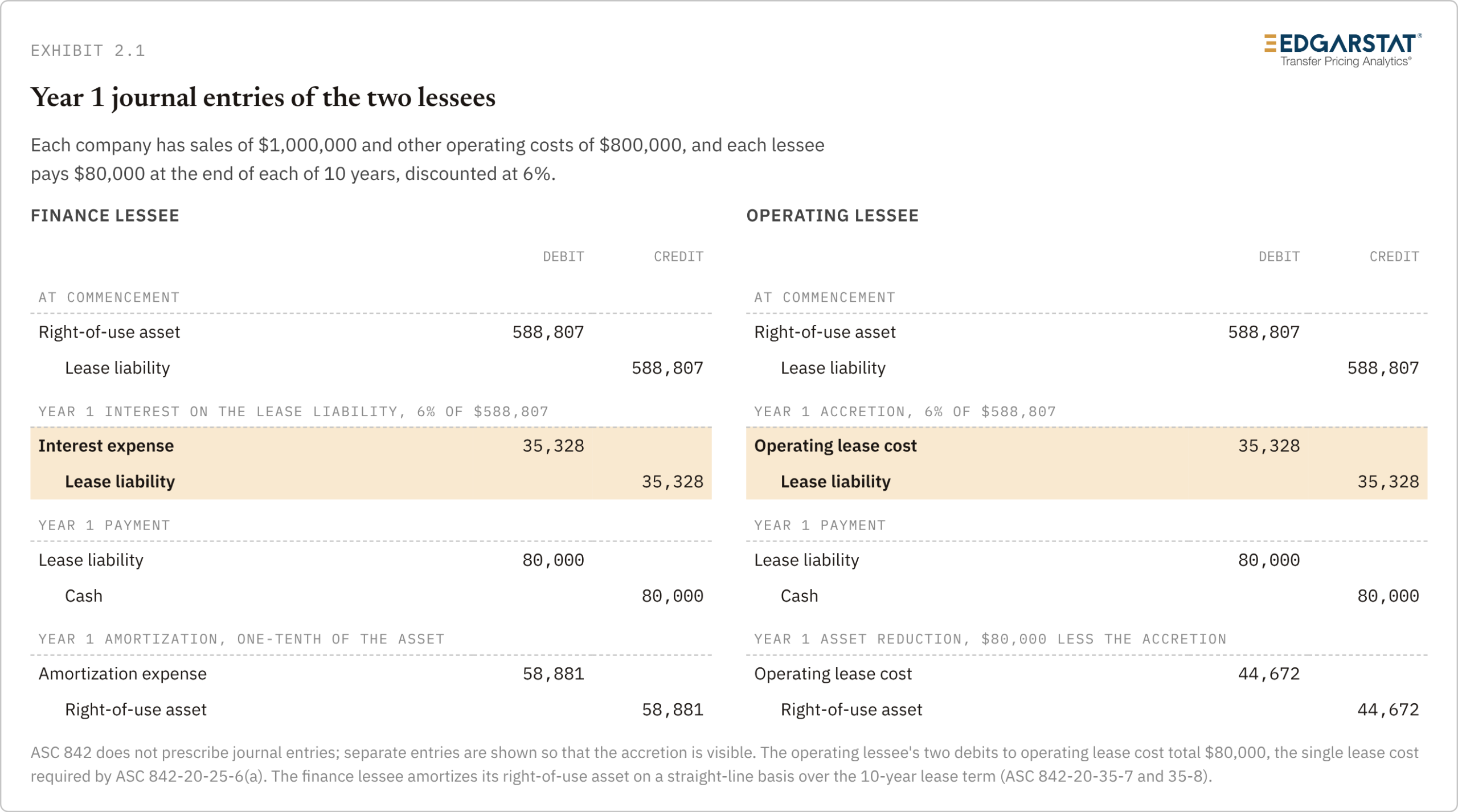
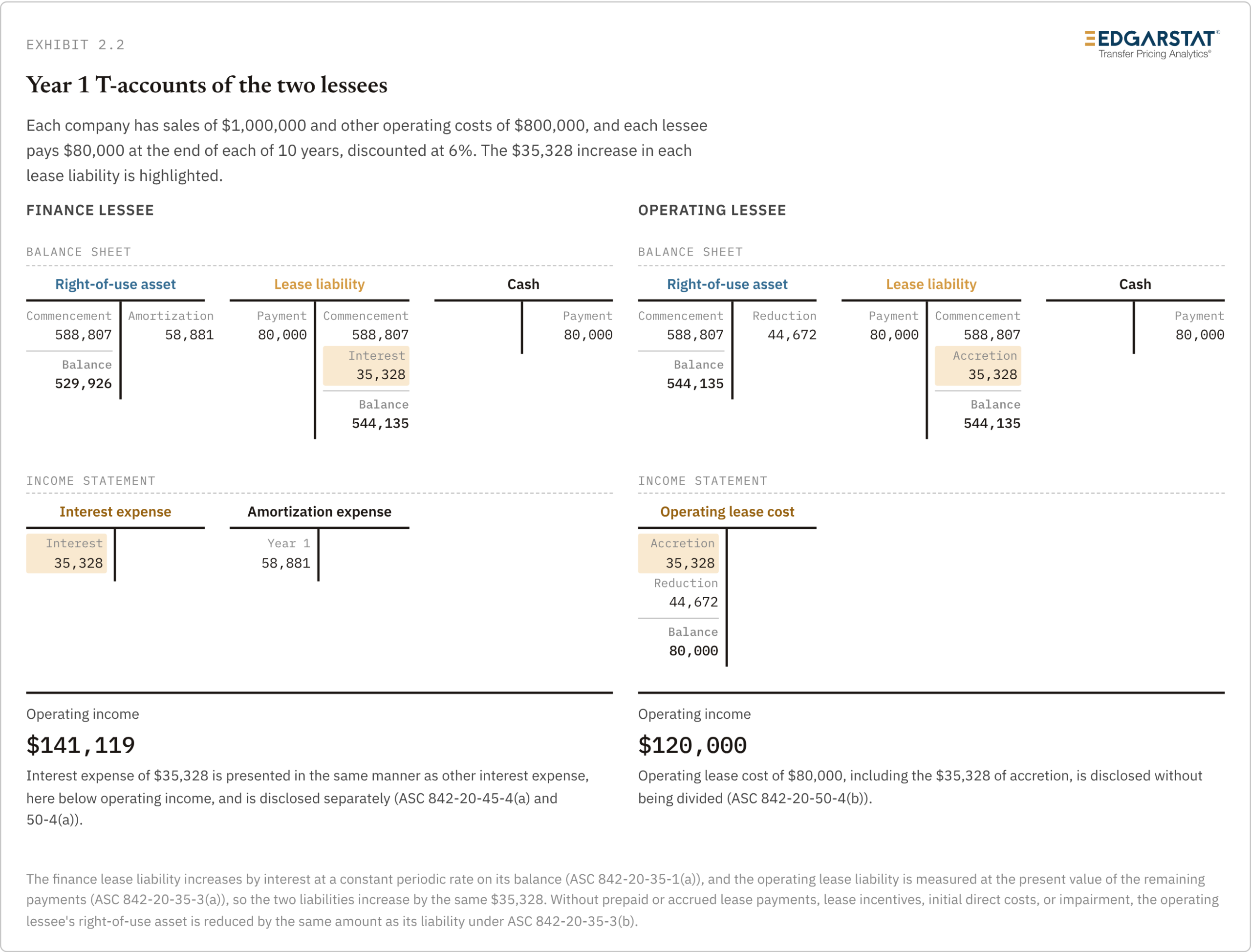
Exhibit 2.2 presents the T-accounts, which are ledger accounts with debits on the left and credits on the right, and shows identical lease liability accounts, each with a balance of $544,135 as of the end of year 1. The finance lessee discloses its $35,328 as interest on the lease liability, while the operating lessee’s $35,328 accretion is included in its $80,000 operating lease cost. ASC 842 does not require the operating lessee’s accretion to be disclosed separately.⁶
Operating margins in year 1
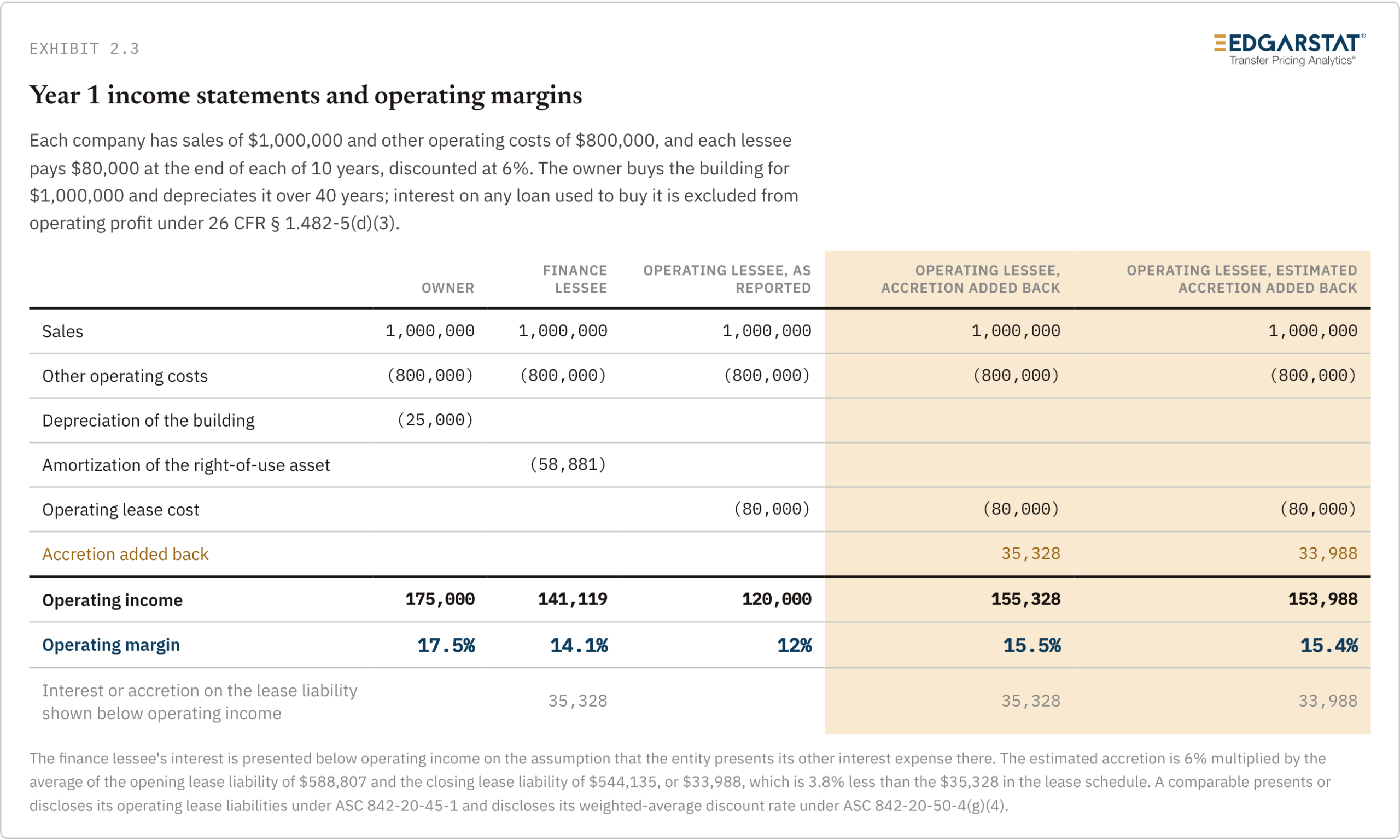
Exhibit 2.3 presents each company’s year 1 income statement on the assumption that the finance lessee reports its other interest expense, and therefore its lease interest, below operating income. The owner’s operating margin is 17.5%. Even though the two lessees make identical payments, the finance lessee’s operating margin of 14.1% is 2.1 percentage points higher than the operating lessee’s 12%. The $21,119 difference in their operating income consists of the $35,328 of accretion in the operating lessee’s lease cost, less the $14,209 by which the finance lessee’s amortization exceeds the operating lessee’s asset reduction.⁷ The last two columns of Exhibit 2.3 add the accretion back to the operating lessee’s operating income. The first uses the $35,328 from the lessee’s lease schedule, a payment-by-payment calculation of the liability known only to the filer; the second uses $33,988, this post’s estimate inferred from the lease liability and discount rate that ASC 842 requires the lessee to present or disclose.
Proposed comparability adjustment
The proposed comparability adjustment, which changes reported results to account for a material difference between the companies compared, adds each operating lessee’s accretion back to its operating income, excluding the accretion from operating profit in the same way as a finance lessee’s interest on its lease liability. Because ASC 842 does not require companies to disclose their operating lease accretion, the adjustment uses an estimate computed from amounts that ASC 842 requires companies to present or disclose: their operating lease liability as of the beginning and end of the year and the weighted-average discount rate, the average of the rates used to measure their operating lease liabilities.⁸ In the working example, 6% of the average of the opening liability of $588,807 and the closing liability of $544,135 is $33,988, which is 3.8% less than the $35,328 in the lease schedule.
Section 1.482-5(c)(2)(iv) provides that, in certain cases, it may also be appropriate to adjust the operating profit of the tested party and the comparables, as illustrated in its example, for material differences in accounts payable. That example increases each party’s operating profit to reflect an imputed interest charge on accounts payable. The proposed adjustment applies that example’s reasoning to the accretion included in operating lease cost. Section 1.482-5(c)(3)(ii), headed “Consistency in accounting”, provides that the degree of consistency in accounting practices between the controlled transaction and the comparables that materially affect operating profit affects the reliability of the result. Under § 1.482-1(d)(2), adjustments must be made for material differences whose effect on prices or profits can be ascertained with sufficient accuracy to improve the reliability of the results.⁹
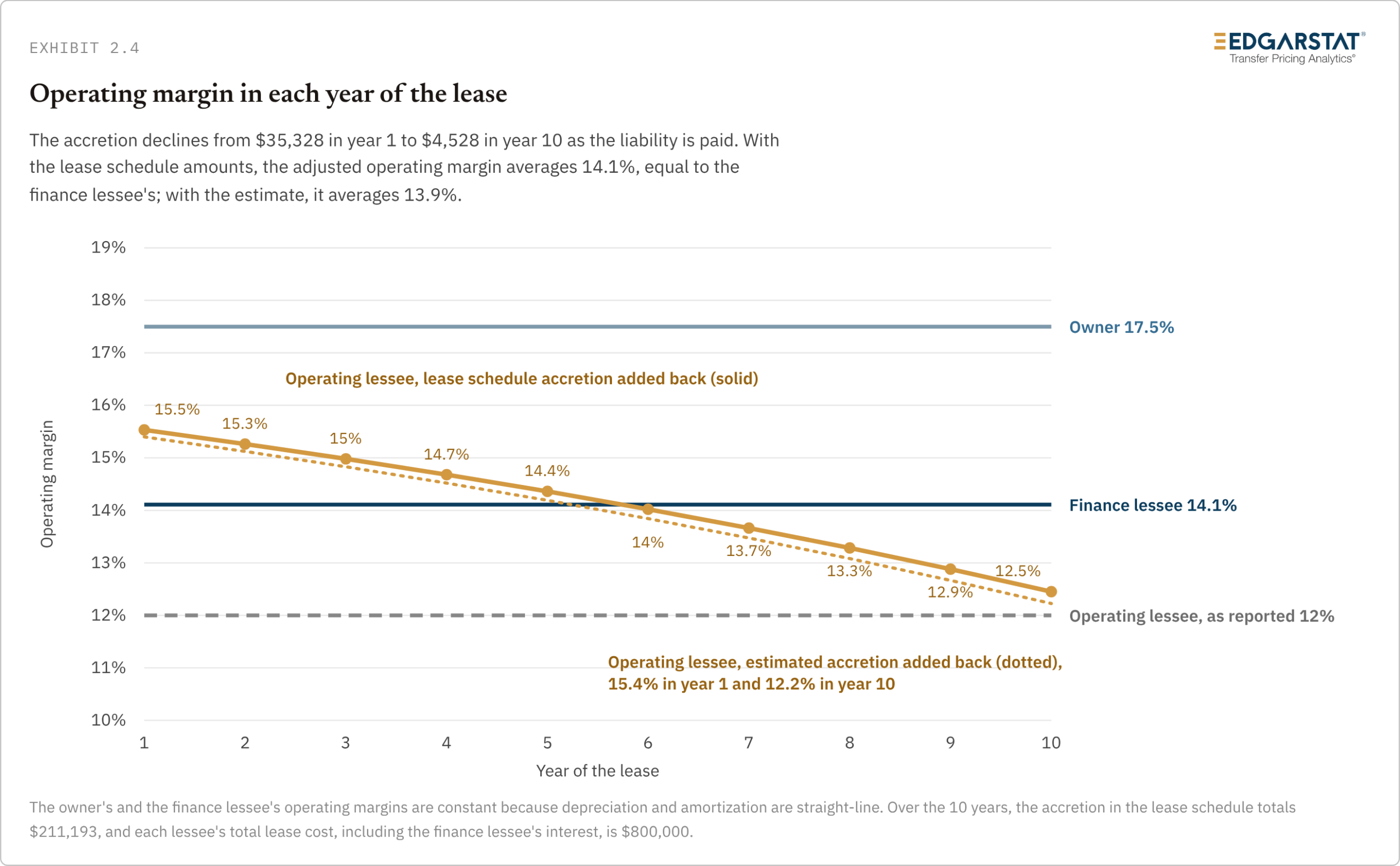
The accretion declines as the liability is paid, from $35,328 in year 1 to $4,528 in year 10. Using the accretion from the lease schedule, the adjusted operating margin declines from 15.5% to 12.5% and averages 14.1% over the lease term, equal to the finance lessee’s (Exhibit 2.4); using the estimate, it averages 13.9%.¹⁰
Takeaways
- Under ASC 842, an operating lessee’s operating income includes a deduction for the accretion on its lease liability, $35,328 in year 1 of the example, that a finance lessee reports as interest expense and § 1.482-5(d)(3) excludes from operating expenses.
- Lease classification alone can therefore produce a difference in operating margins between companies with identical lease payments, 2.1 percentage points in year 1 of the example, and an operating lessee is not required to disclose the accretion separately.
- An estimate computed from the disclosed operating lease liability and weighted-average discount rate was 3.8% below the lease schedule amount in year 1 of the example and 8.4% below it over the 10 years, so the proposed adjustment can be computed for comparables from amounts in their filings.
Future entries in this series will illustrate the adjustment using reported financial data.
Endnotes
- ASC 842-20-25-6(a) requires a single lease cost allocated over the remaining lease term on a straight-line basis, unless another systematic and rational basis is more representative of the pattern in which benefit is expected to be derived, and unless the costs are included in the carrying amount of another asset under other Topics. After an impairment of the right-of-use asset, ASC 842-20-25-7 calculates the cost as amortization of the asset plus “[a]ccretion of the lease liability”, the Codification’s term; for an unimpaired lease, the accretion is the result of measuring the liability under ASC 842-20-35-3(a) and the asset under 35-3(b). ASC 842-20-45-4(a) provides that finance lease interest and amortization are not required to be presented as separate line items and are presented in a manner consistent with how the entity presents other interest expense and depreciation or amortization of similar assets, so finance lease interest is excluded from operating income where the entity presents its other interest expense below operating income. ASC 842-20-45-4(b) requires operating lease expense to be included in income from continuing operations. ASC 842-20-50-4(a) requires finance lease cost to be disclosed segregated between amortization and interest, while paragraph 50-4(b) requires disclosure of operating lease cost without requiring it to be segregated; the lease cost disclosed under paragraph 50-4 includes amounts capitalized as part of the cost of another asset. In paragraph BC64 of Accounting Standards Update (ASU) 2016-02, the Financial Accounting Standards Board (FASB) decided, in response to concerns of many respondents that the prescribed mechanics were complex and unnecessary and of some stakeholders that they would be costly for preparers, not to refer to the single operating lease cost as the unwinding of the discount on the lease liability plus amortization of the right-of-use asset, and added that the characterization “was inconsistent with the view that the single lease cost represents the lessee’s singular consumption of the economic benefits embedded in an operating lease”. In paragraph BC61, some Board members stated that a single operating lease cost “more appropriately reflects the economics of operating leases”; in paragraph BC62, other Board members stated that the straight-line cost “is inconsistent with accounting for the time value of money and the amortization that should result for a right-of-use asset that the lessee consumes on a generally straight-line basis over the lease term”, and they supported issuance of the Update. This post refers to the accretion by its measurement; Part 1 described the same amount in the lease payment as interest. ASU 2024-03, effective for public business entities for annual reporting periods beginning after December 15, 2026, adds ASC 220-40, under which operating lease cost is included as a separate amount in the tabular disclosure of expenses only when it is included entirely in one relevant expense caption (ASC 220-40-50-22(p)); the ASU does not require operating lease cost to be divided.
- Section 1.482-5 of title 26 of the Code of Federal Regulations (26 CFR) is issued under Internal Revenue Code § 482. The paragraphs of 26 CFR § 1.482-5 cited are (b)(4), (d)(3), and (d)(4). Paragraph (b)(4) describes profit level indicators as “ratios that measure relationships between profits and costs incurred or resources employed”. This post uses operating income in the financial statements as the measure of operating profit. Paragraph (b)(4)(ii) states that closer functional comparability normally is required under a financial ratio than under the rate of return on capital employed, and lists (A) the ratio of operating profit to sales and (B) the ratio of gross profit to operating expenses; the sentence that reliability also depends on the similarity in the composition of operating expenses is printed as part of item (B). Paragraph (d)(3) excludes from operating expenses interest expense, foreign and domestic income taxes, and any other expenses not related to the operation of the relevant business activity, and states that operating expenses ordinarily include a reasonable allowance for depreciation and amortization. Paragraph (d)(4) defines operating profit as gross profit less operating expenses, includes in it all income derived from the business activity being evaluated, and excludes interest and dividends, income derived from activities not being tested, and extraordinary gains and losses that do not relate to the continuing operations of the tested party.
- Part 1 is Lease Accounting and Asset-Based Comparability Under § 482. It stated only that the store earns $200,000 a year before rent and depreciation, with land excluded from the building’s cost. The sales of $1,000,000 and other operating costs of $800,000 are assumptions of this post, chosen so that the operating margin can be computed. Interest on any loan the owner uses to buy the building is excluded from operating profit under paragraph (d)(3) and does not affect its operating margin.
- The finance lessee’s column shows only the effect of presentation and does not test whether a lease of this building on these terms meets the classification criteria for a finance lease in ASC 842-10-25-2; a lease that meets one or more of those criteria is a finance lease, and under ASC 842-10-25-3(a), a lessee classifies a lease that meets none of them as an operating lease. ASC 842-20-35-7 and 35-8 require a finance lease right-of-use asset to be amortized on a straight-line basis, unless another systematic basis is more representative of the pattern of consumption, from the commencement date to the earlier of the end of its useful life and the end of the lease term, or to the end of the useful life of the underlying asset if the lease transfers ownership or the lessee is reasonably certain to exercise a purchase option.
- ASC 842-20-35-1(a) increases a finance lease liability by interest that produces a constant periodic discount rate on the remaining balance and reduces it by the payments, taking into consideration the reassessment requirements in ASC 842-10-35-1 through 35-5. ASC 842-20-35-3(a) measures an operating lease liability at the present value of the lease payments not yet paid, discounted at the rate established at commencement unless the rate has been updated under ASC 842-20-35-5, so in this example the two liabilities increase by the same amount. Under ASC 842-20-35-3(b), unless the right-of-use asset has been impaired, the operating lessee’s asset is measured at the amount of the lease liability adjusted for prepaid or accrued lease payments, the remaining balance of lease incentives, unamortized initial direct costs, and impairment; without those items, the asset is reduced by the same $44,672 as the liability. ASC 842 does not prescribe journal entries, and a lessee that records one combined entry each year does not post the accretion to a separate account.
- In paragraph BC65 of the Basis for Conclusions of ASU 2016-02, in deciding “not to require separate disclosure of either the periodic unwinding of the discount on operating lease liabilities or amortization of operating lease right-of-use assets”, the Board “acknowledged that many users would not receive information that they deem important to their analysis (for example, separate interest information)”, and it required “alternative quantitative disclosures (for example, weighted-average discount rate information)” that allow those users to receive much, but not all, of the same information.
- Before ASC 842, an operating lessee charged its whole rent to operating expense. Aswath Damodaran, “Leases, Debt and Value”, Stern School of Business, New York University, April 2009, adds to operating income an imputed interest expense computed as the pre-tax cost of debt multiplied by the present value of leases. After the finance lessee’s interest is deducted, its income before tax is $105,791, compared with $120,000 for the operating lessee; over the 10-year term, the two lessees’ total costs are equal.
- The weighted-average discount rate for operating leases is disclosed under ASC 842-20-50-4(g)(4), and ASC 842-20-45-1 requires operating lease liabilities to be presented in the balance sheet or disclosed in the notes separately from other liabilities. Under ASC 842-20-55-12, the weighted-average rate is calculated from each lease’s discount rate and the remaining balance of its lease payments as of the reporting date. In paragraph BC281(a) of ASU 2016-02, the FASB stated that many users “treat all leases as finance leases in their analyses because they want to compare an entity that leases its assets with one that purchases those same assets”, and that disclosure of the beginning and ending operating lease liabilities and of the weighted-average discount rate as of the beginning and the end of the reporting period would improve their information. The example’s estimate is below the lease schedule amount because its single payment is made at the end of the year, so the year’s accretion is computed on the opening balance; the shortfall increases each year, to 50% in year 10. For a lessee with many leases, changes in its leases during the year and the timing of payments also affect the accretion. Under § 1.482-5(d)(5), a tested party’s reported operating profit is the operating profit reflected on a timely filed U.S. income tax return, its own or, if it does not file one, that of another member of its controlled group whose U.S. taxable income is affected by income attributable to the controlled transaction; where comparable operating profit is derived from comparables’ financial statements, adjustments may be made for material differences between the tested party’s operating profit for U.S. income tax purposes and for financial statement purposes, and finally determined § 482 adjustments may be taken into account under § 1.482-1(f)(2)(iii)(D).
- Section 1.482-5(c)(2)(iv) provides that differences that would materially affect the profits determined under the profit level indicator should be adjusted under § 1.482-1(d)(2), and that where the assets of a comparable are adjusted, its operating income attributable to those assets must also be adjusted. Its accounts payable example provides that where accounts payable differ materially among the parties, it will generally be appropriate to make that adjustment, and a second example permits an adjustment for material differences in the utilization of or accounting for stock-based compensation; Example 6 of § 1.482-5(e) applies the accounts payable adjustment. Paragraph (c)(2)(iv) does not mention leases, and paragraph (d)(6) refers to leased assets only in defining operating assets. Paragraph (d)(3) does not define interest expense, so its text does not establish whether accretion included in operating lease cost is interest expense, and the reliance on the accounts payable example is an interpretation. Paragraph (c)(3)(ii) provides that “if differences in inventory and other cost accounting practices would materially affect operating profit, the ability to make reliable adjustments for such differences would affect the reliability of the results”. Under § 1.482-1(d)(2), a material difference is one that would materially affect the measure of an arm’s length result under the method applied; adjustments must be made if the effect of such differences on prices or profits can be ascertained with sufficient accuracy to improve the reliability of the results; if they cannot be made, the comparable may still be used, but the reliability of the analysis is reduced; and adjustments generally must be made to the results of the comparable and be based on commercial practices, economic principles, or statistical analyses. The extent and reliability of any adjustments affect the relative reliability of the analysis. Section 1.482-1(c)(2)(ii)(B), headed “Reliability of assumptions”, states that adjustments for differences in payment terms between controlled and uncontrolled transactions may assume price differences reflecting the time value of money and that, although selecting the interest rate involves some judgment, the economic analysis on which the assumption is based is relatively sound. Against treating the accretion as interest, paragraph BC268 of ASU 2016-02 describes the single operating lease cost as “operating in nature”, and paragraph BC264, which concerns the presentation of lease liabilities in the balance sheet, states: “While both types of lease liabilities are financial liabilities, finance lease liabilities are the equivalent of debt, and operating lease liabilities are not ‘debt like’ but, rather, operating in nature”.
- Over the 10 years, the accretion in the lease schedule totals $211,193 and the estimate totals $193,529. The adjustment changes where the accretion is recorded and does not change the reduction of the asset. For a comparable, the accretion depends on the age of its leases as well as on its lease liability and weighted-average discount rate. With the schedule amounts, the adjusted operating margin is higher than the finance lessee’s 14.1% in years 1 to 5 and lower from year 6; with the estimate, it declines from 15.4% to 12.2%. The owner’s operating margin is 17.5% in every year. The adjustment does not apply to variable lease payments not included in the lease liability, which ASC 842-20-25-6(b) recognizes in the period in which the obligation is incurred, or to short-term leases that a lessee has elected under ASC 842-20-25-2 not to recognize.