
Tariffs imposed under the International Emergency Economic Powers Act (IEEPA) were collected on goods imported into the United States from February 2025 until February 2026. On February 20, 2026, the Supreme Court held that IEEPA did not authorize the tariffs. In March 2026, the Court of International Trade ordered U.S. Customs and Border Protection (CBP) to begin refunding the duties, and in April 2026 CBP opened a system through which importers could submit refund claims. In their results for periods ended in March 2026, companies that had paid the tariffs began to recognize recoveries, which create a new comparability issue for financial data used in transfer pricing analyses.
We reviewed the 2026 quarterly and annual reports of 54 Securities and Exchange Commission registrants that discussed the IEEPA tariffs, using reports filed through September 14, 2026. The review was intended to determine how the recoveries were reported and how differences in reporting affect comparability under § 482. Reporting treatment differed among registrants in the account in which the recovery was recorded, the timing of recognition, and the amount retained after obligations to customers. The fiscal 2026 results of a comparable company may include a large, non-recurring credit that is not presented on a separate income statement line, while the related tariff cost was recognized in fiscal 2025. Depending on how the company recorded the recovery, an adjustment to operating income may remove all, part, or none of the effect.
Registrants recorded the recoveries within existing financial statement lines
In the fourth quarter of its fiscal year ended May 31, 2026, Nike recognized a $986 million benefit in cost of sales (COGS) for the expected recovery of IEEPA tariffs. Nike reported that the recovery contributed $0.52 of the quarter’s $0.72 of diluted earnings per share and approximately 9.0 percentage points of gross margin. Fourth-quarter gross margin increased to 49.2% from 40.3% in the prior-year quarter; excluding the recovery, gross margin was 40.2%. Nike’s income statement does not present the credit separately; it is included in COGS.
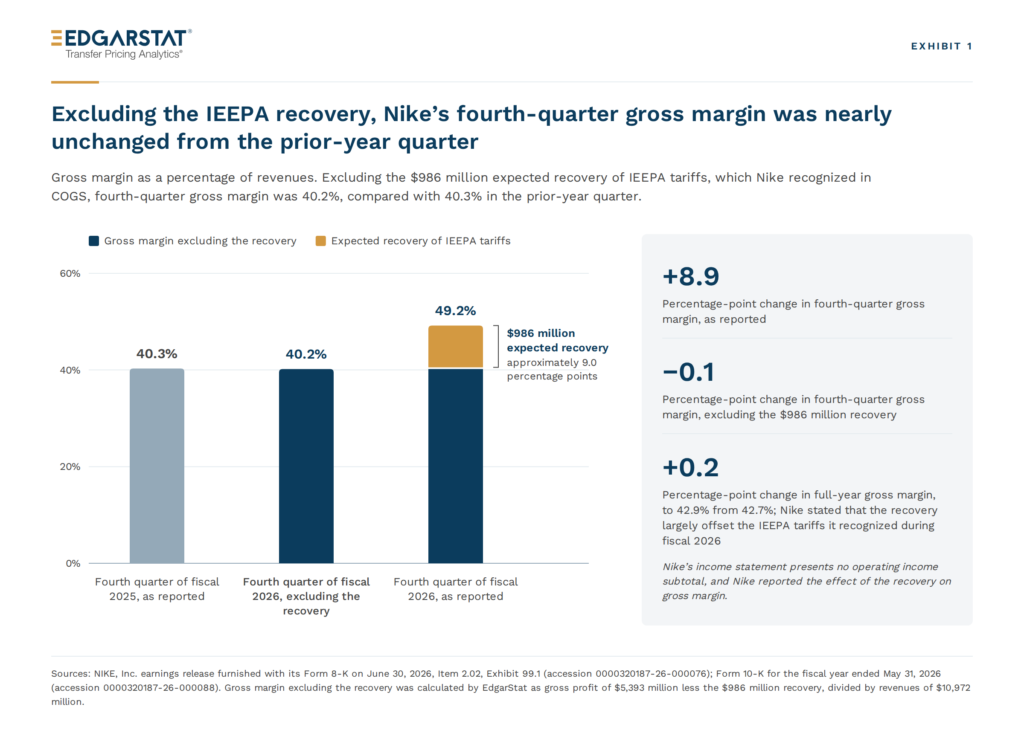
Table 1. Disclosure of IEEPA recoveries in each registrant’s most recent filing
| Registrants | |
| Recovery recognized, with the amount and the income statement line identified | 39 |
| Recovery recognized, with the amount but not the line | 4 |
| Recovery recognized, with no amount stated in the report | 4 |
| Recovery recorded on the balance sheet as a liability to customers | 2 |
| No recovery recognized at the balance sheet date | 1 |
| No material effect reported | 2 |
| IEEPA discussed, with no recovery described | 2 |
| Total | 54 |
Four registrants disclosed the amount recognized without identifying the income statement line in which it was recorded, while another four described a recognized recovery without quantifying it. Two freight companies recorded their refunds as liabilities to customers, and one registrant had submitted claims but had recognized no recovery as of its balance sheet date.
Because many registrants allocated a single recovery among several accounts, a registrant may appear in more than one row of Table 2.
Table 2. Accounts in which the recognized recoveries were recorded
| Account | Registrants | Effect on operating income |
| COGS or an equivalent cost line | 39 | Included in operating income |
| Selling, general and administrative expense | 3 | Included in operating income |
| Reduction of net sales | 4 | Included in operating income; also reduces net sales |
| Bad debt expense | 1 | Included in operating income |
| Interest or other income | 10 | Excluded from operating income |
| Inventory carrying value | 9 | Reduces COGS in later periods as the inventory is sold |
| Property and equipment | 1 | Included in the asset base only |
| Liability to customers, with no income statement effect | 2 | Recorded on the balance sheet only |
The reported recovery amount does not always equal the appropriate adjustment
LCI Industries, a supplier to recreational vehicle manufacturers and other original equipment manufacturers (OEMs), provided one of the most detailed disclosures in the sample. The disclosure indicates that a normalization adjustment based on the largest amount reported in the footnote may overstate the effect of the recovery.
LCI expects $119.3 million of refunds, representing the IEEPA duties it paid while the tariffs were in effect from February 2025 through February 2026. Of that amount, LCI recognized $104.8 million as a reduction of COGS for duties previously expensed on inventory already sold and reduced the carrying value of inventory still on hand by $14.5 million. LCI recognized $3.7 million of interest on the refunds in interest expense, net, which is excluded from operating profit.
LCI also recorded an $88.8 million liability for the portion of the refunds it expects to remit to certain customers, with a corresponding reduction of net sales. Because the COGS credit and the reduction of net sales are both included in operating profit, the net benefit recognized in the quarter was $16.0 million. Removing the full $104.8 million COGS credit from operating profit would produce an adjustment more than six times the net benefit.
LCI reported operating profit of $96.0 million for the quarter, an increase of 9% from $87.8 million in the prior-year quarter. Excluding the $16.0 million net benefit, operating profit would have been $80.0 million, 9% below the prior-year quarter.
Medline applied a similar treatment, recognizing approximately $332 million as a reduction of COGS and $89 million as a reduction of net sales for amounts it expects to remit to customers. In both cases, the COGS credit alone overstates the operating benefit retained by each company.
The amount credited to COGS is therefore not necessarily the amount that should be removed from operating income. The combined effect of obligations to remit refunds to customers and of amounts recorded in inventory should be determined before a normalization adjustment is quantified.
Recognition timing creates a further comparability issue
The reported amount also depended on the status of each company’s claims at its balance sheet date. Some registrants recognized recoveries as refunds were received, while others recorded accepted claims as receivables before receiving payment. Nike, for example, had received $302 million of its $986 million recovery as of May 31, 2026, while Caterpillar recorded $392 million of expected recoveries as a receivable.
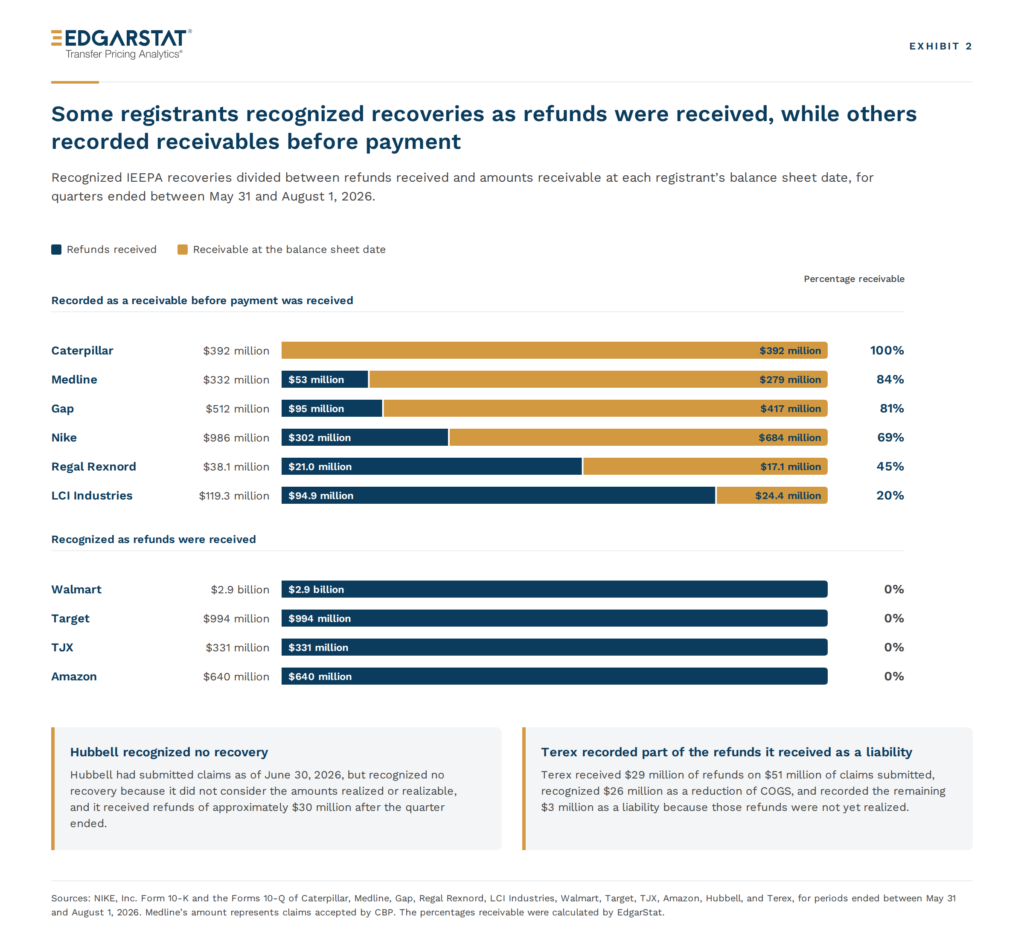
Recognition timing also depended on the accounting model. Some registrants applied the gain-contingency guidance in Accounting Standards Codification (ASC) 450-30, recognizing a recovery only when realized or realizable. Others applied loss-recovery guidance, which permits recognition when recovery becomes probable.
Hubbell and Caterpillar illustrate the difference. Both had submitted claims as of June 30, 2026, the end of the quarter. Hubbell recognized no recovery because it did not consider the amounts realized or realizable, while Caterpillar recorded $392 million of accepted claims as a receivable.
Registrants also recognized recoveries in different reporting periods. Target, Abercrombie & Fitch, Stanley Black & Decker, American Eagle, Motorola Solutions, Newell Brands, Universal Electronics, Phibro, and Children’s Place each reported no recovery in one quarterly filing and recognized a recovery in the next. Five of them recognized recoveries for claims that had been accepted or paid through the system CBP opened on April 20, 2026: Target, Stanley Black & Decker, American Eagle, Phibro, and Children’s Place. Comparables compiled from the earlier filings would include none of these recoveries, while the same comparables compiled one quarter later would include all of them.
Economically similar companies could therefore be presented differently solely because of the date of the filing reviewed. Recoveries recorded as receivables also remain subject to claim review and, for some registrants, continuing litigation.
Differences in industry and fiscal year end cause further variation in reported results
Some industries applied a common treatment, but industry was a less consistent indicator of reporting treatment than the factors described above. Among machinery companies, Caterpillar, Deere, Stanley Black & Decker, Terex, Ingersoll Rand, Manitowoc, CNH, and Regal Rexnord each credited recoveries to COGS. Obligations to remit refunds to customers were reported in several industries, while apparel and footwear retailers recorded recoveries in five of the eight accounts listed in Table 2. Walmart, Ford, Target, and Nike reported the largest recoveries by amount.
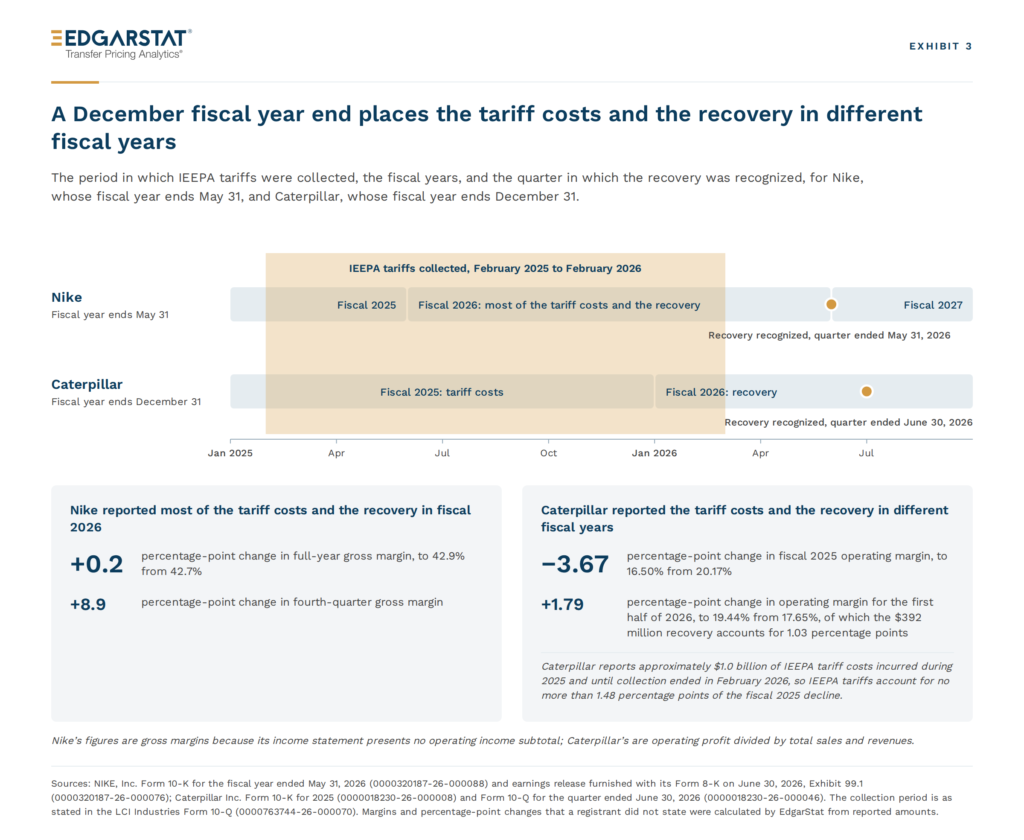
Differences in fiscal year end created a more direct comparability issue. Nike’s fiscal 2026, which ended May 31, 2026, included most of the period in which the tariffs were collected as well as the recovery. Although fourth-quarter gross margin increased 8.9 percentage points, full-year gross margin increased only 0.2 percentage points, to 42.9% from 42.7%. Nike stated in its Form 10-K that the recovery largely offset the impact of the IEEPA tariffs it recognized during fiscal 2026.
Caterpillar’s fiscal year ends in December, so its tariff costs and its recovery were reported in different fiscal years. Its operating margin declined 3.67 percentage points in fiscal 2025, from 20.17% to 16.50%. Its operating margin for the first half of 2026 was 19.44%, 1.79 percentage points above the 17.65% reported for the first half of 2025. The $392 million tariff recovery accounts for 1.03 percentage points of that increase.
Caterpillar reports approximately $1.0 billion of IEEPA tariff costs incurred during 2025 and until collection ended in February 2026, so IEEPA tariffs account for no more than 1.48 percentage points of the fiscal 2025 decline. Its Form 10-K for fiscal 2025, filed on February 13, 2026, one week before the Supreme Court ruling, does not mention IEEPA. An analyst relying solely on the Form 10-K would observe the margin decline without a disclosure that quantifies the IEEPA effect.
A multi-year range that combines companies with May and December fiscal year ends may therefore show dispersion attributable to differences in fiscal year end in addition to differences in operating performance.
The filings do not support a uniform normalization rule under § 482
The filings raise the following questions, which a uniform normalization rule does not resolve:
Where both the tariff cost and the recovery are quantified, should the analysis consider both periods together? How should the treatment change where part of the recovery reduced net sales, remained in inventory, or was offset by amounts owed to customers or vendors?
Where the recovery is quantified but the original tariff cost is not, how much can be inferred about the earlier-period effect? To what extent does the inability to quantify the original cost limit the reliability of an adjustment?
Where the cost and the recovery are reported in the same fiscal year, does normalization improve comparability, or could separating the two offsetting effects create a distortion not present in the reported full-year results?
Where the exposure is material but the filing does not quantify it, is there enough information to make a reliable adjustment, and how does that uncertainty affect the company’s suitability as a comparable?
The comparability analysis must also distinguish IEEPA recoveries from three other categories: amounts related to tariffs imposed under § 122 of the Trade Act of 1974, § 232 of the Trade Expansion Act of 1962, and § 301 of the Trade Act of 1974; other customs recoveries; and unrelated credits in adjacent periods. Several registrants discussed these items in the same filings.
Across the filings, the reported effect of the same underlying event depended on factors unrelated to operating performance: the accounting model applied, obligations to remit refunds to customers, fiscal year end, and the quarter in which the filing was reviewed.
For comparables whose results include fiscal 2025 and fiscal 2026, the filings do not support a single normalization rule. The filings indicate that the underlying accounting and disclosure should be examined before an analyst determines whether the reported results remain comparable and, if not, whether the available information is sufficient to support an adjustment.
The sample comprises the 54 registrants whose 2026 quarterly and annual reports, filed through September 14, 2026, discuss the IEEPA tariffs. Figures are as reported in the registrants’ Forms 10-Q and 10-K, except that Nike’s fourth-quarter figures are taken from the earnings release furnished with its Form 8-K on June 30, 2026. Margins and percentage-point changes that a registrant did not state were calculated by EdgarStat from reported amounts.