
On November 6, 2026, cable operator Optimum Communications, Inc. (Optimum) restated its 2025 and first-half 2026 results after it “inadvertently failed to recognize non-cash deferred tax benefits” from two write-downs of cable franchise rights. It blamed “an insufficient depth of specialized tax expertise, lack of a formal tax consultation policy, and ineffective controls to identify and evaluate the deferred tax consequences of a non-routine matter.”¹
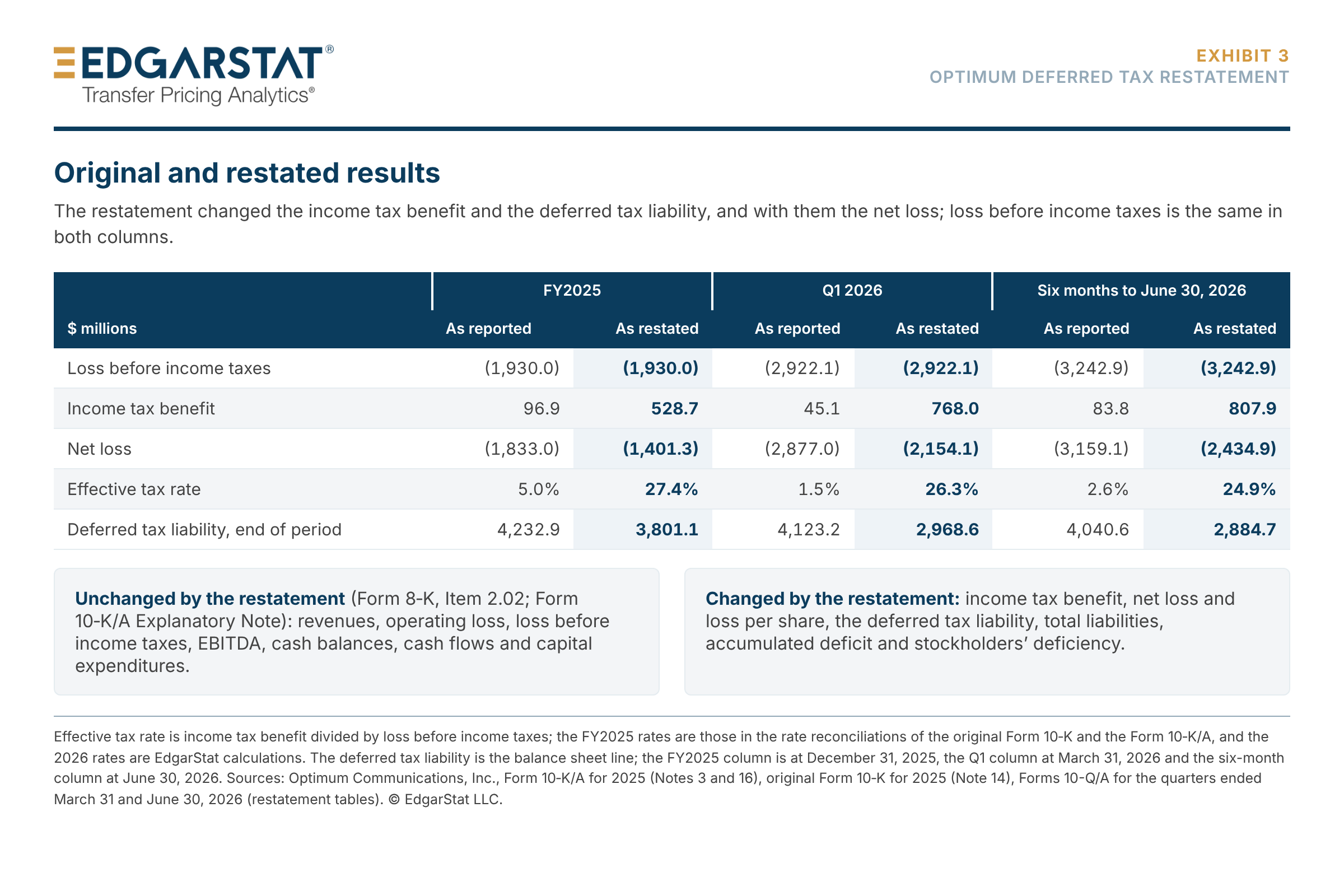
Correcting the omission added $1.16 billion in income tax benefits through June 30, 2026, and reduced the 2025 net loss from $1.83 billion to $1.40 billion. The 2025 effective tax rate increased from 5% to 27.4%, while revenue, operating loss, cash flows, and loss before income taxes were unaffected.² This post examines the journal entries Optimum omitted and the resulting changes from the corrections.
The Write-downs
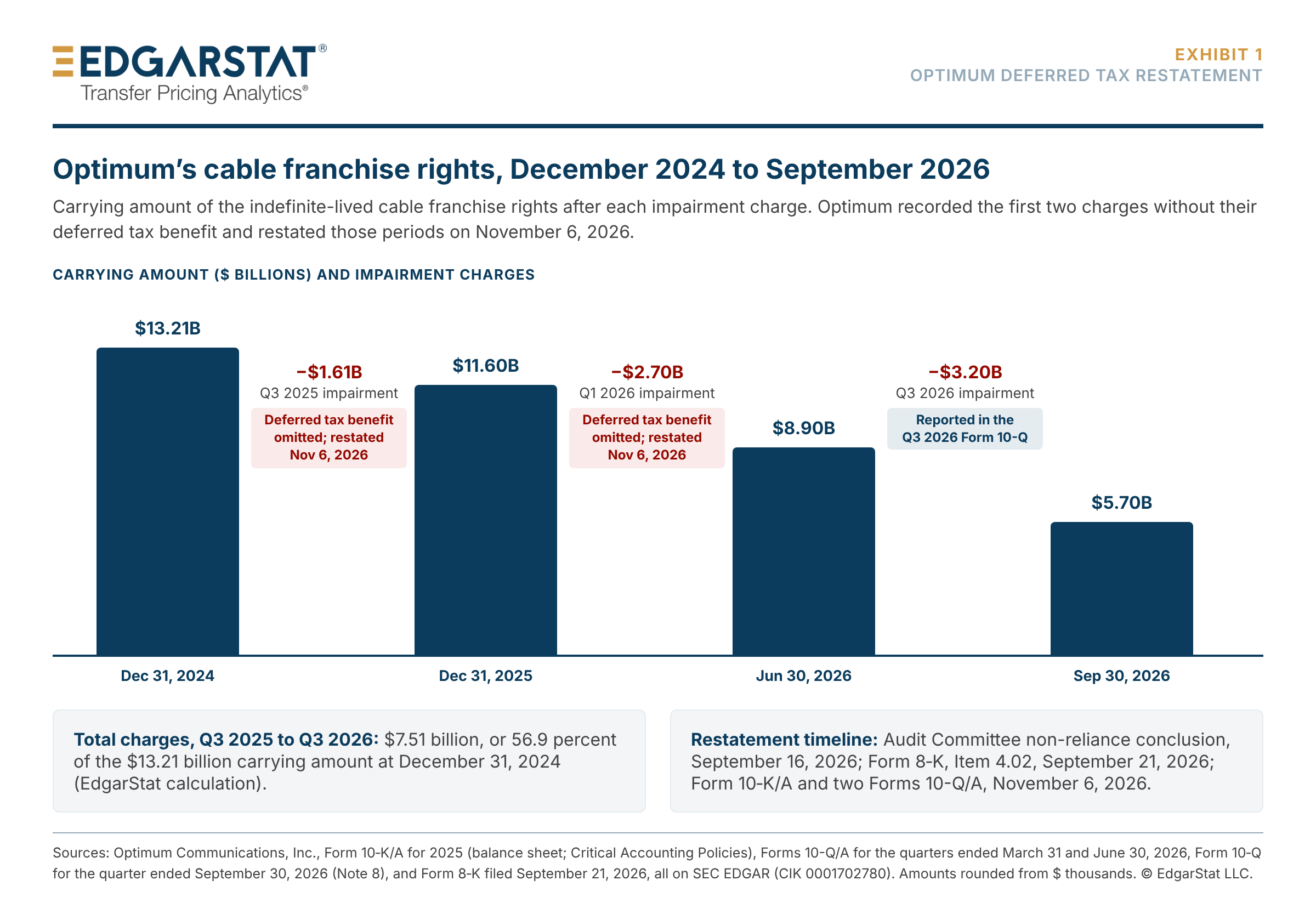
Cable franchise rights are Optimum’s agreements with state and local governments to operate cable systems. Optimum reports them as an intangible asset that is not amortized and is written down when its fair value falls below its carrying amount.³ Optimum recorded impairment charges, or write-downs, of $1.61 billion in the third quarter of 2025 and $2.70 billion in the first quarter of 2026. A third write-down of $3.20 billion in the third quarter of 2026 reduced the intangible asset balance to $5.70 billion, down from $13.21 billion at the end of 2024 (Exhibit 1). The restatement concerns the first two write-downs.
The Missing Journal Entry
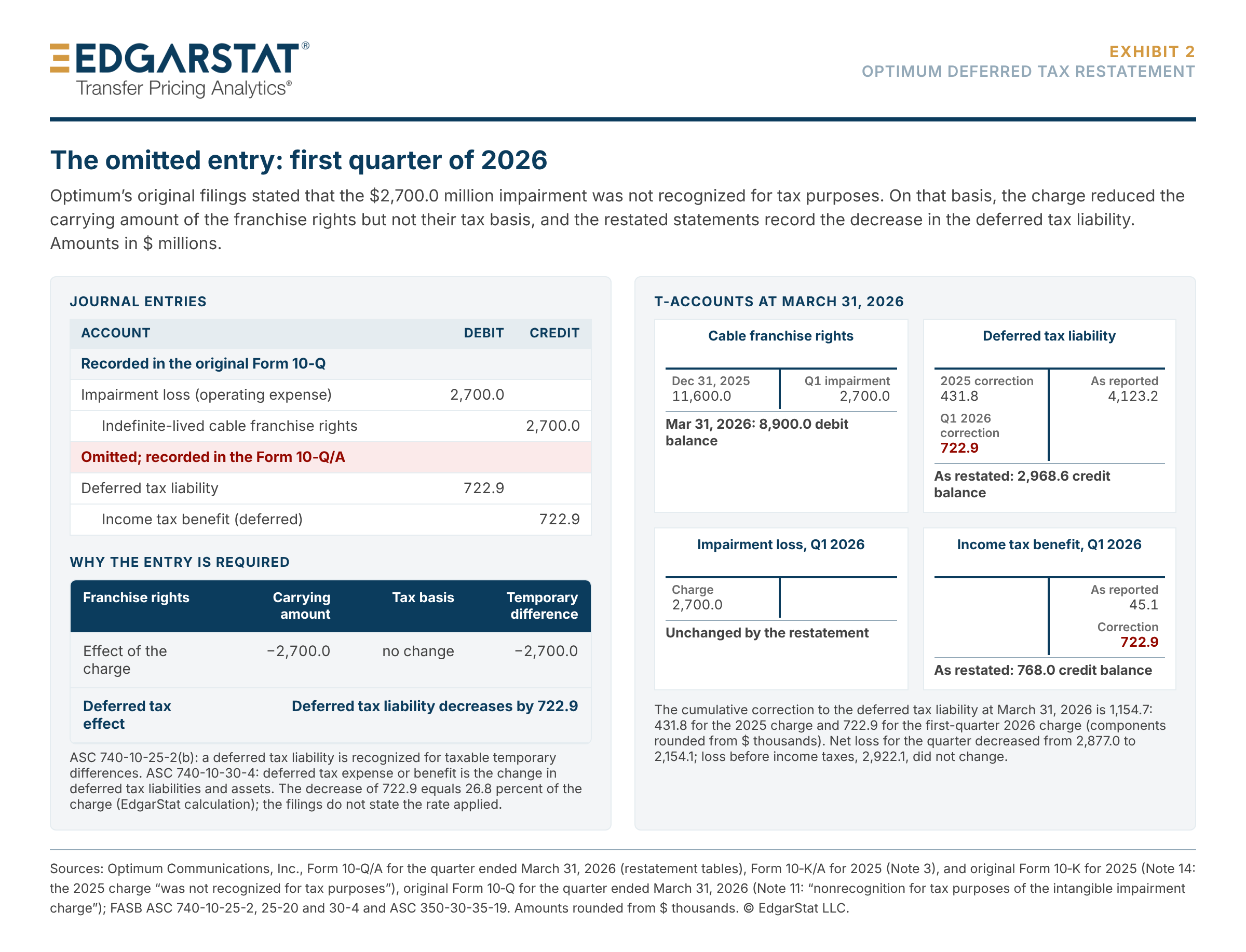
Optimum’s original filings stated that it did not recognize the write-downs for tax purposes. On that basis, each write-down, as originally recorded, reduced the carrying amount of the franchise rights but not their tax basis. Under ASC 740, a smaller excess of carrying amount over tax basis means less tax payable in future years, so the deferred tax liability (DTL) on the franchise rights decreases, and the income tax benefit on the income statement increases by the same amount.⁴ The original filings did not record the decreased DTL. Optimum’s original 2025 income tax rate reconciliation instead listed the tax effect of the write-down as a nondeductible item on the same line as a 2023 goodwill impairment. In the first quarter of 2026, for example, the $2.70 billion write-down reduced the tax Optimum expects to pay in future years by $722.9 million. The restated filings decrease the DTL by that amount and increase the income tax benefit by the same amount, which reduces the net loss (Exhibit 2).⁵
What Changed
The corrections changed income tax amounts and the amounts that depend on them (Exhibit 3). For the first six months of 2026, the net loss decreased from $3.16 billion to $2.43 billion, and the effective tax rate increased from 2.6% to 24.9%.⁶ Because operating results did not change, profit level indicators (PLIs) derived from operating line items are the same in the original and restated filings. All income statement changes were below the operating line, affecting the income tax benefit and the net loss.⁷
Takeaways
- Write-downs of different intangible assets require different income tax entries. Writing down goodwill with no tax basis has no deferred tax effect because ASC 740 does not permit a DTL for goodwill whose amortization is not deductible for tax purposes. Writing down an intangible asset that carries a DTL, such as Optimum’s franchise rights, reduces the DTL and increases the income tax benefit.
- Balancing journal entries do not establish that an event was fully recorded. Optimum’s write-down entry was balanced, so omitting the deferred tax entry did not unbalance its accounts. Optimum identified the error only after it had issued the original statements.
- Data from the original filings now differ from the restated amounts. Net income, income tax expense, and the effective tax rate for 2025 and the first half of 2026 changed, while operating measures (e.g., Sales and OIADP) didn’t.
Endnotes
¹ Optimum Communications, Inc., Form 8-K filed September 21, 2026 (accession no. 0001702780-26-000057), Items 2.02 and 4.02(a); Form 10-K/A for 2025, filed November 6, 2026 (accession no. 0001702780-26-000071), Item 9A, which reports a material weakness in internal control over financial reporting related to income tax accounting. Optimum’s Audit Committee concluded on September 16, 2026, that the original statements “should no longer be relied upon.” The Securities and Exchange Commission’s EDGAR data list Altice USA, Inc. as the registrant’s name until November 6, 2025.
² Form 10-K/A for 2025, Note 3: income tax benefit of $96.9 million as originally reported and $528.7 million as restated, on an unchanged loss before income taxes of $1,930 million; effective tax rates of 5.02% (original Form 10-K, accession no. 0001702780-26-000013, Note 14) and 27.39% (Form 10-K/A, Note 16). The $1.16 billion is the cumulative correction to the DTL as of June 30, 2026 (Form 10-Q/A for that quarter, accession no. 0001702780-26-000073). The Form 8-K (Item 2.02) and the Form 10-K/A Explanatory Note (operating loss) list the items the restatement does not affect.
³ Form 10-K/A for 2025, Note 2; ASC 350-30-35-15 and 35-19. The write-downs are reported in the Form 10-K/A (2025) and in the Form 10-Q for the quarter ended September 30, 2026 (accession no. 0001702780-26-000074, Note 8).
⁴ The original 2025 Form 10-K (Note 14) states that the 2025 write-down (the “impairment charge”) “was not recognized for tax purposes.” The original 2026 first-quarter Form 10-Q (accession no. 0001702780-26-000035, Note 11) refers to “the nonrecognition for tax purposes of the intangible impairment charge.” The amended filings do not repeat these statements or state the tax basis. ASC 740-10-25-2(b), ASC 740-10-25-20, and ASC 740-10-30-4 set forth the recognition and measurement requirements. The Form 10-K/A (Note 16) reports a DTL of $2.94 billion for franchise rights as of December 31, 2025.
⁵ Original Form 10-K for 2025, Note 14: a reconciling item of $338.4 million (17.53 percentage points), equal to 21% of the write-down, under “Nontaxable or Nondeductible Items” on the line labeled “Impairment,” which also shows the 2023 goodwill impairment. ASC 740-10-25-3(d) prohibits a DTL for goodwill “for which amortization is not deductible for tax purposes.” The restated reconciliation (Form 10-K/A, Note 16) removes the 2025 item and labels the line “Goodwill impairment.” The filings do not explain why the write-down was presented on that line. The first-quarter 2026 amount of $722.9 million is from the Form 10-Q/A for that quarter (accession no. 0001702780-26-000072) and equals 26.8% of the $2.70 billion write-down (calculated by EdgarStat).
⁶ Form 10-Q/A for the quarter ended June 30, 2026, restatement tables; effective tax rates are calculated by EdgarStat (income tax benefit divided by loss before income taxes).
⁷ Treas. Reg. § 1.482-5(b)(4)(ii)(A) (Electronic Code of Federal Regulations).