
On October 22, 2026, the Financial Accounting Standards Board (FASB) issued a proposed Accounting Standards Update (ASU), Revenue from Contracts with Customers (Topic 606): Consideration Payable to a Customer.¹ The proposal is aimed at improving the reporting consistency of consideration paid to customers and customers’ customers outside of the direct distribution chain by requiring entities that engage in these types of transactions to report them as a reduction in revenue. The entities most affected by this proposed amendment include platform and marketplace businesses that connect customers with goods and services offered by others (e.g., Uber, DoorDash, and eBay). The proposal arose because stakeholders noted that “economically similar payments may be accounted for differently (either as a reduction of revenue or as an expense),” leading to inconsistent accounting that affects comparability between companies in the same industry.²
The proposed rule
Under existing paragraph 606-10-32-25, consideration payable to a customer includes amounts paid to the customer “or to other parties that purchase the entity’s goods or services from the customer.” Such amounts reduce the transaction price and, therefore, revenue unless the payment is in exchange for a distinct good or service that the customer transfers to the entity. Proposed paragraph 606-10-32-25B would extend that guidance to payments made on behalf of a customer or to a customer of the entity’s customer that are “made in connection with an entity satisfying its promise to its customer.” Under proposed paragraph 606-10-32-25C, that connection exists if the entity has explicitly promised the payment or if the customer reasonably expects it because an implicit promise exists or because the payment represents an in-substance price concession.
Using the FASB’s illustration, a platform acting as an agent for sellers gives each first-time buyer a $10 credit. The credit is consideration payable to the seller (the platform’s customer) whether the seller’s contract requires it or the seller reasonably expects it based on the platform’s customary practice and published marketing.³ The Board expects the amendments to affect primarily entities that make such payments, “such as entities operating on a platform,” and states that they “may result in a reclassification of amounts between expense and revenue.”⁴ An entity would adopt on a modified prospective basis, under which comparative periods are not restated, or on a modified retrospective basis. As of this writing, the Board has not set an effective date.
The effect on profit level indicators
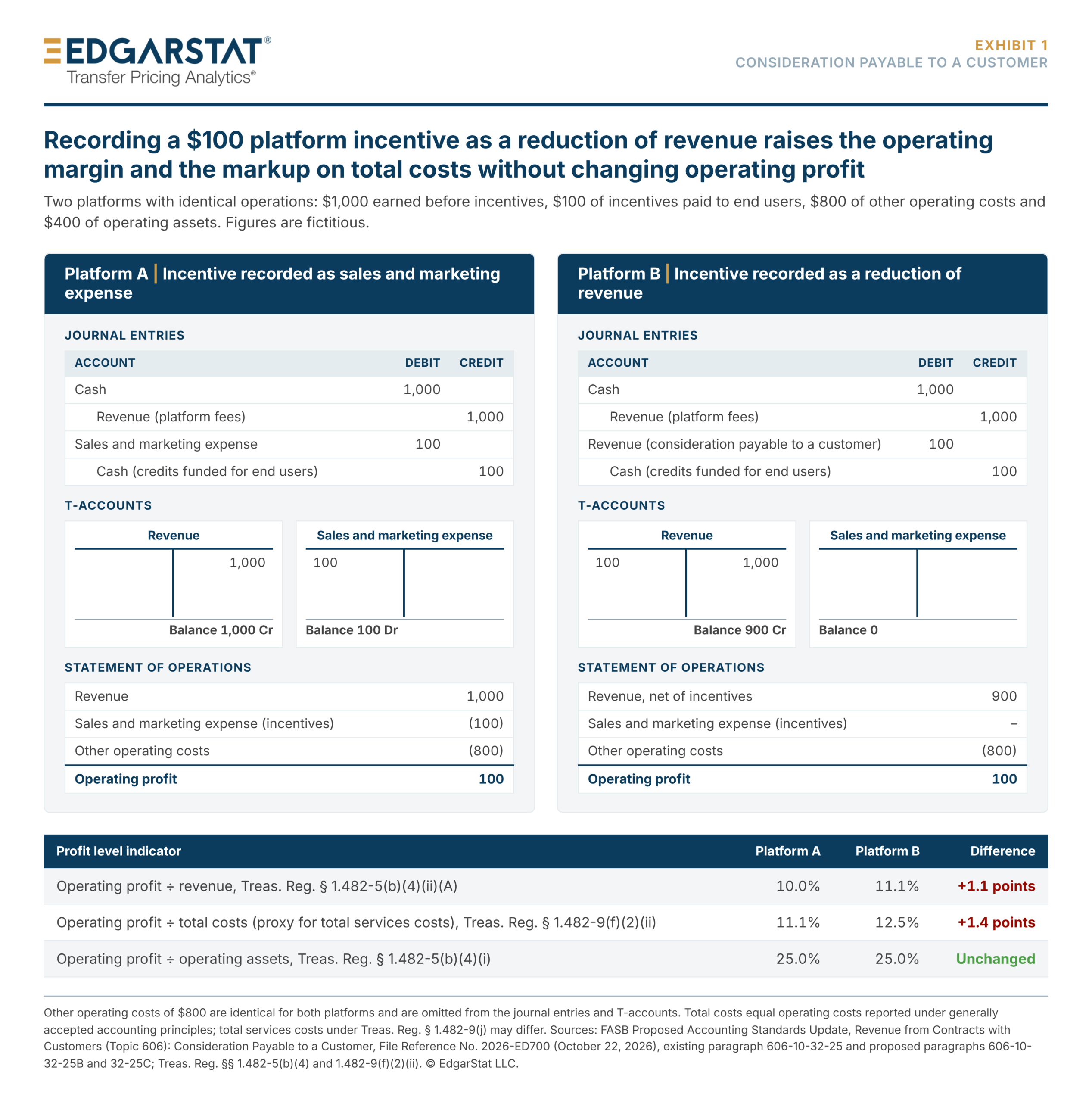
For a payment recognized in the same period and amount under either classification, reclassifying an operating expense as a reduction of revenue decreases revenue and operating expenses equally, leaving operating profit unchanged. Its effect on a profit level indicator (PLI) depends on the denominator. For an entity with positive operating profit, the ratio of operating profit to sales (ROS) increases because its sales denominator decreases. Similarly, for a tested party that renders services, the ratio of operating profit to total services costs (ROC) also increases due to a reduction in the services cost denominator. The rate of return on capital employed, operating profit divided by operating assets (ROA), is unaffected since the numerator and denominator remain the same.⁵
Exhibit 1 presents two platforms with identical operations. Each earns $1,000 before incentives, pays $100 in incentives to end users, incurs $800 in other operating costs, and reports $100 in operating profit. Platform A records the incentives as sales and marketing expense and reports an operating margin of 10.0 percent and a markup on total costs of 11.1 percent. Platform B instead records the $100 incentives as a reduction of revenue, resulting in an operating margin of 11.1 percent and a markup on total costs of 12.5 percent.
The differences in current filings
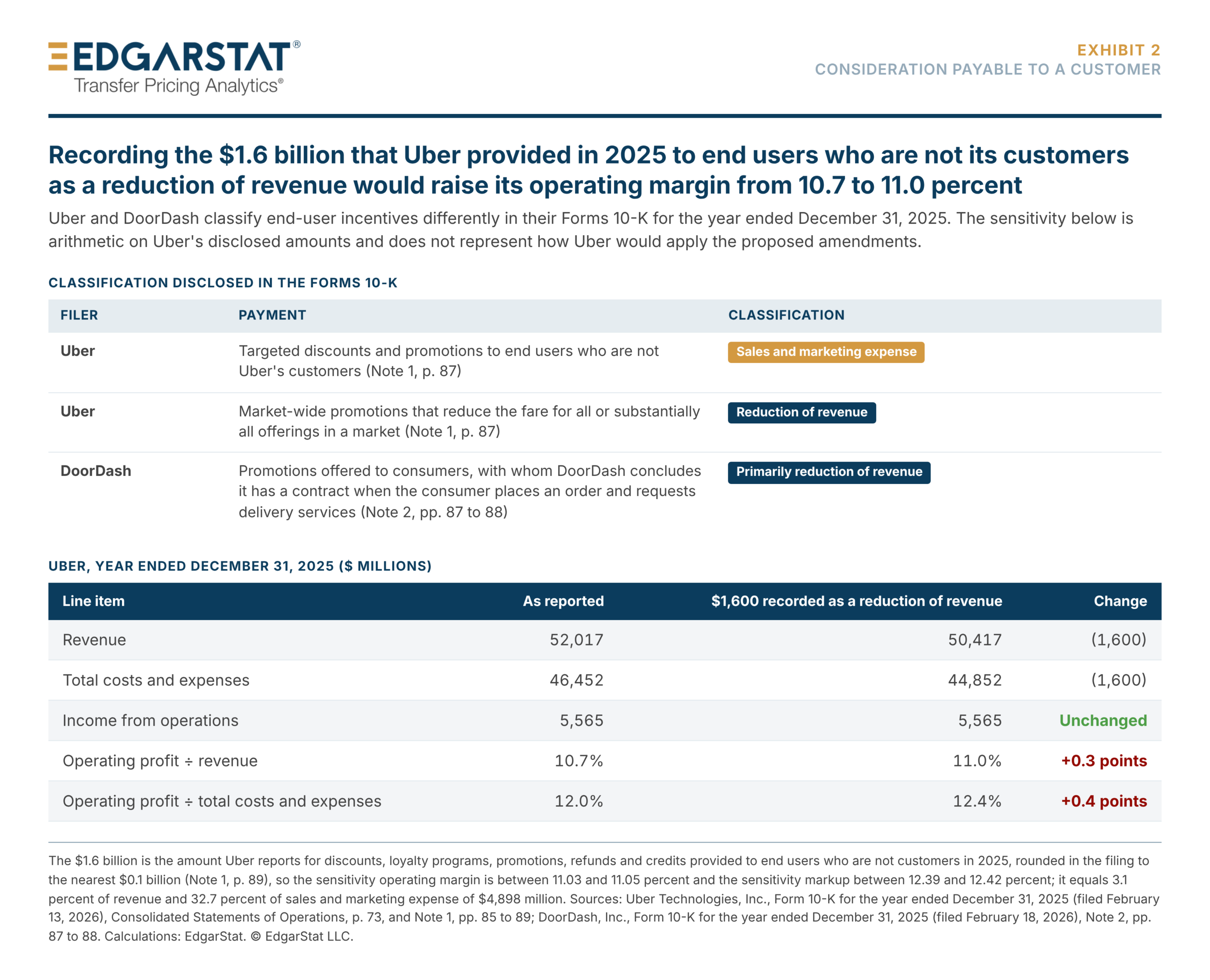
Forms 10-K for the year ended December 31, 2025, include both treatments. Uber contracts with drivers and merchants and treats end users as customers in some markets, including those where Uber is responsible for the mobility or delivery service. Uber records targeted discounts and promotions to “end-users who are not our customers” as sales and marketing expense and records market-wide promotions as a reduction of revenue. Discounts, loyalty programs, promotions, refunds, and credits provided to end users who are not customers totaled $1.6 billion in 2025, compared with revenue of $52.0 billion and income from operations of $5.6 billion.⁶ DoorDash concludes that it has a contract with the consumer when the consumer places an order and requests delivery services, and it records consumer promotions primarily as a reduction of revenue.⁷ With these disclosures, we observe two potential comparables recording promotions differently in ways that affect the comparability of their reported operating profits.
Uber recording the full $1.6 billion in non-customer promotions as a reduction in revenue rather than as sales and marketing expense would raise Uber’s 2025 operating margin from 10.7 percent to 11.0 percent and its markup on total costs and expenses from 12.0 percent to 12.4 percent. This sensitivity is hypothetical and applied only to disclosed amounts; the exposure draft doesn’t specify how Uber or any other filer would classify these payments.⁸
Consequences for comparability
Section 1.482-5(c)(2)(iv) provides for adjustments under § 1.482-1(d)(2) when differences “would materially affect the profits determined under the relevant profit level indicator.” An adjustment for a classification difference requires the amount, which Uber discloses. Under § 1.482-1(d)(2), a comparable for which the adjustment cannot be made may still be used, “but the reliability of the analysis will be reduced.”
Treas. Reg. § 1.482-5(b)(4) also provides that PLIs generally should be derived from at least the taxable year under review and the preceding two taxable years. A comparable that adopts on a modified prospective basis will not restate its comparative periods, so a three-year average of reported amounts that includes the adoption year combines years measured under different rules. The proposal’s transition paragraph does not require a modified prospective adopter to disclose the effect of the change on revenue.⁹
Endnotes
- FASB, Proposed Accounting Standards Update, Revenue from Contracts with Customers (Topic 606): Consideration Payable to a Customer, File Reference No. 2026-ED700 (issued October 22, 2026; comments due November 23, 2026). The seven Board members approved the exposure draft for publication unanimously (p. 13). The project originated in an agenda request from Deloitte that the Emerging Issues Task Force (EITF) received on January 30, 2026, which the EITF Agenda Committee added at its March 2026 meeting. FASB, EITF Issue Summary No. 2, Consideration Payable to a Customer (June 23, 2026 meeting), paragraph 1.
- Proposed ASU, Summary, p. 1; see also paragraph BC1.
- Proposed paragraphs 606-10-55-254A through 55-254E (Example 32A, Cases A and B). In Case B, the seller “can access the entity’s marketing materials and is aware that credits are being offered” (paragraph 606-10-55-254E). Example 32B (paragraphs 606-10-55-254F and 55-254G) describes a retailer that pays a bank the market interest rate on 0 percent six-month promotional financing for its customers, which the FASB treats as an in-substance price concession. Proposed paragraph 606-10-32-25C(b) states that a promise “may be implied by an entity’s customary business practices, published policies, or specific statements” and that in-substance price concessions “include but are not limited to incentives, rebates, credits, and direct cash payments.” In each example the FASB concludes only that the payments are consideration payable to a customer; the entity must still evaluate whether each payment is in exchange for a distinct good or service, which the amendments do not change (Proposed ASU, p. 2; paragraph BC15).
- Proposed ASU, Questions 2 and 3, p. 4; paragraph BC19. The Board’s expectation of reclassification is qualified elsewhere in the proposal: paragraph BC10 states that “the Board expects that, generally, the proposed amendments would be consistent with current practice,” and paragraph BC32 notes that “some entities may already reach similar outcomes under existing guidance.” Question 3 also asks whether the amendments could change “the timing or measurement of revenue or expense,” and Question 4 asks about negative revenue, which “can arise when consideration payable to a customer reduces revenue in an amount that exceeds consideration received from the customer” (paragraph BC20). Early adoption would be permitted; an entity that adopts in an interim period would apply the amendments as of the beginning of that annual period (proposed paragraph 606-10-65-4(b)).
- For an entity with an operating loss, the reclassification makes both ratios more negative. Total services costs under Treas. Reg. § 1.482-9(j) may differ from reported operating costs; the regulation states that generally accepted accounting principles “may provide a useful starting point but will not necessarily be conclusive.” Treas. Reg. § 1.482-5(d)(1) defines sales revenue as “the total receipts from sale of goods and provision of services, less returns and allowances,” determined under “accounting principles and conventions that are generally accepted in the trade or industry of the controlled taxpayer under review,” and § 1.482-5(d)(3) states that operating expenses “ordinarily include expenses associated with advertising, promotion, sales, marketing, warehousing and distribution, administration, and a reasonable allowance for depreciation and amortization.” This post does not address the ratio of gross profit to operating expenses (Barry ratio) in § 1.482-5(b)(4)(ii)(B).
- Uber Technologies, Inc., Form 10-K for the year ended December 31, 2025 (filed February 13, 2026), Consolidated Statements of Operations, p. 73 (revenue $52,017 million, total costs and expenses $46,452 million and income from operations $5,565 million); Note 1, Description of Business and Summary of Significant Accounting Policies, Revenue Recognition, pp. 85 and 87, and sales and marketing expenses, p. 89; Management’s Discussion and Analysis, Critical Accounting Estimates, p. 64. Uber also states that, in markets where it charges end users a fee to use the platform, it has a performance obligation to end users (p. 85), and that refunds and credits to end users are recorded as sales and marketing expense or as a reduction of revenue depending on whether the end user is a customer in the market (p. 87). The $1.6 billion is rounded in the filing.
- DoorDash, Inc., Form 10-K for the year ended December 31, 2025 (filed February 18, 2026), Note 2, Summary of Significant Accounting Policies, Revenue Recognition, pp. 87 and 88. DoorDash accounts for referral credits up to the fair value of acquiring a new consumer as a consumer acquisition cost, the majority of which is expensed as incurred in sales and marketing expense, and records the excess as a reduction of revenue. DoorDash’s classification of consumer promotions is consistent with its conclusion that it has a contract with the consumer; the proposed amendments do not address how an entity identifies its customer.
- Operating margin: $5,565 ÷ $52,017 = 10.7 percent reported; $5,565 ÷ ($52,017 − $1,600) = 11.0 percent. Markup on total costs and expenses: $5,565 ÷ $46,452 = 12.0 percent reported; $5,565 ÷ ($46,452 − $1,600) = 12.4 percent. Amounts are in millions. Because the $1.6 billion is rounded to the nearest $0.1 billion, the sensitivity margin is between 11.03 and 11.05 percent and the sensitivity markup is between 12.39 and 12.42 percent. The $1.6 billion equals 3.1 percent of 2025 revenue and 32.7 percent of 2025 sales and marketing expense of $4,898 million.
- Proposed paragraph 606-10-65-4(c) through (e). Both transition methods apply to payments paid or promised rather than to contracts (paragraph BC34), and for payments made or promised before the adoption date a modified prospective adopter would continue applying current guidance (Proposed ASU, p. 3). A modified prospective adopter must disclose the nature of and reason for the change, including an explanation of the newly adopted principle, and the method of applying the change. A modified retrospective adopter must also disclose the effect of the change on income from continuing operations, net income, any other affected financial statement line items, and any affected per-share amounts for prior periods retrospectively adjusted. This post does not address disclosure requirements outside the proposed transition paragraph. The predecessor guidance took a different approach: the consensuses on Issues 1 and 2 of EITF Issue No. 01-9, which applied “no later than in financial statements for annual or interim periods beginning after December 15, 2001,” required that “financial statements for prior periods presented for comparative purposes should be reclassified,” and, where reclassification was impracticable, disclosure of “the reasons why reclassification was not made and the effect of the reclassification on the current period” (paragraph 12).