“A trillion here, a trillion there, pretty soon you’re talking real money.” — with apologies to Everett Dirksen
On August 17, 2026, the Wall Street Journal reported that nine large technology companies had approximately $3 trillion of off-balance-sheet commitments, most of it related to artificial intelligence. On the Journal’s measurement, those commitments are approximately three times the amount the companies owe under outstanding leases and long-term borrowings, and they are increasing faster than the approximately $600 billion of capital expenditures the companies reported over the preceding year (“Why Big Tech’s AI Spending Is $3 Trillion Higher Than It Seems,” Rudegeair and Santilli, Aug. 17, 2026).
To test that measurement, we reviewed every Form 10-Q and Form 10-K the nine companies filed from November 2022 through August 25, 2026, together with the relevant Forms 8-K.
Summary of findings
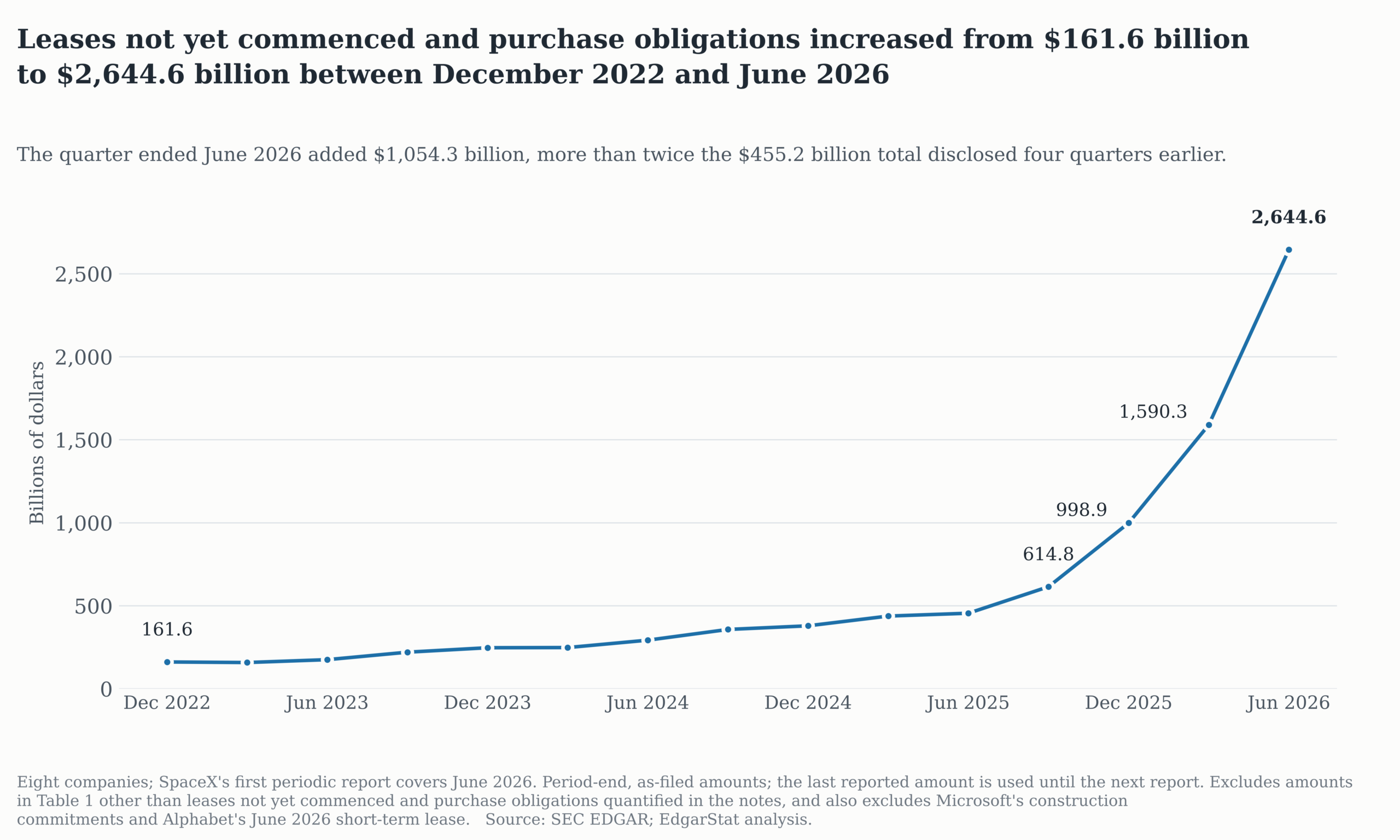
From each company’s most recent quarterly or annual report filed through August 25, 2026, including additions the reports disclose as subsequent events, we tallied $1.21 trillion of future payments under signed leases that have not yet commenced and $1.90 trillion of purchase, supply, energy, and cloud commitments. We identified an additional $138 billion in guarantees, lease backstops, contingent capacity, and investment commitments. Total off-balance-sheet commitments are $3.25 trillion, or 3.6 times the $895.4 billion of lease liabilities and debt reported on the balance sheets of the same nine companies. The two totals are measured on different bases: The commitments are stated undiscounted, as the sum of the contractual payments or, for a guarantee, the maximum potential payment. Lease liabilities are carried at present value, and debt is carried at amortized cost.
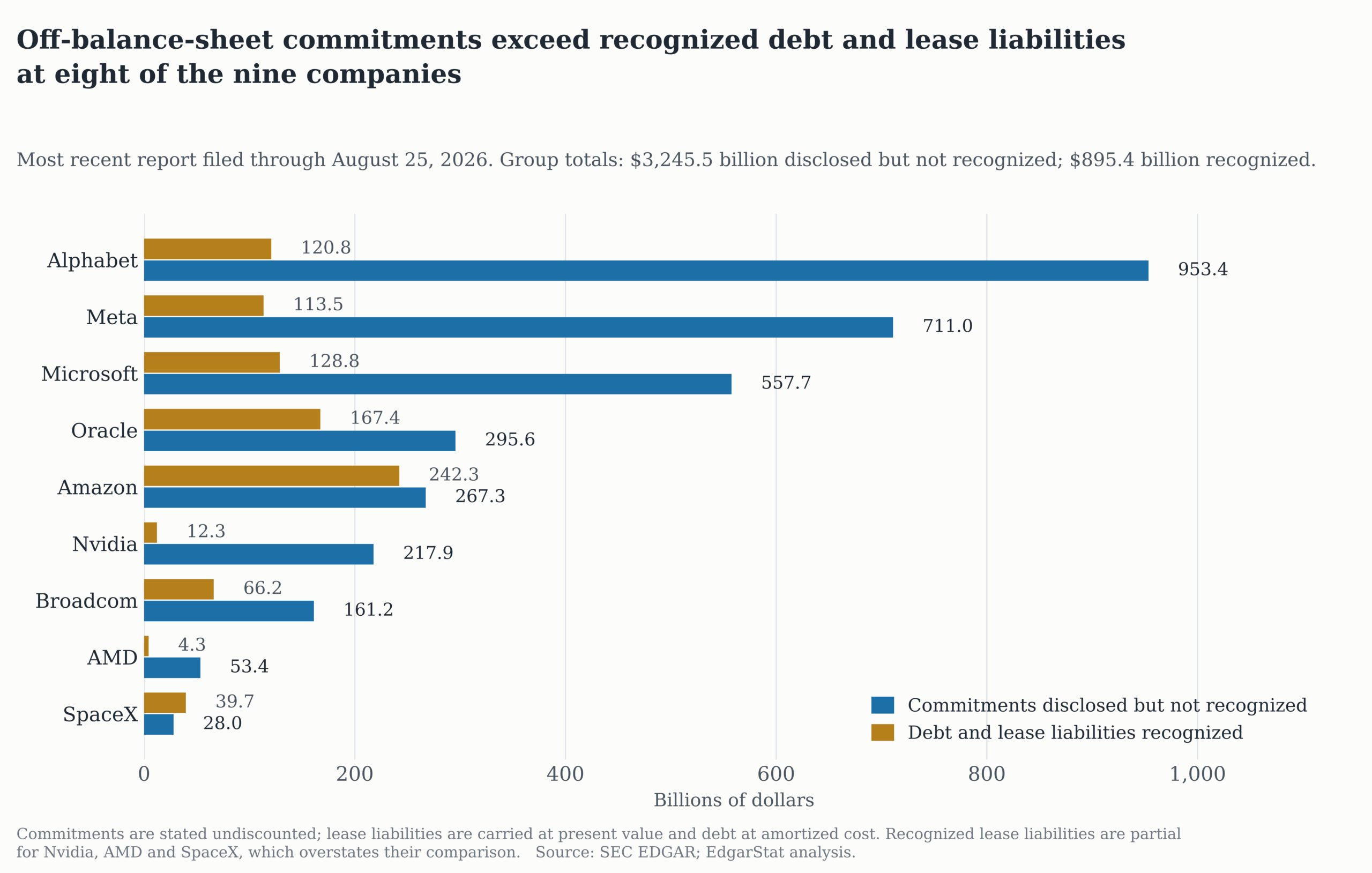
The commitments have increased at an accelerating rate. In the quarter ended December 31, 2022, the eight companies then filing reports disclosed $162 billion across two categories: leases signed but not yet commenced, and purchase obligations quantified in the notes to the financial statements. The total was $455 billion in the quarter ended June 30, 2025, $615 billion after the September 2025 reports, $999 billion after the December 2025 reports, $1.59 trillion after the March 2026 reports, and $2.64 trillion after the June 2026 reports. The quarter ended June 30, 2026 added $1.05 trillion, more than twice the total disclosed four quarters earlier. Part of that comparison reflects changes in definition. Alphabet’s commitments note quantified only content licensing commitments through December 2025 ($7.7 billion); since March 2026, it has also quantified long-term supply agreements and energy service agreements. Meta first included third-party cloud capacity arrangements in its total in September 2025. The series is stated as filed at each period end. It excludes the following amounts that Table 1 includes: the Management’s Discussion and Analysis aggregates, guarantees, investment commitments, Meta’s contingent cloud capacity, signings after the quarter end, Microsoft’s construction commitments, and Alphabet’s $5.8 billion short-term lease. It also excludes SpaceX, whose first periodic report covers the quarter ended June 30, 2026.
| Company | As of | Leases not yet commenced | Purchase and other commitments | Total not recognized | Debt and lease liabilities recognized | Multiple (times) |
| Alphabet | June 30, 2026 | 91.0 | 862.4 | 953.4 | 120.8 | 7.9 |
| Meta | June 30, 2026 | 347.0 | 364.0 | 711.0 | 113.5 | 6.3 |
| Microsoft | June 30, 2026 | 329.1 | 228.6 | 557.7 | 128.8 | 4.3 |
| Amazon | June 30, 2026 | 137.2 | 130.1 | 267.3 | 242.3 | 1.1 |
| Oracle | May 31, 2026 | 260.0 | 35.6 | 295.6 | 167.4 | 1.8 |
| Nvidia | April 26, 2026 | 32.4 | 185.5 | 217.9 | 12.3 | 17.6 |
| Broadcom | May 3, 2026 | Not disclosed | 161.2 | 161.2 | 66.2 | 2.4 |
| AMD | June 27, 2026 | 14.0 | 39.4 | 53.4 | 4.3 | 12.5 |
| SpaceX | June 30, 2026 | Not disclosed | 28.0 | 28.0 | 39.7 | 0.7 |
| Total | 1,210.7 | 2,034.8 | 3,245.5 | 895.4 | 3.6 |
Table 1. Off-balance-sheet commitments by company, in billions of dollars, from each company’s most recent Form 10-Q or Form 10-K filed through August 25, 2026, including additions the reports disclose as subsequent events: Meta’s $68 billion of leases, Oracle’s $19 billion of purchase commitments, AMD’s $9.5 billion of leases and $5.0 billion of investment commitments, and Broadcom’s $29 billion backstop. Alphabet’s lease amount includes a $5.8 billion short-term lease signed in June 2026. Purchase and other commitments combine purchase obligations with guarantees, lease backstops, contingent capacity, and investment commitments. Alphabet’s $811.0 billion of purchase commitments and Microsoft’s $194.1 billion of $228.6 billion are taken from Management’s Discussion and Analysis; neither amount is tagged in XBRL, the data format in which filers tag financial statement figures. Recognized liabilities are total debt, including current portions and short-term borrowings, plus lease liabilities. Nvidia and AMD exclude short-term operating lease liabilities, and SpaceX excludes non-current operating lease liabilities, which overstates the multiple for those three companies. We take Meta’s finance lease liabilities and Broadcom’s operating lease liabilities from each company’s Form 10-K for fiscal 2025 because the quarterly reports do not disclose them. Broadcom and SpaceX do not quantify leases not yet commenced. Totals and multiples are computed from unrounded amounts; the rounded amounts in the recognized column sum to $895.3 billion. Source: SEC EDGAR; EdgarStat analysis.
We have assigned these amounts to three disclosure categories, each discussed below.
Leases signed but not yet commenced total $1.21 trillion
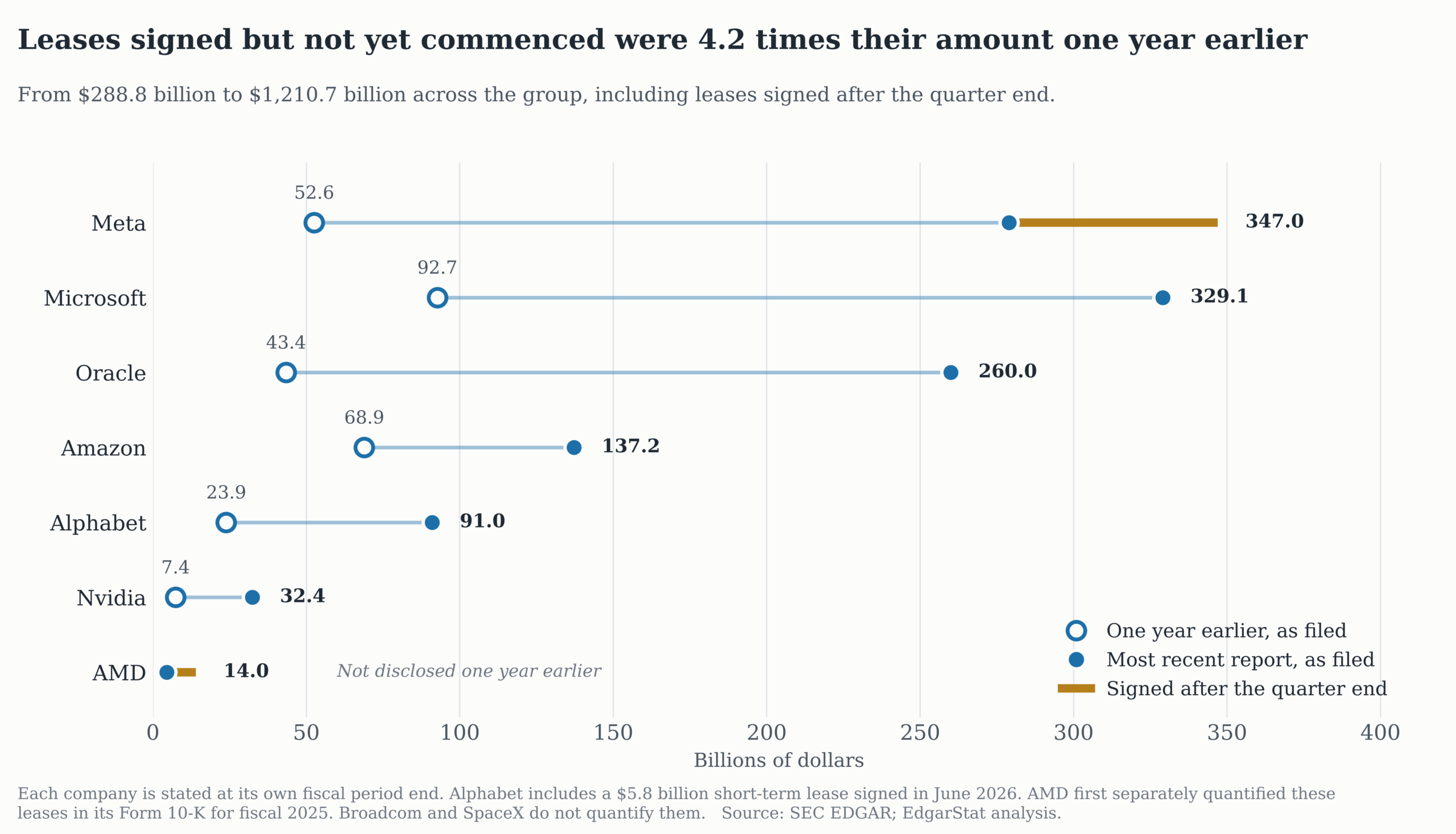
The relevant provision is the commencement rule in Topic 842 of the Accounting Standards Codification (ASC), the body of authoritative United States accounting standards. A lessee recognizes a lease liability at the commencement date, which is the date on which the lessor makes the underlying asset available for use. A company may therefore sign long-term data center leases that are reported only in the notes until the space is delivered. The $1.21 trillion outstanding at the most recent reports, including signings after the quarter end, is 4.2 times the $288.8 billion the same companies disclosed one year earlier.
Meta disclosed $9.8 billion of these future payments as of December 31, 2022. Its Form 10-Q for the quarter ended June 30, 2026, discloses $279.0 billion, and Meta entered into an additional $68 billion in leases in July 2026, for a combined $347.0 billion. Microsoft’s disclosure increased from $26.0 billion as of December 31, 2022 to $329.1 billion as of June 30, 2026, for leases it expects to commence between fiscal 2027 and fiscal 2033 with terms of one to 20 years; Microsoft states that some of these arrangements are subject to contractual conditions. Oracle’s increased from $9.1 billion as of May 31, 2023 to $260.0 billion as of May 31, 2026. Amazon’s increased from $68.9 billion to $137.2 billion over the four quarters ended June 30, 2026. AMD first separately quantified these leases in its Form 10-K for fiscal 2025, at $1.3 billion as of December 27, 2025; its Form 10-Q for the quarter ended September 27, 2025 had included them, without a separate amount, in total commitments of $12.1 billion. It reported $4.5 billion as of June 27, 2026, and a further $9.5 billion entered into after the quarter end, for $14.0 billion.
Meta’s data center venture in Louisiana illustrates the extent of these arrangements. Meta holds a 20 percent interest in the venture, entered into in October 2025, and accounts for it under the equity method. Its leases from the venture commence in 2029, with an aggregate initial lease commitment of approximately $12.31 billion, four-year initial terms and renewal options for a total lease period of up to 20 years. Meta has also provided residual value guarantees. If Meta terminates or does not renew a lease and certain other conditions are met, it pays any shortfall between the property’s fair value and the guarantee threshold, which is approximately $28 billion in aggregate and decreases over time. Meta states that “RVG payments are not probable, and therefore no liability has been recorded to date.” The disclosure is presented in Note 5, Non-Marketable Equity Investments. In July 2026, Meta entered into an exclusivity agreement for a similar venture in El Paso, Texas, which it disclosed as a subsequent event. On closing, which is subject to definitive agreements, Meta expects to provide residual value guarantees with a maximum aggregate exposure of approximately $13 billion.
Purchase obligations total $1.90 trillion
The second category comprises unrecorded commitments to purchase chips, technical infrastructure, energy, and cloud capacity. Of the $1.90 trillion, $298.1 billion is disclosed only in Management’s Discussion and Analysis by two companies: $104.0 billion at Alphabet and $194.1 billion at Microsoft.
Alphabet reports the largest amount. Its Management’s Discussion and Analysis reports “material purchase commitments and other contractual obligations totaling $811.0 billion” as of June 30, 2026, compared with $332.4 billion as of March 31, 2026; the Journal reported the same two amounts. The commitments note reports $707.0 billion and $232.7 billion. The two measures differ in scope. The note quantifies “expected future fixed or guaranteed commitments” under agreements with remaining terms greater than one year, principally long-term supply agreements, together with energy service and content licensing agreements. The Management’s Discussion and Analysis total also includes open purchase orders. Alphabet’s commitments increased by $478.6 billion in the quarter on the Management’s Discussion and Analysis measure and by $474.3 billion on the note measure, and its energy service agreements include obligations through 2054. The Management’s Discussion and Analysis total was $62.1 billion as of March 31, 2025 and $149.1 billion as of December 31, 2025, so the June 2026 amount is 13.1 times the March 2025 amount. Part of that increase reflects a change in definition. Through December 2025, the total comprised open purchase orders and the non-cancelable portion or minimum cancellation fee of certain agreements; since March 2026, it has included long-term supply agreements.
Microsoft is the second case, and a screen limited to the financial statement notes would omit most of it. Microsoft’s notes do not quantify its purchase commitments. Its Form 10-K for fiscal 2026 includes a contractual obligations table in Management’s Discussion and Analysis that reports purchase commitments of $194.1 billion, up from $110.0 billion a year earlier. The table’s footnote states that the purchase commitments “primarily relate to datacenters and include open purchase orders and take-or-pay contracts,” meaning contracts under which the buyer pays for contracted capacity whether or not it uses that capacity. Including $34.6 billion of construction commitments, which Note 6 also reports, Microsoft’s unrecorded purchase-type obligations are $228.6 billion, 6.6 times the amount quantified in the notes. The same table reports total contractual obligations of $743.8 billion, compared with $397.0 billion a year earlier.
Definitions have also changed. In its Form 10-Q for the quarter ended June 30, 2024, Amazon added energy procurement and software licensing to its description of unconditional purchase obligations, which were then $32.4 billion; in its Form 10-Q for the quarter ended March 31, 2025, it added property and equipment. The line has since increased to $130.1 billion. Meta’s non-cancelable contractual commitments increased from $27.95 billion as of June 30, 2025, to $349.31 billion as of June 30, 2026, and Meta first described the total as including third-party cloud capacity arrangements as of September 30, 2025. The reported increases in this category therefore combine new signings with changes in disclosure practice.
Nvidia’s manufacturing, supply, and capacity commitments were $119 billion as of April 26, 2026, and Nvidia states that some of these agreements “are cancellable, able to be rescheduled, or adjustable” before firm orders are placed. Its total purchase commitments, including $30 billion in multi-year cloud service agreements and $6 billion in other vendor commitments, rose from $8.1 billion as of January 29, 2023, to $155 billion as of April 26, 2026. Nvidia also reported $27 billion of investment commitments, “subject to certain contingencies.” That line was first reported on October 26, 2025, at $6.5 billion, including $5 billion in Intel Corporation, and in November 2025 Nvidia agreed to invest up to $10 billion in Anthropic. Nvidia’s Form 10-Q for the quarter ended July 26, 2026, filed on August 26, 2026, after the cutoff for Table 1, reports commitments of $366 billion, comprising $279 billion of supply and capacity, $29 billion of cloud service agreements, $25 billion of data center leases not commenced, $25 billion of equity investments and $8 billion of capital expenditures. The same report discloses a further $56 billion, comprising $36 billion of artificial intelligence (AI) cloud agreements and $20 billion of data center leases not commenced, that Nvidia expects to reassign to third parties. Under the AI cloud agreements, the cloud providers purchase Nvidia’s data center products, and Nvidia commits to purchase cloud services from them, which the providers may stop providing and sell to third parties.
SpaceX completed its initial public offering on June 15, 2026. Its first Form 10-Q, for the quarter ended June 30, 2026, reports $28.0 billion of unconditional obligations, which it describes as “non-cancelable contractual commitments primarily related to the Company’s investments in AI infrastructure and third-party cloud capacity arrangements and other service arrangements,” of which $22.2 billion is due in 2027. The total also includes SpaceX’s commitments under its acquisition of spectrum licenses, payable in cash and in Class A common stock, so not all of the $28.0 billion is attributable to computing capacity.
Broadcom reported $4.3 billion of purchase and other contractual commitments as of February 1, 2026. Its Form 10-Q for the quarter ended May 3, 2026 reports $128.1 billion of unconditional purchase commitments, “primarily inventory,” of which $55.2 billion is due in fiscal 2027 and $72.9 billion in fiscal 2028, and $4.1 billion of other contractual commitments for information technology and other services. The report does not state the reason for the increase.
The same commitments are reported as contracted revenue by sellers in the sample. Microsoft’s commercial remaining performance obligation, which is contracted revenue not yet recognized, was $678 billion as of June 30, 2026, an increase of 84 percent from a year earlier. In October 2025, Microsoft furnished, with a Form 8-K, a statement that OpenAI “has contracted to purchase an incremental $250B of Azure services”; Microsoft does not state how much of that amount is included in the $678 billion. Oracle’s remaining performance obligations increased from $62.3 billion as of February 28, 2023, to $638 billion as of May 31, 2026.
Guarantees and backstops total $261.4 billion
Guarantees and backstops across the sample total $261.4 billion. Of that amount, $91.3 billion is included in the $3.25 trillion total, and $170.1 billion is excluded. The $138 billion third category comprises that $91.3 billion and $46.7 billion of disclosed items that are not guarantees. Those items include investment commitments of $27.0 billion at Nvidia and $5.0 billion at AMD (the latter entered into after AMD’s quarter end), and Meta’s contingent obligations to purchase up to $14.72 billion of cloud capacity.
On August 17, 2026, the date of the Journal’s article, Nvidia filed a Form 8-K reporting that it had entered into “multiple residual value guaranties” with SB Energy relating to leases for approximately 4.25 gigawatts of information technology load at a data center campus in Pike County, Ohio, whose tenant is an affiliate of OpenAI. Nvidia’s aggregate payment obligation is capped at $105 billion. Nvidia’s obligations are subject to the lessor meeting ready-for-service conditions, “expected beginning in 2028.” If OpenAI defaults through insolvency or fails to make lease payments, Nvidia pays “an amount generally equal to any shortfall between the guaranteed minimum value of a lease” and the amounts recovered through a replacement lease or sale. The obligations terminate on events that include OpenAI achieving a satisfactory credit rating. Nvidia also has an option, exercisable in its sole discretion, to provide credit support for approximately 3.8 additional gigawatts.
Alphabet discloses a comparable structure. Its Management’s Discussion and Analysis reports backstops “in the form of financial guarantees and credit derivatives with maximum potential amount of future payments of $7.6 billion and $43.8 billion, respectively,” and states that, in the event of a default, it may assume the underlying leases for its own use or sublease them. The credit derivative component was $28.4 billion three months earlier. Alphabet has also agreed to provide an estimated $24.1 billion of future backstops for data center and energy supply infrastructure, subject to finalization of terms. Separately, it has $20.0 billion of capital funding commitments to a private company, contingent on milestones through 2030, which it accounts for as an equity derivative.
The $3.25 trillion total includes Alphabet’s $51.4 billion of financial guarantees and credit derivatives, Oracle’s $3.3 billion guarantee of a lessor’s borrowing, AMD’s $4.1 billion and Nvidia’s $3.5 billion of guarantees of partners’ data center lease obligations, and Broadcom’s $29.0 billion backstop of a customer’s lease obligations, which Broadcom entered into on June 8, 2026. The total excludes Nvidia’s $105 billion and Meta’s approximately $41 billion, which comprises $28 billion for Louisiana and $13 billion for El Paso. Nvidia’s 10-Q states that each of its guarantees generally becomes effective upon commencement of the applicable lease, the first expected in fiscal 2029. Meta’s El Paso guarantees depend on a closing that had not occurred, and Meta states that payment under its Louisiana guarantees is not probable and has recorded no liability; Nvidia discloses its cap without characterizing likelihood. The total also excludes Alphabet’s $24.1 billion of backstops, whose terms are not final, and Alphabet’s $20.0 billion of milestone-contingent funding, which is not a guarantee. Including Nvidia’s and Meta’s amounts, total off-balance-sheet commitments in the sample are approximately $3.39 trillion. Nvidia and Broadcom each guarantee a customer’s lease obligations, assigning credit risk to the company that also sells that customer its products. AMD guarantees data center lease obligations of commercial partners, in some cases in exchange for warrants. Meta’s guarantees cover properties Meta itself leases.
The regulatory history
The information these companies are required to disclose about commitments today is attributable to the specific episodes that produced each requirement.
Purchase obligations, 1981
The purchase obligation footnote originates in Statement No. 47 of the Financial Accounting Standards Board (FASB), issued in March 1981, when the Board found that accounting and disclosure for take-or-pay and throughput contracts, and for project financing arrangements, were “inconsistent among enterprises.” The standard is codified in ASC 440. Paragraph 6 limits the disclosure to an unconditional purchase obligation that was negotiated as part of arranging financing for the facilities that will provide the contracted goods or services. Chip supply and cloud capacity contracts do not meet that condition, so the standard excludes them, and the Securities and Exchange Commission’s requirement in Management’s Discussion and Analysis applies instead. That scope condition is a likely explanation for Microsoft’s purchase commitments and $104.0 billion of Alphabet’s, appearing only in Management’s Discussion and Analysis.
Guarantees, 2002
FASB Statement No. 5 has required disclosure of guarantees of the indebtedness of others since 1975. FASB Interpretation No. 45, issued in November 2002, arose from the Board’s consolidation work and from “diversity in practice” about the disclosures required (paragraph A4). It requires a guarantor, subject to the standard’s scope exceptions, to recognize a liability for a guarantee at inception and to disclose the maximum potential amount of future payments, undiscounted and not reduced by recoveries, even where payment is remote. That requirement, now codified in ASC 460, applies to Alphabet’s $7.6 billion of financial guarantees; Nvidia’s 10-Q does not state how it accounts for its SB Energy guarantees. Alphabet’s $43.8 billion and Nvidia’s $3.5 billion of partner lease guarantees are classified as credit derivatives and carried at fair value; FASB Staff Position FAS 133-1 and FIN 45-4, issued September 12, 2008, require the seller of a credit derivative to disclose the maximum potential amount of future payments, undiscounted. Meta discloses its residual value guarantees with its equity method and variable interest entity disclosures. Meta states that payment under its residual value guarantees is not probable; Alphabet and Nvidia disclose their caps without characterizing likelihood.
Leases, 1976 to 2016
The lease requirements have the longest history. FASB Statement No. 13, issued in November 1976, permitted a lease that failed all four of its classification criteria, including the 75 percent of economic life test and the 90 percent of fair value test, to remain off the lessee’s balance sheet as an operating lease. In a report released on June 15, 2005 under Section 401(c) of the Sarbanes-Oxley Act of 2002, the staff of the Securities and Exchange Commission concluded that “there may be approximately $1.25 trillion in non-cancelable future cash obligations committed under operating leases that are not recognized on issuer balance sheets,” an undiscounted amount extrapolated from a sample of 200 issuers, and recommended that the accounting guidance for leases be reconsidered. In February 2016, the FASB issued the standard that became ASC 842, effective for public business entities for fiscal years beginning after December 15, 2018, which requires an operating lease to be recognized on the balance sheet at commencement. For a lease signed but not yet commenced, ASC 842-20-50-3(b) requires narrative information and does not require quantification. ASC 842 therefore does not require the $1.21 trillion quantified in the sampled reports, although Item 303 of Regulation S-K requires Management’s Discussion and Analysis to address material cash requirements from known lease obligations. Measured on the same undiscounted basis, the $1.21 trillion is 97 percent of the $1.25 trillion of unrecognized obligations the staff estimated in 2005.
The contractual obligations table, 2003 to 2020
The Commission modified one requirement to reduce disclosure. In Release No. 33-8182, adopted on January 28, 2003, the Commission required a standardized table of contractual obligations in Management’s Discussion and Analysis, with purchase obligations as a named category and a corresponding definition. Section 401(a) of the Sarbanes-Oxley Act directed the Commission to require disclosure of off-balance-sheet arrangements. The release states that it adopted its rules under that mandate and justifies the table by citing investors’ need for “aggregated information about a registrant’s contractual obligations in a single location.” In Release No. 33-10890, adopted on November 19, 2020 as part of its disclosure modernization initiative, the Commission eliminated the table in favor of a principles-based discussion of material cash requirements, effective February 10, 2021 and mandatory for fiscal years ending on or after August 9, 2021. The commitments in Figure 2 increased most rapidly in 2025 and 2026, after the one requirement designed to aggregate them in comparable form was withdrawn.
The retired rule is still evident in current practice. Microsoft continues to publish a contractual obligations table in Management’s Discussion and Analysis, which is why it discloses $194.1 billion in purchase commitments in quantified form. Broadcom and Oracle each define their purchase commitments in language that agrees with the retired definition almost word for word. Alphabet publishes an aggregate that the retired rule would have required in tabular form and that the current rule requires only in narrative form. Each company reconstructs the retired disclosure in a different form, which is the comparability problem the contractual obligations table was adopted to address.
Total debt across the sample increased by $235.8 billion
Debt balances in the group have increased with these commitments. Alphabet’s total debt more than doubled over six months, from $48.5 billion as of December 31, 2025 to $100.2 billion as of June 30, 2026. Amazon’s increased from $55 billion to $133 billion over the nine months ended June 30, 2026. Oracle’s was $130 billion as of May 31, 2026. Meta’s increased from $29 billion to $84 billion over the twelve months ended June 30, 2026. Microsoft’s decreased by $2.9 billion over the same twelve months. Across the eight companies with prior-year reports, total debt, including commercial paper and other short-term borrowings, increased by $235.8 billion over the year to each company’s Table 1 date. Alphabet’s June 2026 issuance of common and mandatory convertible preferred stock raised net proceeds of $49.6 billion, and Amazon entered into a $17.5 billion delayed-draw term loan, under which it may borrow up to that amount in a single draw on or before September 30, 2026.
The construction program is reflected in the cash flow statements. Amazon’s operating cash flow of $71.4 billion in the first half of 2026 was $27.0 billion less than its purchases of property and equipment of $98.4 billion, and $24.9 billion less after proceeds from property and equipment sales and incentives. Alphabet’s earnings release for the quarter ended June 30, 2026, reports negative free cash flow of $5.9 billion. Oracle’s capital expenditures in fiscal 2026 were $55.7 billion, against $32.0 billion of operating cash flow. Management guidance across the sample is higher still. In a Form 8-K dated June 1, 2026, Alphabet stated that it expects 2026 capital expenditures of $180 to $190 billion, as announced on its first-quarter 2026 earnings call. Amazon stated in its February 2026 earnings release that it expects to invest approximately $200 billion in 2026. Meta guided to $130 to $145 billion, including principal payments on finance leases, as of its July 2026 update. Alphabet’s low end, Amazon’s estimate, and Meta’s low end total $510 billion of capital expenditures in one year.
Implications for transfer pricing
Standard comparability screening seldom accounts for executory commitments, meaning contractual obligations that neither party has yet performed, and a screen built on reported financial data includes only recognized assets and liabilities. Two prospective comparables can report identical balance sheets even though one has committed to decades of fixed capacity costs that the other has not. For tested parties and comparables in the technology sector, review of the commitments footnote and of Management’s Discussion and Analysis is prudent in a comparability analysis.
Subsequent installments will address off-balance-sheet commitments and their effect on transfer pricing analysis in greater detail.
References
Press
Rudegeair, Peter, and Peter Santilli. “Why Big Tech’s AI Spending Is $3 Trillion Higher Than It Seems.” The Wall Street Journal (Online), August 17, 2026.
Company filings
Forms 10-K, 10-Q and 8-K filed with the SEC by Alphabet, Amazon, Meta, Microsoft, Oracle, Nvidia, Broadcom, AMD and SpaceX between 2023 and 2026, covering fiscal periods from late 2022 through the second quarter of 2026. The quarterly series draws on 118 filings. Retrieved from SEC EDGAR.
Accounting standards
- FASB Statement No. 5, Accounting for Contingencies (March 1975), codified as ASC 450. Source. The probable, reasonably possible and remote framework that governs whether a guarantee is accrued.
- FASB Statement No. 13, Accounting for Leases (November 1976). The four classification criteria, including the 75 percent and 90 percent tests, under which leases failing all four remained off the lessee’s balance sheet as operating leases.
- FASB Statement No. 47, Disclosure of Long-Term Obligations (March 1981), codified as ASC 440-10-50-2 and 440-10-50-4. Source. Paragraph 6 limits the unconditional purchase obligation disclosure to obligations negotiated as part of arranging financing for the facilities that will supply the goods or services, a condition chip supply and cloud contracts do not meet.
- FASB Interpretation No. 45, Guarantor’s Accounting and Disclosure Requirements for Guarantees (November 2002), codified as ASC 460. Source. Paragraph 13(b) requires disclosure of the maximum potential amount of future payments, undiscounted and not reduced by recoveries, even where payment is remote. Paragraphs A4 and A5 attribute the project to the Board’s consolidation work and to diversity in practice.
- FASB Accounting Standards Update No. 2016-02, Leases (Topic 842) (February 25, 2016), effective for public business entities for fiscal years beginning after December 15, 2018.
- ASC 842 Master Glossary, “commencement date of the lease,” and ASC 842-20-25-1. A lessee recognizes nothing until the lessor makes the underlying asset available for use.
- ASC 842-20-50-3(b). Requires narrative disclosure of leases signed but not yet commenced. It does not require quantification, which is why the amounts in this analysis are voluntary and unevenly comparable across filers.
- ASC 606-10-50-13. The remaining performance obligation disclosure behind the Microsoft and Oracle figures used here as the seller-side mirror of buyer commitments.
SEC rulemaking and staff reports
- SEC Release No. 33-8182, Disclosure in Management’s Discussion and Analysis About Off-Balance Sheet Arrangements and Aggregate Contractual Obligations (adopted January 28, 2003; 68 Fed. Reg. 5982). Source. Created the contractual obligations table with purchase obligations as a named category. The table was adopted under the Commission’s own authority; Section 401(a) of Sarbanes-Oxley directed the off-balance-sheet arrangements disclosure, not the table.
- SEC Release No. 33-10890, Management’s Discussion and Analysis, Selected Financial Data, and Supplementary Financial Information (adopted November 19, 2020). Source. Eliminated the contractual obligations table in favor of a principles-based liquidity discussion, phased in during 2021.
- Staff of the U.S. Securities and Exchange Commission, Report and Recommendations Pursuant to Section 401(c) of the Sarbanes-Oxley Act of 2002 On Arrangements with Off-Balance Sheet Implications, Special Purpose Entities, and Transparency of Filings by Issuers (June 15, 2005). Source. Estimated approximately $1.25 trillion of undiscounted non-cancelable future cash obligations under operating leases, extrapolated from a 200-issuer sample.
- 17 C.F.R. 229.303 (Item 303 of Regulation S-K), current text. Source. Contains no contractual obligations table today, but still requires discussion of material cash requirements from known contractual obligations.
Method
Figures are stated as the companies disclosed them, from each company’s most recent Form 10-Q or Form 10-K filed through August 25, 2026, including amounts the report discloses as subsequent events. Where a company discloses an aggregate in Management’s Discussion and Analysis that is not reported in its commitments footnote, this analysis uses the Management’s Discussion and Analysis amount. That choice accounts for $298.1 billion of the $1.90 trillion of purchase obligations: $104.0 billion at Alphabet, being the $811.0 billion aggregate less the $707.0 billion in the commitments note, and $194.1 billion at Microsoft, whose purchase commitments appear only in the Management’s Discussion and Analysis table. Microsoft’s $34.6 billion of construction commitments is also quantified in Note 6 and is not part of that $298.1 billion. Recognized liabilities are total debt at carrying value, including current portions and short-term borrowings, plus lease liabilities at present value, at each company’s own period end; Meta’s finance lease liabilities and Broadcom’s operating lease liabilities are taken at their fiscal 2025 year ends because the quarterly reports do not disclose them. Guarantees that become effective only on a future event, such as lease commencement or a closing, and guarantees the guarantor states are not probable, are excluded from the $3.25 trillion total and reported separately. Multiples are computed from unrounded amounts. The quarterly series in Figure 2 covers eight companies, assigns each report to the calendar quarter that contains its fiscal period end, and uses each company’s last disclosed amount until its next report.
This post is analysis and commentary. It is not investment advice.