
This is the first post in a series on reported research and development (R&D) as evidence in a transfer pricing functional analysis. In this post, we describe the components of the various R&D amounts.
Three definitions determine the reported R&D amounts:
- ASC 730 of the FASB Accounting Standards Codification applies to R&D expense in financial statements prepared under U.S. GAAP.
- Sections 174 and 174A provide for the deduction of research or experimental (R&E) expenditures.
- § 41 defines the qualified research expenses (QREs) on which the federal research credit is calculated.
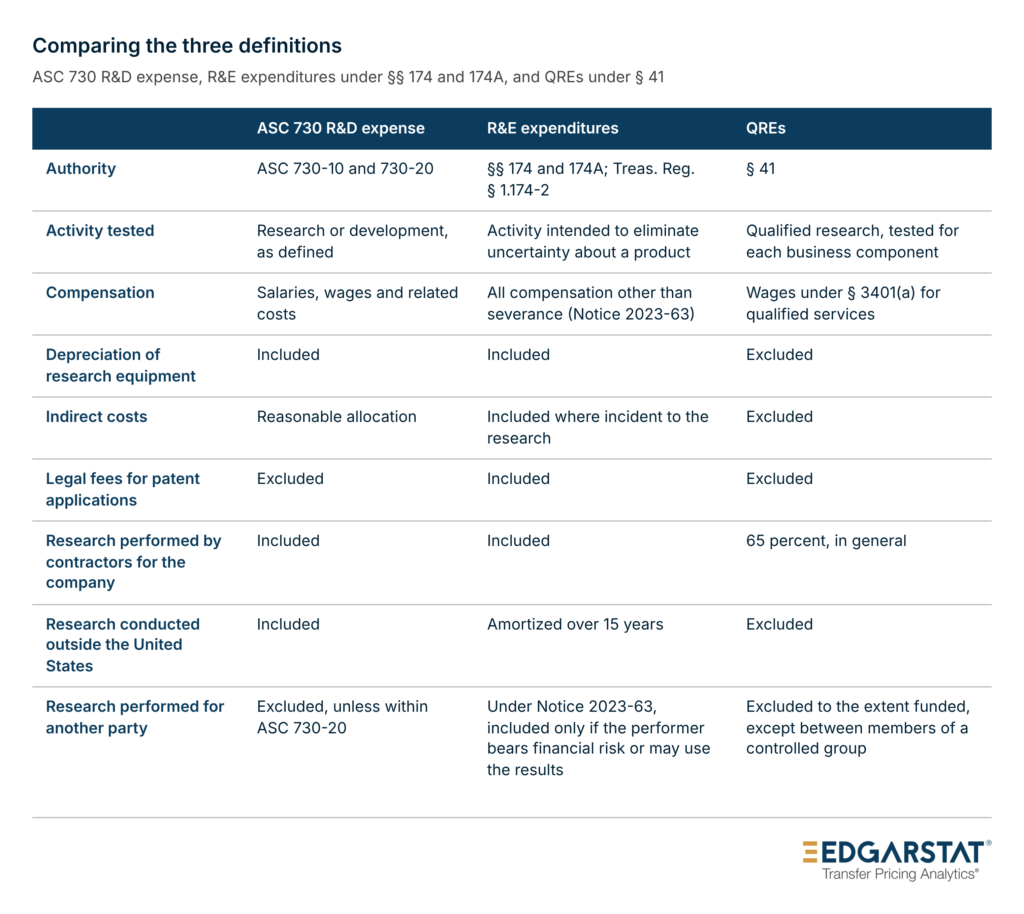
Because each definition is comprised of different costs, one research program can be measured at a different amount under each.
Each definition also distinguishes research performed for another party under contract from research a company performs for itself. Most of the rules that make that distinction depend on which party bears the risk of failure and which party may use the results. The § 482 regulations consider those facts in the functional analysis and in the separate comparability factor for risk.[1]
ASC 730: R&D under GAAP
ASC 730 defines research as a “planned search or critical investigation aimed at discovery of new knowledge” useful for developing a new product, service, or process, or for significantly improving an existing one, and development as “the translation of research findings or other knowledge into a plan or design” for such a product or process.[2] The design and testing of preproduction prototypes are typically R&D; quality control during commercial production and legal work on patent applications typically are not.[3]
R&D costs are expensed as incurred.[4] These costs include materials consumed, depreciation of research equipment and facilities, compensation for research personnel, services performed by others for the company, and a reasonable allocation of indirect costs. They exclude general and administrative costs “not clearly related” to R&D.[5]
ASC 730 does not apply to research a company performs on behalf of another party under a contract; those costs are accounted for under “accounting for contracts in general.”[6] A company that can obtain the results of research funded by others falls within ASC 730-20. If it is obligated to repay the funding regardless of the outcome, it recognizes a liability and charges the research costs to expense as incurred. If repayment depends solely on the results having future economic benefit, it accounts for its obligation as a contract to perform research for others. Where conditions indicate that repayment is probable, the company is presumed to have an obligation to repay, and that presumption “can be overcome only by substantial evidence to the contrary.” A significant related-party relationship with the funding party at the time the arrangement is entered into is one of the conditions the standard lists.[7] A related-party performer that can obtain the results is therefore presumed to be obligated to repay the funding and to charge its costs to R&D expense. Under the standard, an entity committed to repay has not transferred the risk of failure to the funding party.
Sections 174 and 174A: R&E under the Internal Revenue Code
Under Treas. Reg. § 1.174-2(a)(1), R&E expenditures are costs of “activities intended to discover information that would eliminate uncertainty concerning the development or improvement of a product,” and whether a cost qualifies depends on the nature of the activity to which the expenditures relate.[8]
The tax definition includes the costs of obtaining a patent, such as attorneys’ fees for a patent application, whereas ASC 730 excludes legal work on patent applications. Notice 2023-63 lists costs incident to research, including compensation other than severance, supplies, depreciation, patent costs, and the overhead of research facilities.[9] Amounts paid to another person to perform research for the taxpayer are R&E expenditures of the payer.[10] Quality control testing and advertising are among the regulation’s exclusions.[11]
For tax years beginning after December 31, 2024, § 174A permits a current deduction for domestic R&E expenditures or, by election, amortization over at least 60 months beginning with the month in which benefits are first realized. Foreign R&E expenditures remain subject to amortization over 15 years under § 174. Depreciation on research property is an R&E expenditure; the cost of the property is not.[12]
Section 6 of Notice 2023-63 addresses research performed under contract. The payer treats its payments as R&E expenditures. The performer treats its own costs as R&E expenditures only if it “bears financial risk under the terms of the contract,” meaning it “may suffer a financial loss related to the failure of the research,” or if it has a right to use or exploit the results. A right subject to another party’s approval is disregarded only if that party is “not related to the research provider.” Thus, a right that a related party must approve is taken into account.[13] The notice interprets § 174 as amended in 2017, and § 174A uses the same term, “research or experimental expenditures,” that Treas. Reg. § 1.174-2 defines.[14]
Section 41: QREs for claiming the federal research credit
Under § 41(d)(1), research qualifies only if its expenditures “are treated as domestic research or experimental expenditures under section 174A,” it seeks information that is “technological in nature,” and substantially all of its activities are “elements of a process of experimentation,” with each test applied separately to each business component.[15] QREs therefore include only the costs of research whose expenditures are treated as domestic R&E expenditures, but many domestic R&E expenditures are not QREs.
Section 41(d)(4) excludes, among other things, research conducted after commercial production begins, research conducted outside the United States, and research “to the extent funded by any grant, contract, or otherwise by another person.”[16] Amounts payable only if the research succeeds are not considered funding, and a performer that must pay to use the results does not retain substantial rights and is treated as fully funded.[17]
QREs include wages for qualified services, supplies, and payments for computer use, plus generally 65 percent of payments to others for qualified research. Depreciation, overhead, and patent costs are not QREs.[18]
Members of a controlled group, determined under a more-than-50-percent ownership test, are treated as a single taxpayer, and transfers among members are generally disregarded. A member that performs research for another member includes its in-house research expenses in its own QREs and “shall not treat any amount received or accrued as funding the research.”[19] Within a group, a credit claim therefore identifies the member that performs the research but does not establish which member bears the risk.
One research budget, three different measures
A company that spends $100 million on research in a tax year can report $95 million of R&D expense, $100 million of R&E expenditures, and $71.5 million of QREs for the same work. The table below assumes that the research is performed in the United States for the company’s own benefit, that it meets the § 41 tests, that the wages are § 3401(a) wages for qualified services, that the contractor is paid regardless of whether its research succeeds, that the company does not elect amortization under § 174A(c), and that the company elects the reduced credit under § 280C(c)(2).
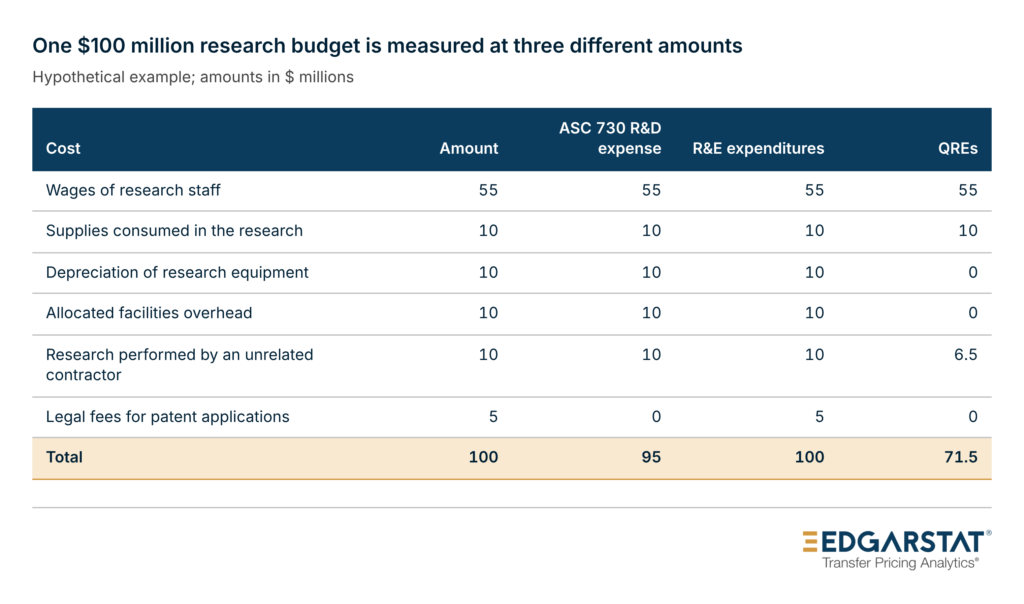
R&D expense excludes the $5 million in patent legal fees that the tax definition includes. QREs exclude depreciation, overhead, and patent costs and include only 65 percent of the contractor’s fee, reducing QREs by $28.5 million in total.
If $20 million of the wages were paid for research conducted abroad, R&D expense would not change, but the $20 million would be amortized over 15 years under § 174 and excluded from QREs. Differences among the three amounts are therefore expected and do not, by themselves, indicate which party bears the risk of the research.
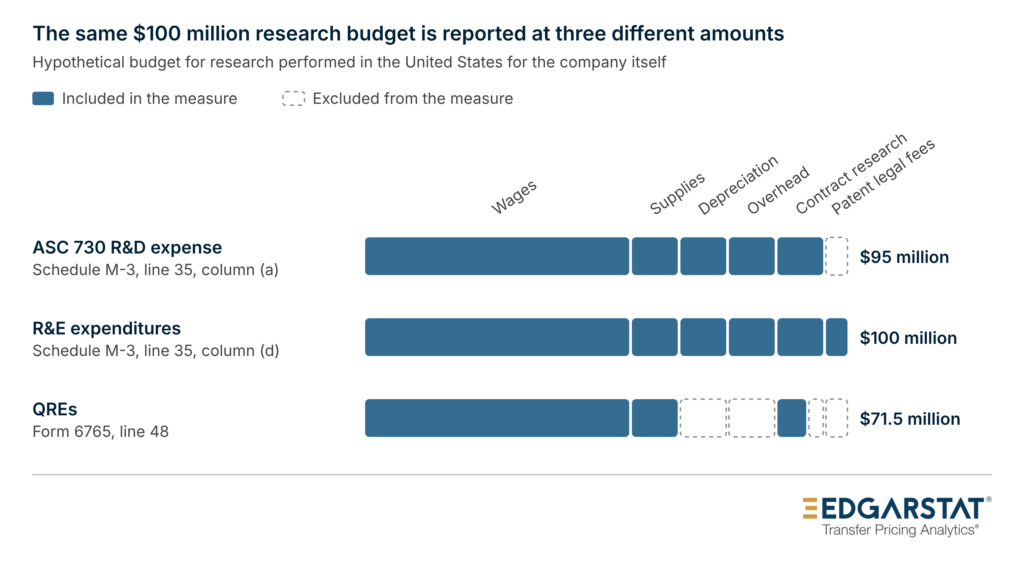
Wages and supplies are included in all three measures. Depreciation and overhead are excluded only from QREs; contract research is included in QREs at 65 percent; and patent legal fees are included only in R&E expenditures.
All three definitions categorize commissioned research by risk and rights to the results
Each definition considers risk and rights when research is performed for another party. Under ASC 730-20, a performer that can obtain the results charges the costs to R&D expense if it is obligated to repay the funding, and that obligation is presumed when a significant related-party relationship with the funding party exists. The SEC staff considers a related-party relationship significant when related parties own 10 percent or more of the entity providing the funds. Under Notice 2023-63, the performer’s costs are R&E expenditures if it bears financial risk or may use the results, including under a right that a related party must approve. Under § 41, research is funded and excluded from QREs to the extent of payments that do not depend on its success, and it is fully funded where the performer “retains no substantial rights”; between members of a controlled group, payments are not treated as funding. In each case, the related-party rule makes inclusion in the performer’s measure more likely.

For a company that performs research for a related party, the reported numbers reflect the company’s positions on those facts. R&D expense in the company’s own financial statements indicates that the research is performed for itself or that the company is obligated, or presumed obligated, to repay the funding. Under Notice 2023-63, deducting the costs as R&E expenditures indicates that the research is performed for itself, that the company bears financial risk, or that it may use the results. Among members of a controlled group, a credit claim indicates only that the company performs the research.
Notes
- Treas. Reg. § 1.482-1(d)(3)(i) (a functional analysis considers functions, including “[r]esearch and development,” and “the use of valuable intangibles”) and (d)(3)(iii)(A)(2) (“Risks associated with the success or failure of research and development activities”); (d)(3)(iii)(B) (the allocation of risks specified or implied by the taxpayer’s contractual terms “will generally be respected if it is consistent with the economic substance of the transaction”).
- ASC 730-10-20, glossary term “Research and Development.”
- ASC 730-10-55-1(f); ASC 730-10-55-2(b) and (i).
- ASC 730-10-25-1. Software acquired, developed or improved for an entity’s selling or administrative activities is outside ASC 730 (ASC 730-10-15-4(c)); ASC 350-40 addresses software for internal use, and ASC 985-20 addresses software to be sold, leased or marketed.
- ASC 730-10-25-2(a) through (e).
- ASC 730-10-15-4(a).
- ASC 730-20-15-2 and 25-3 through 25-8; ASC 730-20-S99-1 (SAB Topic 5.O, Question 1).
- Treas. Reg. § 1.174-2(a)(1).
- Treas. Reg. § 1.174-2(a)(1); Notice 2023-63, § 4.03(1)(a) through (e); ASC 730-10-55-2(i).
- Treas. Reg. § 1.174-2(a)(10).
- Treas. Reg. § 1.174-2(a)(6).
- Section 174A(a), (c) and (d)(1), added by Pub. L. 119-21, § 70302, enacted July 4, 2025; § 174(a). The Instructions for Form 1120 (2025) describe the § 174A(c) election as amortization over not less than 60 months “beginning with the month in which the corporation first realizes benefits from such expenditures.”
- Notice 2023-63, §§ 6.02(3), 6.03 and 6.04, as clarified by Notice 2024-12, § 3, which also disregards a right that is separately bargained for or acquired only to perform the research. The full condition is that the approving party be “not related to the research provider within the meaning of § 267 or § 707.”
- Rev. Proc. 2025-23, § 7.03(1)(a), as modified by Rev. Proc. 2026-32, § 3.04, permits reliance on section 6 of Notice 2023-63 for foreign R&E expenditures.
- Section 41(d)(1) and (2)(A).
- Section 41(d)(4)(A) through (H).
- Treas. Reg. § 1.41-4A(d)(1) through (3), applied by § 1.41-4(c)(9).
- Section 41(b)(1) through (3).
- Section 41(f)(1) and (5); § 1563(a); Treas. Reg. § 1.41-6(i)(1) and (2).
Authorities cited
Statutes
- 26 U.S.C. § 41, § 174, § 174A, § 280C and § 1563
Regulations
- Treas. Reg. § 1.174-2 and § 1.482-1
- Treas. Reg. § 1.41-4, § 1.41-4A and § 1.41-6
IRS guidance, forms and instructions
- Notice 2023-63, Notice 2024-12, Rev. Proc. 2025-23, and Rev. Proc. 2026-32
- Instructions for Form 1120 (2025)
Accounting standards
- FASB Accounting Standards Codification, ASC 730-10 and 730-20, effective as of this article’s publication date
- SEC Staff Accounting Bulletin Topic 5.O, Research and Development Arrangements, codified at ASC 730-20-S99-1